
1. Why Mumbai Businesses Need Consistent Content Today
For a modern business, having a good product or service is only one part of the equation. Customers also need to see, understand and trust the business before they decide to contact or purchase from it.
This is particularly important for businesses operating in a competitive market like Mumbai. Whether you run a restaurant in Bandra, a real estate company in Borivali, a fashion brand in Andheri, a professional service firm in Lower Parel or a D2C business serving customers across India, your digital presence often becomes the first point of contact.
Potential customers may discover your business through Google, Instagram, YouTube, LinkedIn, a website, a marketplace or a recommendation. Across these platforms, content plays an important role in communicating what your business actually offers.
The challenge is that producing good content consistently requires more than simply taking a few photographs or recording occasional videos.
A business may need:
- Social media Reels and short-form videos
- Product photography
- Product demonstration videos
- Founder and personal branding photography
- Corporate videos
- Customer testimonials
- Educational videos
- Podcast episodes
- Website photographs
- Promotional campaigns
- Behind-the-scenes content
- Graphic and visual assets
Hiring separate full-time employees for every part of this process can become expensive and difficult to manage.
That is why many businesses can benefit from an outsourced content production model.
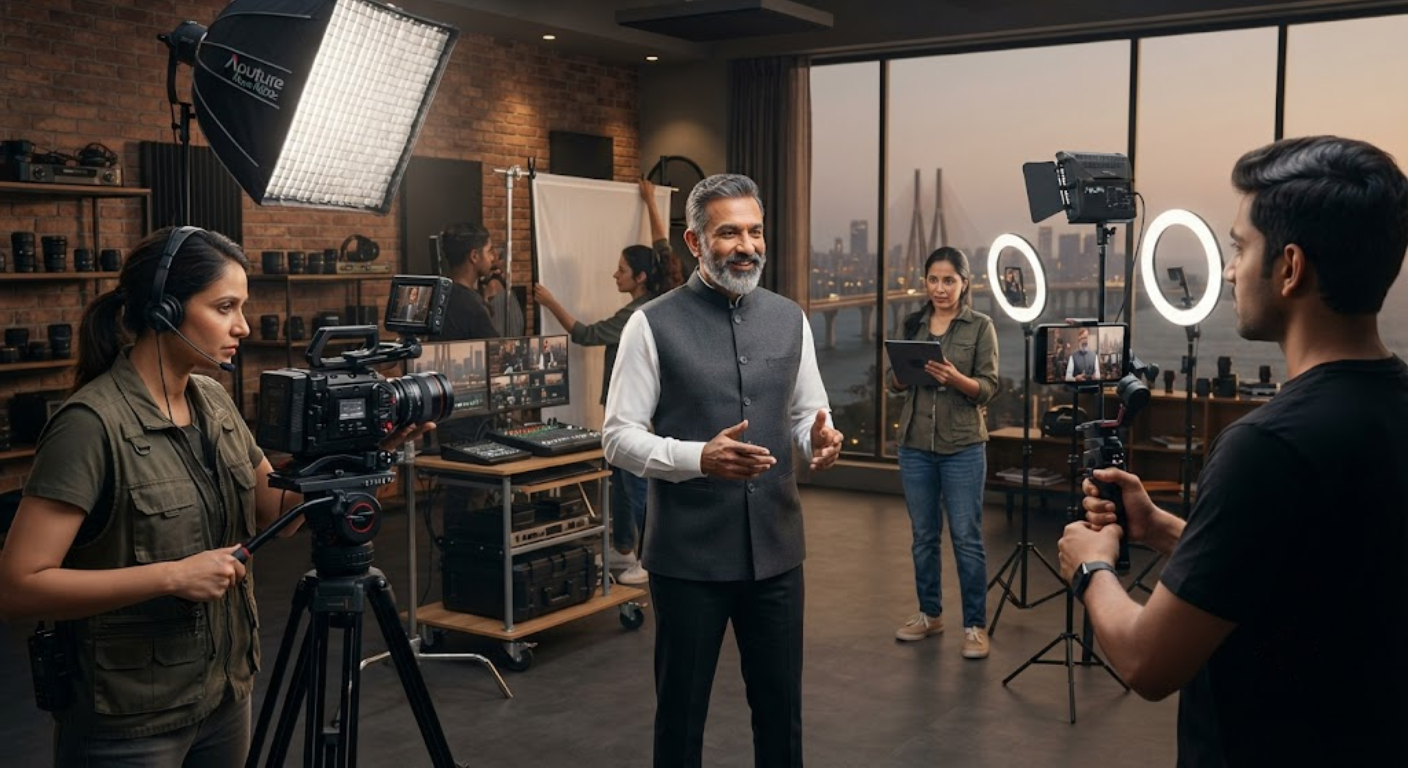
Instead of building a large internal production department, businesses can work with an external professional studio whenever they need photography, videography, podcast production or other creative services.
This approach allows the business to access professional equipment, production expertise and specialized people without maintaining an entire in-house production team.
The objective should not simply be to produce more content. It should be to create content that looks professional, communicates clearly and can be reused across multiple channels.
2. Why Hiring a Full In-House Content Team Is Not Always Necessary
An in-house team can be valuable for large organizations with continuous high-volume content requirements. However, it is not automatically the best option for every business.
A small or medium-sized company may only need professional production once or twice a month. Hiring full-time specialists for those requirements can leave expensive resources underutilized.
A typical internal content department might require several roles:
- Content strategist
- Videographer
- Photographer
- Video editor
- Graphic designer
- Social media manager
- Copywriter
- Production coordinator
Even when one employee handles multiple responsibilities, the business still needs to provide equipment, software, workspace and management.
There is also a difference between creating content and creating professional production-quality content.
A smartphone can be excellent for spontaneous updates and behind-the-scenes material. However, certain projects require controlled lighting, professional audio, camera equipment, dedicated backgrounds, product styling and post-production.
For example, a jewellery company may need detailed product photographs and videos. A real estate company may need property walkthroughs and professional presenter videos. A founder may need a library of personal branding photographs. A company may require an interview-based corporate film.
These requirements do not necessarily justify maintaining permanent production staff.
Outsourcing gives businesses the flexibility to book production when it is actually required.
The business can maintain a smaller internal marketing team while using external specialists for production-heavy requirements.
This can be especially useful when content demand changes from month to month.
3. Build a Content Strategy Before You Book a Shoot
One of the biggest mistakes businesses make is arranging a photoshoot or video shoot before deciding what content they actually need.
Professional production becomes much more valuable when the business starts with a content plan.
Before booking a studio, identify the platforms, audiences and business objectives the content needs to support.
For example, a Mumbai restaurant might need Instagram Reels, food photographs, chef videos, customer-experience content and Google Business Profile photographs.
A B2B company might need founder videos, LinkedIn photographs, employee interviews, corporate videos and website imagery.
A D2C brand might need product photographs, demonstration videos, lifestyle content, short-form advertisements and marketplace assets.
Start by creating a simple content inventory.
Questions to answer before production:
- Who is the target audience?
- Which platforms are most important?
- What products or services need visibility?
- What questions do customers frequently ask?
- Which offers or features need explanation?
- What content already exists?
- What content is missing?
- What should customers do after watching or viewing the content?
- How frequently will the content be published?
- Which assets can be reused?
This planning process prevents a common problem: completing an expensive shoot and later realizing that important content formats were missed.
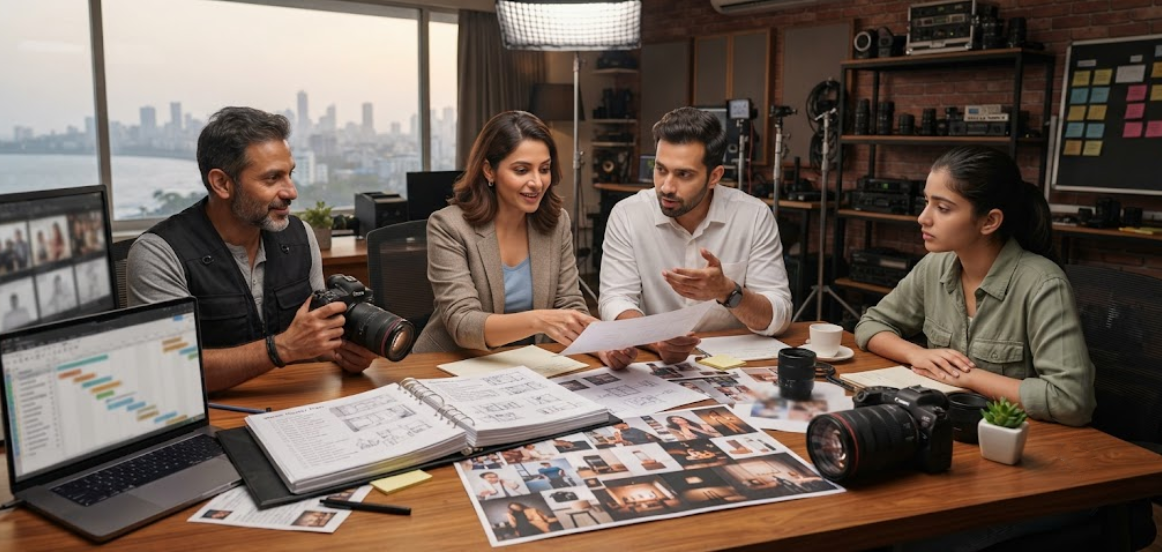
A single production session can often be planned around multiple objectives.
For example, instead of recording one founder video, the shoot could produce:
- One long-form interview
- Five short educational videos
- Several professional portraits
- Behind-the-scenes footage
- Website photographs
- LinkedIn content
- Short promotional clips
The key is to plan the content ecosystem, rather than treating every post as a separate project.
4. Use One Production Session to Create Multiple Content Formats
One of the most effective ways to avoid the cost and time associated with constant production is to create multiple assets during the same shoot.
This is often called content batching.
Instead of booking separate sessions for every Reel, photograph or video, businesses can plan a production day around several content requirements.
For example, a founder-focused shoot could include:
- Professional headshots
- Website About Us photographs
- LinkedIn portraits
- Founder introduction videos
- Educational Reels
- Interview footage
- Behind-the-scenes clips
- Short promotional videos
Similarly, an e-commerce brand could combine product photography and product videography.
A product can be photographed against a clean background, captured in lifestyle settings and filmed being used.
This approach creates visual consistency because the photographs and videos are produced under the same creative direction.
A single shoot can potentially produce:
Photography
- Website images
- Product photographs
- Team photographs
- Personal branding images
- Social media posts
Video
- Reels
- Shorts
- Product demonstrations
- Testimonials
- Founder videos
- Advertisements
Supporting content
- Behind-the-scenes clips
- Thumbnail images
- Vertical cutdowns
- Website banners
- Campaign assets
The exact output depends on the shoot duration, production requirements and number of products or concepts.
The important principle is to think beyond one final video or one photograph.
Think about how the production session can create a library of reusable content.
5. Choose the Right External Production Partner
Outsourcing content does not mean choosing the cheapest available production provider.
The right partner should understand both production quality and business objectives.
A studio may have excellent cameras but limited experience with your type of content. Another provider may be strong at Reels but not equipped for product photography or corporate interviews.
Before choosing a production partner, review their portfolio and ask how they approach projects.
Look for evidence of:
- Professional photography
- Video production
- Lighting and sound quality
- Different types of business content
- Product photography
- Social media video
- Corporate content
- Editing and post-production
- Creative direction
- Consistent visual quality
It is also useful to understand whether the studio provides only equipment and space or a complete production service.
A studio rental may work for businesses that already have their own production team.
A full-service production setup can be more suitable when the business wants support with planning, shooting, direction and editing.
Ask questions before booking:
- What services are included?
- Is professional equipment provided?
- Is a photographer or videographer included?
- Is lighting included?
- Is editing included?
- How many final assets are expected?
- Are vertical and horizontal formats available?
- Can the content be customized for different platforms?
- How is the shoot planned?
- What happens after the shoot?
The right partner should make the production process easier rather than creating another layer of work for your internal team.
6. Give Your Business a Professional Visual Identity
High-quality content is not only about camera resolution.
Consistency matters.
If your website uses one visual style, Instagram uses another, LinkedIn uses unrelated photographs and product pages contain inconsistent imagery, customers may struggle to understand the brand identity.
A professional production partner can help businesses maintain consistency across:
- Photography
- Video
- Lighting
- Backgrounds
- Wardrobe
- Composition
- Editing
- Branding
- Presenter style
- Visual storytelling
For example, a premium jewellery company should have product photography that feels consistent with its brand positioning.
A professional services firm may want photographs that communicate expertise and credibility.
A restaurant needs food images that accurately represent the dishes while making them visually appealing.
A founder-led company may want photographs that feel professional without appearing overly staged.
This is why production planning should include a visual direction.
Before the shoot, define:
- Preferred photography style
- Background requirements
- Wardrobe
- Props
- Locations
- Camera angles
- Video formats
- Brand references
- Intended platforms
The goal is to make different pieces of content feel like they belong to the same business.
For Google Business Profile, Google recommends photos that are in focus, well lit and representative of reality. It also encourages businesses to use category-specific imagery such as exterior, interior, product, service and team photographs.
7. Prioritize Video Content Without Building a Permanent Video Department
Video has become an important format for businesses across social media, websites and digital advertising.
However, producing professional video does not always require a permanent video department.
Businesses can create a flexible video pipeline by outsourcing production while keeping topics and communication internally managed.
For example, a company can prepare 20 video topics for a monthly production day.
The production team can then record those topics in batches.
Possible formats include:
- Frequently asked questions
- Founder insights
- Product demonstrations
- Customer problems and solutions
- Industry education
- Service explanations
- Testimonials
- Behind-the-scenes videos
- Company culture content
- Short promotional videos
This is particularly useful for founders and subject-matter experts who do not want to spend several hours every week setting up cameras and lights.
Instead, they can prepare their talking points, attend a planned production session and record multiple videos.
The external team handles production while the internal team focuses on the business.
For businesses that need professional audio, controlled lighting, multiple camera angles or polished editing, this approach can also produce a more consistent result than repeatedly recording in different office environments.
The content can then be edited into different lengths and formats depending on the platform.
8. Combine Photography, Video, Podcasts and Reels Under One Workflow
One major advantage of working with a full-service creative studio is the ability to combine different content requirements.
Instead of coordinating with one photographer, another videographer, a podcast studio, an editor and a separate graphic designer, businesses can simplify production through one coordinated workflow where available.
This can be especially useful for founder-led brands.
Imagine a Mumbai entrepreneur launching a new service.
A single content day could include:
- Founder portraits
- Website photographs
- Service explanation videos
- Instagram Reels
- LinkedIn videos
- Podcast recording
- Customer testimonial recording
- Behind-the-scenes footage
The same creative direction can be applied across all assets.
This saves time in planning and reduces the risk of inconsistent visual quality.
It also makes it easier to build campaigns rather than isolated posts.
For example, a new product launch could be planned as one production project containing:
Before launch:
Teaser photographs and short videos.
Launch:
Product demonstration video, founder announcement and social media Reels.
After launch:
FAQs, customer-focused videos, product details and educational content.
This approach transforms content production from an occasional activity into a repeatable marketing process.
9. Repurpose Every Major Piece of Content
A business should avoid treating every content asset as a one-time publication.
A long-form video can become several shorter pieces of content.
A podcast can generate social media clips.
A professional photoshoot can provide website images, LinkedIn posts and social media graphics.
A product demonstration can become an e-commerce video, Reel and advertising asset.
For example, suppose a founder records a 30-minute interview.
The production team could potentially create:
- One long-form video
- Several short clips
- Founder quote graphics
- LinkedIn posts
- Instagram Reels
- YouTube Shorts
- Website content
- Podcast audio
- Thumbnail photographs
The exact number of final assets depends on the content and editing requirements, but the principle remains the same.
Think in terms of content layers:
Primary content
The original podcast, interview, product video or photoshoot.
Secondary content
Short clips, photographs, quotes and cutdowns.
Platform-specific content
Instagram Reels, YouTube Shorts, LinkedIn videos, website visuals and advertising formats.
Evergreen content
FAQs, educational clips, product explanations and expert insights that remain useful over time.
This approach helps businesses get more value from every production session.
It also reduces the pressure to constantly invent completely new ideas.
Instead, businesses can focus on producing strong core content and intelligently distributing it.
10. Maintain Quality Across Your Website, Social Media and Google Presence
Professional content should not exist only on Instagram.
Businesses should consider every digital touchpoint where customers may interact with their brand.
This includes:
- Website
- Google Business Profile
- YouTube
- E-commerce marketplaces
- Digital advertisements
- Email campaigns
- Presentation decks
- Sales materials
Google specifically recommends high-quality, well-lit and realistic business imagery for Business Profiles. It also recommends category-specific photos that help customers understand the business, products and services.
That means a business should think about creating an organized visual library rather than collecting random images.
For example, a service company might maintain:
- Office photographs
- Team photographs
- Founder portraits
- Service-in-action photographs
- Customer interaction images
- Website banner images
- Short-form videos
- Corporate videos
An e-commerce company might maintain:
- Product-on-white photographs
- Lifestyle photographs
- Detail photographs
- Product videos
- Demonstration videos
- Social media clips
- Advertisement creatives
A content library makes future marketing campaigns much easier to execute.
Instead of starting from zero every time the business needs a post, the marketing team can work from an organized collection of approved assets.
Conclusion
Mumbai businesses do not necessarily need a large in-house content department to maintain a professional digital presence.
What they need is a clear strategy, consistent production process and access to the right creative expertise.
By outsourcing photography, video production, Reels, podcasts and post-production when required, businesses can access professional capabilities without taking on the cost and management responsibilities associated with a permanent production team.
The most effective approach is to plan content in batches, produce multiple formats during each session, repurpose major assets and maintain a structured library of professional photographs and videos.
Instead of asking, “How can we create another post this week?”, businesses can start thinking, “How can we create a complete month of useful content in one organized production cycle?”
That shift can make content creation more efficient, consistent and sustainable.