


Video has become one of the most important formats for businesses that want to communicate with customers online. From short-form social media videos and product demonstrations to founder videos, customer testimonials and corporate presentations, businesses can use video at almost every stage of the customer journey.
However, simply producing more videos does not automatically create an effective marketing system.
A business can have professional cameras, attractive locations and high-quality editing, yet still struggle if every video is created without a clear purpose.
This is why a professional video content strategy is important.
A video content strategy defines what your business should record, who the content is for, which platforms it should be published on, how frequently content should be produced and what business objective each video should support.
For a small business, startup or established company, having a structured strategy can also make production more efficient. Instead of arranging a separate shoot every time a new video is required, businesses can plan multiple content pieces together and build a reusable content library.
The right strategy also helps balance different types of videos. Educational content can build expertise, product videos can explain offerings, founder videos can humanize the business, testimonials can build trust and promotional videos can support campaigns.
This guide explains how to build a professional video content strategy for your business, from defining objectives and audiences to planning production, creating content pillars, repurposing videos and measuring performance.
1. Start With Clear Business Goals
The foundation of a professional video content strategy is knowing what the videos need to achieve.
Do not begin by asking:
“What videos should we make?”
Start by asking:
“What does the business need video to accomplish?”
Different businesses may have different objectives.
Your video strategy could focus on:
- Building brand awareness
- Generating leads
- Increasing product sales
- Educating customers
- Building founder authority
- Improving customer trust
- Launching a product
- Demonstrating services
- Increasing website engagement
- Supporting paid advertising
- Strengthening social media presence
A business can have multiple objectives, but they should be prioritized.
For example, an e-commerce brand may focus heavily on product demonstrations and conversion-oriented videos.
A consulting firm may focus more on educational videos and founder thought leadership.
A restaurant may prioritize food videos, customer experiences and behind-the-scenes content.
Clear objectives help determine what type of content should receive production time and budget.
When every video has a purpose, content production becomes much more focused.
2. Define Your Target Audience
A video cannot be strategically planned without knowing who will watch it.
Your target audience influences the topics, language, presentation style, video length and platform.
Start by identifying:
- Who your customers are
- What problems they face
- What questions they ask
- What motivates their purchase decisions
- What objections they have
- What type of information they need
- Which platforms they use
For example, a B2B company may create professional educational videos for decision-makers.
A fashion brand may create visually engaging short-form videos for social media audiences.
A local service business may create videos answering practical customer questions.
Audience research can also help determine the level of technical detail.
If your audience is unfamiliar with your industry, educational videos should use simple explanations.
If your audience is highly knowledgeable, more detailed industry content may be appropriate.
A strong professional video content strategy is built around audience needs rather than simply what the business wants to say.
3. Build Clear Video Content Pillars
Content pillars make video planning easier.
Instead of creating random topics every week, divide your content into several repeatable categories.
A business could use four or five main pillars.
Educational Content
Teach customers something useful.
Examples:
- How-to videos
- Industry tips
- Common mistakes
- Expert explanations
- Frequently asked questions
Product or Service Content
Explain what the business offers.
Examples:
- Product demonstrations
- Feature explanations
- Service walkthroughs
- Product comparisons
- Use cases
Founder and Team Content
Show the people behind the company.
Examples:
- Founder stories
- Business lessons
- Team introductions
- Behind-the-scenes videos
- Company culture
Trust-Building Content
Give customers reasons to believe in the business.
Examples:
- Testimonials
- Case studies
- Customer stories
- Process videos
- Results and experiences
Promotional Content
Support specific marketing campaigns.
Examples:
- Product launches
- Offers
- New services
- Seasonal campaigns
- Event promotions
These pillars create variety while keeping the overall strategy organized.

4. Choose the Right Video Formats
Not every video needs to be produced in the same format.
Your professional video content strategy should include different formats based on your audience and platforms.
Common formats include:
- Short-form vertical videos
- Long-form educational videos
- Product demonstrations
- Founder videos
- Customer testimonials
- Interviews
- Tutorials
- Behind-the-scenes videos
- Corporate videos
- Product launch videos
- Explainer videos
- Event videos
Short-form videos can communicate one idea quickly.
Longer videos can provide more detailed education.
Product demonstrations can explain functionality.
Testimonials can provide customer perspective.
Founder videos can build personal connection.
Using several formats prevents your content strategy from becoming repetitive.
However, you should not create every format simply because it exists.
Choose formats that support your business objectives.
5. Plan Batch Video Production
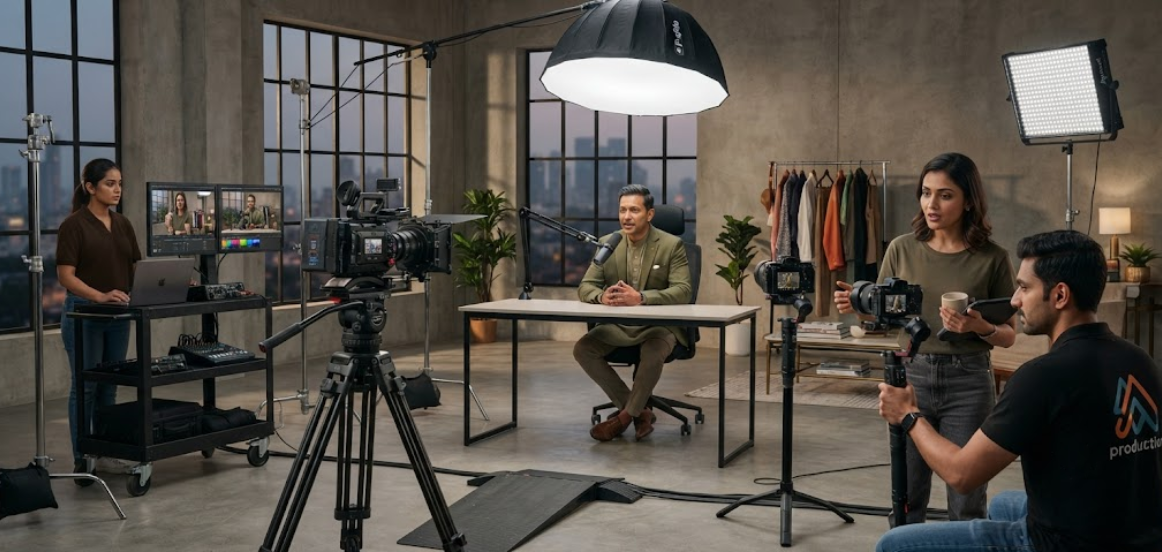
One of the most effective ways to make a professional video content strategy practical is to batch production.
Rather than recording one video every few days, organize a production session around multiple topics.
For example, one shoot could include:
- Founder videos
- Educational clips
- Product demonstrations
- Customer FAQs
- Short-form Reels
- B-roll
- Professional photographs
The production team can group similar setups together.
For example, record all founder talking-head videos while the camera, microphone and lighting are already positioned.
Then move to product demonstrations.
Then capture supporting B-roll.
This approach can reduce repeated setup time and make studio bookings more productive.
Batch production can also help businesses maintain consistency because several weeks of content can be prepared in advance.
6. Write Scripts Without Making Videos Sound Artificial
Scripts can make production easier, but they should not make the founder or presenter sound unnatural.
For educational or promotional videos, prepare a simple structure.
A useful format is:
Hook
Introduce the topic quickly.
Problem
Explain what the audience may be struggling with.
Main Information
Provide the useful explanation.
Example
Give a practical example where appropriate.
Takeaway
Summarize the key point.
Call to Action
Tell the viewer what they can do next.
The presenter does not always need to memorize every word.
Depending on the format, you can use:
- Bullet-point notes
- Talking points
- Teleprompter
- Interview questions
- Structured conversation
For founder videos, talking points can often create a more natural result than a word-for-word script.
The goal is to maintain clarity while allowing the speaker’s personality to come through.
7. Invest in Production Quality Where It Matters
Professional video does not necessarily require the most expensive equipment.
However, certain production elements have a major effect on perceived quality.
Prioritize:
- Clear audio
- Good lighting
- Stable camera footage
- Appropriate framing
- Clean backgrounds
- Professional editing
- Accurate colour
- Consistent visual presentation
Audio deserves particular attention.
Viewers may tolerate a simple visual setup, but distracting background noise or unclear speech can make a video difficult to watch.
Lighting is equally important.
Professional lighting can improve facial visibility, product presentation and overall consistency.
The production environment should also match the brand.
A corporate business may require a polished studio environment.
A creative brand may benefit from a more expressive setup.
The objective is to create production quality that supports the message.
8. Repurpose Every Major Video
A major advantage of video content is that one recording can create multiple pieces of content.
For example, a 15-minute founder interview could potentially produce:
- Several short-form clips
- Educational Reels
- LinkedIn videos
- YouTube content
- Quote graphics
- B-roll clips
- Website content
- Audio snippets
A product video can also generate:
- Short feature clips
- Product close-up footage
- Social media advertisements
- Website visuals
- Product page content
- B-roll
This is called content repurposing.
The key is to record with repurposing in mind.
Capture clean footage, multiple angles, useful B-roll and enough supporting visuals.
Then edit the material into different formats.
This allows businesses to get greater value from each production session.
9. Adapt Content for Each Platform
The same video does not always need to be published identically everywhere.
Different platforms may require different:
- Aspect ratios
- Video lengths
- Captions
- Hooks
- Editing styles
- Thumbnails
- Calls to action
For example, a detailed educational video may work well in a longer format, while the same topic can be converted into several short clips.
A founder interview could become a long-form YouTube video and several shorter LinkedIn or Instagram videos.
A product demonstration could be edited into short feature clips for social media while a longer version appears on a product page.
Your professional video content strategy should therefore consider distribution before production.
Knowing where a video will be published helps the production team capture the right framing and supporting footage.
10. Measure Video Performance
A video strategy should be reviewed regularly.
Look at performance according to the objective of each video.
Useful measurements can include:
- Views
- Watch time
- Average viewing duration
- Engagement
- Shares
- Saves
- Website visits
- Leads
- Enquiries
- Product page visits
- Conversions
Different metrics matter for different goals.
If your goal is awareness, reach and viewing behaviour may be useful indicators.
If your goal is lead generation, enquiries and website activity may be more relevant.
If your goal is product education, watch time and engagement can help indicate whether people are consuming the content.
Do not judge every video using the same measurement.
Instead, compare videos against their intended purpose.
Over time, these insights can help you identify which topics and formats deserve more production attention.
11. Build a Repeatable Video Production System
The final step is to turn your strategy into a repeatable process.
A sustainable system can follow this cycle:
Step 1: Set Goals
Decide what the business wants to achieve.
Step 2: Select Topics
Choose topics from your content pillars.
Step 3: Build the Calendar
Assign topics to specific weeks or campaigns.
Step 4: Prepare Scripts
Create talking points, scripts or interview questions.
Step 5: Batch the Shoot
Record multiple pieces of content during one production session.
Step 6: Edit and Repurpose
Turn the footage into different formats.
Step 7: Publish
Distribute the content across appropriate channels.
Step 8: Measure
Review performance.
Step 9: Improve
Use the results to plan the next production cycle.
This creates a continuous content engine rather than isolated video projects.
For a small or growing business, this approach can also make production costs more predictable.
Instead of constantly starting from zero, your team develops a repeatable workflow.
Conclusion
A professional video content strategy gives your business a structured way to create video that supports real marketing objectives.
Instead of producing random videos whenever an idea appears, start with clear business goals and understand your audience.
Build content pillars around education, products or services, founder stories, trust and promotions. Then create a monthly calendar and plan batch production around multiple topics.
Think about distribution before recording so that videos can be adapted for different platforms.
Most importantly, make every production session work harder.
One well-planned shoot can create long-form videos, short-form Reels, product demonstrations, founder content, B-roll, photographs and other marketing assets.
Finally, measure performance and use the results to improve your next production cycle.
A strong professional video content strategy is not simply about producing more videos.
It is about producing the right videos, for the right audience, with the right message, in a consistent and repeatable way.