
For small businesses, creating professional content can feel expensive and complicated. Many business owners assume they need a large production team, expensive equipment, multiple locations and a big marketing budget to produce high-quality videos, photographs and social media content. In reality, content production for small businesses can be planned strategically to achieve professional results without unnecessary spending.
The key is not simply reducing the cost of every individual shoot. Instead, businesses should focus on getting more useful content from every production session. A well-planned shoot can generate Reels, product photographs, founder videos, testimonials, social media clips, website visuals and other marketing assets at the same time.
Professional content also plays an important role in how customers perceive a business. Clear product photographs, well-recorded videos and consistent visual branding can make a small business appear more established and trustworthy.
The good news is that small businesses do not need to compromise between quality and budget. By defining clear goals, planning content in advance, batching production and selecting the right studio or production partner, businesses can create a practical content system that delivers professional results.
This guide explains how to approach content production for small businesses while keeping production practical, efficient and budget-conscious.
1. Why Small Businesses Need Professional Content
Small businesses compete for attention across websites, Instagram, YouTube, Google and other digital platforms. Customers often encounter a brand through its visual content before they speak with a salesperson or visit a physical location.
Professional content helps communicate what a business offers and how seriously it approaches its work.
However, professional does not necessarily mean extravagant. A small business may only need a carefully planned studio setup, good lighting, clear audio, professional photography and strong creative direction.
The goal of content production for small businesses should be to create content that supports actual business objectives rather than producing visually impressive material without a purpose.
Professional content can help a business:
- Present products and services clearly
- Build credibility with potential customers
- Create a consistent visual identity
- Explain complicated services more effectively
- Produce regular social media content
- Improve website presentation
- Support digital advertising campaigns
- Build stronger personal branding for founders
- Create reusable marketing assets
The important question is not, “How much can we spend on one video?”
Instead, ask:
“How much useful business content can we create from one production investment?”
That change in thinking can significantly improve the efficiency of your content budget.
2. Start With Your Business Goals
One of the biggest mistakes small businesses make is starting production before deciding what they actually need.
A camera can produce hundreds of photographs and hours of footage, but that does not automatically create useful marketing content.
Before booking a shoot, identify the business goals behind the production.
For example, a business may want to:
- Generate more enquiries
- Launch a new product
- Build founder visibility
- Improve social media consistency
- Promote a new service
- Create website visuals
- Produce customer testimonials
- Build advertising creatives
- Refresh outdated brand photography
Once the goal is clear, the production requirements become easier to define.
For example, a small consulting company building founder authority may need professional headshots, founder videos, educational Reels and website photographs.
An e-commerce company may need product photography, product videos, lifestyle images and short-form promotional videos.
A restaurant may need food photography, preparation videos, Reels and ambience photographs.
This is why effective content production for small businesses starts with strategy rather than equipment.
When the objective is clear, you can avoid spending money on content that will never be used.
3. Create a Content List Before You Book the Shoot
A detailed content list can save significant production time.
Instead of arriving at the studio and deciding what to shoot, create a list of every asset you want from the session.
Your list could include:
- Founder photographs
- Professional headshots
- Product photographs
- Product demonstration videos
- Instagram Reels
- Educational videos
- Customer testimonials
- Behind-the-scenes footage
- Website banner images
- Team photographs
- Short promotional clips
- B-roll footage
Once you have this list, group similar content together.
For example, record all founder videos while the same camera, lighting and microphone setup is ready. Then change the setup for product photography.
This approach reduces unnecessary setup and breakdown time.
It also makes it easier for the production team to understand exactly what needs to be delivered.
A good content list should answer three questions:
- What content do we need?
- Where will each piece be used?
- What production setup is required?
This simple preparation can make content production for small businesses considerably more efficient.

4. Prioritize High-Value Content First
When the budget is limited, not every possible content format needs to be produced.
Start with the content that has the highest potential business value.
For example, a small business might prioritize:
- Product demonstration videos
- Founder introduction videos
- Customer testimonial videos
- Professional product photographs
- Educational Reels
- Website photographs
Once these essential assets are completed, additional content can be captured if time and budget allow.
This prevents the shoot from becoming overloaded with low-priority ideas.
A practical production priority can be divided into three levels:
Essential Content
Content directly connected to sales, trust and business communication.
Supporting Content
Content that strengthens social media and brand visibility.
Optional Content
Creative experiments, trends and additional visual assets.
This prioritization is particularly useful when planning content production for small businesses because it ensures the available budget goes toward content that has a clear purpose.
5. Use One Shoot to Create Multiple Content Formats
One of the most effective ways to control production costs is to capture multiple content formats during the same shoot.
A single production session can potentially generate:
- Long-form videos
- Instagram Reels
- YouTube Shorts
- Product photographs
- Founder portraits
- Website images
- Behind-the-scenes footage
- B-roll
- Promotional clips
- Social media photographs
For example, while a founder is recording a business video, the production team can also capture portrait photographs and short vertical clips.
Similarly, while products are being photographed, short product demonstration videos can be recorded using the same lighting and styling.
This approach creates a larger content library without requiring separate production days for every asset.
The goal is to think in terms of content ecosystems rather than individual posts.
One shoot should ideally provide enough raw material to support multiple marketing channels.
6. Choose the Right Production Setup for Your Budget
A practical budget does not mean using the cheapest possible equipment.
It means choosing equipment and production resources based on what the content actually requires.
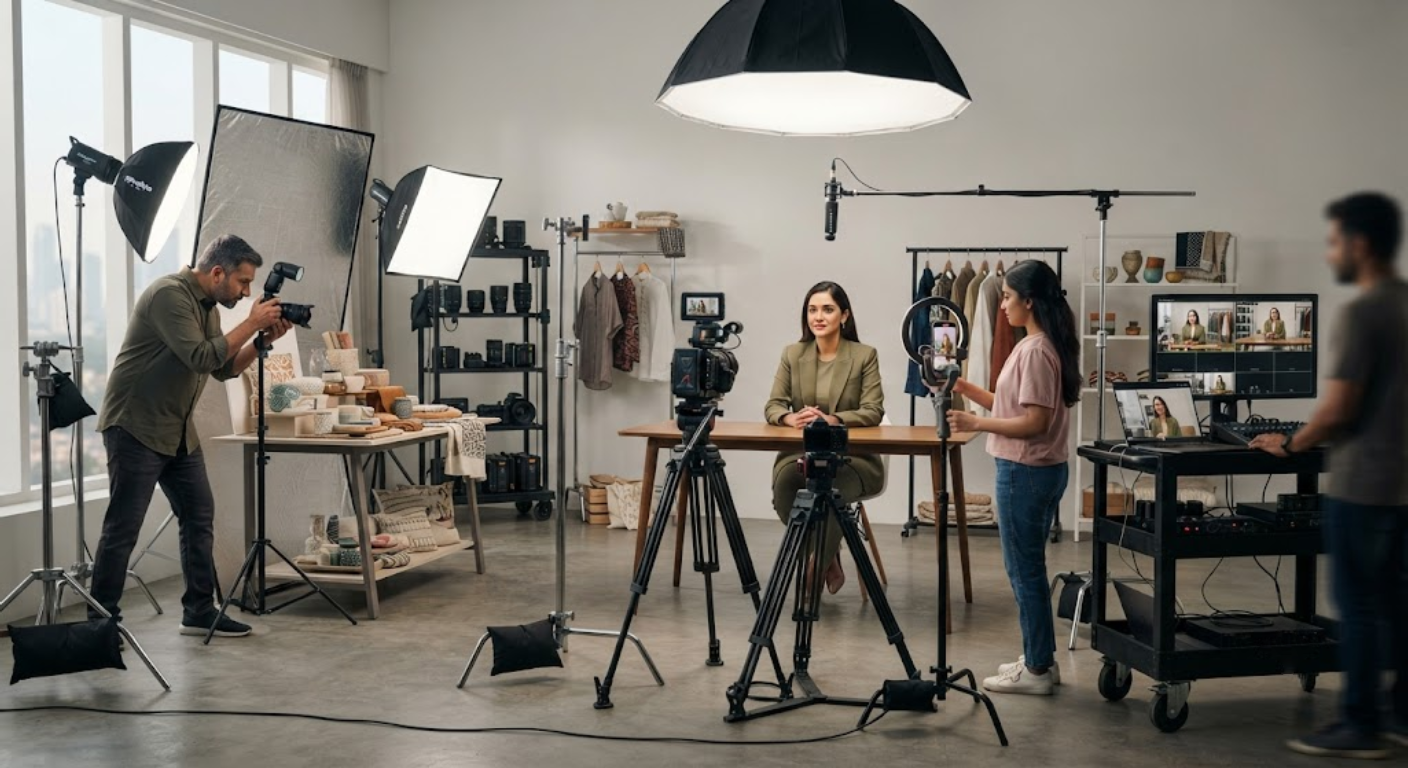
For some businesses, a simple professional setup may be enough. Others may require multiple cameras, advanced lighting, professional audio and additional production support.
The production setup may include:
- Professional camera
- Appropriate lenses
- Studio lighting
- Softboxes or modifiers
- Professional microphones
- Tripods
- Reflectors
- Backgrounds
- Product tables
- Props
- Monitoring equipment
For talking-head videos, audio quality can be just as important as image quality.
For product photography, lighting and styling may have a greater impact than using an unnecessarily complicated camera setup.
The right question is:
“What equipment will improve the final content?”
Rather than:
“What is the most expensive equipment available?”
That distinction helps businesses spend their budget intelligently.
7. Batch Your Content Production
Batch production is one of the most useful strategies for controlling content costs.
Instead of arranging a separate shoot every time a business needs a Reel, photograph or video, plan several pieces of content together.
For example, a business could prepare a monthly content batch containing:
- 8–15 short-form videos
- Founder photographs
- Product images
- Several educational clips
- B-roll footage
- Promotional assets
The exact number depends on the complexity of the concepts, number of people involved, setup changes and production requirements.
Batching can reduce repeated costs associated with:
- Studio bookings
- Equipment setup
- Travel
- Styling
- Production crew
- Makeup and grooming
- Creative planning
More importantly, it gives the business a ready-to-use content library.
This makes content production for small businesses more predictable and easier to manage.
8. Focus on Four Types of Content That Deliver Practical Value
Small businesses do not need to create every possible content format.
A focused content mix can be much more manageable.
Four particularly useful categories are:
1. Educational Content
Answer common customer questions and explain your expertise.
Examples include:
- How-to videos
- Industry tips
- Product education
- Frequently misunderstood topics
2. Product or Service Content
Show customers exactly what you sell and how it works.
This could include:
- Product demonstrations
- Service explanations
- Before-and-after visuals
- Feature videos
3. Founder and Team Content
People often want to understand the people behind a business.
Founder videos, professional portraits and team photographs can make a business feel more approachable.
4. Trust-Building Content
This includes:
- Customer testimonials
- Case-study videos
- Behind-the-scenes content
- Workspace photographs
- Process videos
Together, these four categories create a balanced content library without requiring an enormous production budget.
9. Don’t Overspend on Sets, Props and Locations
A professional shoot does not always require an elaborate set.
For many businesses, a clean and carefully designed studio environment can provide everything needed for high-quality content.
Instead of building complicated sets, consider using:
- Simple professional backgrounds
- Brand-relevant props
- Existing products
- Minimal furniture
- Practical workplace elements
- Portable backdrops
- Different camera angles
The same environment can look significantly different when the camera position, lighting and composition change.
For example, one studio space could provide a talking-head setup, product setup, founder portrait setup and social media Reel setup.
This flexibility makes studio-based production particularly useful for small businesses that want professional results without paying for multiple locations.

10. Plan Your Post-Production Budget
Production is only one part of the total content cost.
Post-production can include:
- Video editing
- Colour correction
- Audio cleanup
- Sound design
- Captions
- Motion graphics
- Thumbnail creation
- Photo retouching
- Background removal
- Image resizing
- Platform-specific exports
Small businesses should decide which post-production services are essential before the shoot.
For example, a professional interview may require detailed audio cleanup and editing, while a simple product photograph may only need colour correction and retouching.
You should also consider how many final assets you actually need.
If you shoot 20 videos but only need 10 edited videos immediately, you may be able to keep the remaining footage as a future content resource.
A clearly defined post-production scope prevents unexpected costs and makes budgeting easier.
11. Measure the Value of Your Content
Professional content should ultimately support business objectives.
After publishing your content, review how audiences respond.
Depending on the platform and objective, useful measurements may include:
- Video views
- Watch time
- Engagement
- Website visits
- Enquiries
- Leads
- Product page visits
- Direct messages
- Sales
- Audience growth
Not every piece of content will generate immediate sales.
Some content builds awareness, while other content helps customers understand your products or services.
The purpose of measurement is to discover which topics, formats and messages are useful to your audience.
Over time, this information can improve your next production session.
Instead of repeatedly creating content based only on assumptions, you can use previous performance to make better production decisions.
This creates a more efficient long-term content production for small businesses strategy.
Conclusion
Content production for small businesses does not have to mean choosing between professional quality and a practical budget.
The key is to approach production strategically.
Start with clear business goals. Decide what content you actually need. Build a detailed shoot list. Prioritize high-value assets. Batch similar content together and use one production session to create multiple formats.
You should also consider the entire production process, including planning, studio setup, photography, video recording, editing and distribution.
Instead of asking how cheaply you can produce one piece of content, consider how many useful marketing assets you can create from one well-planned production investment.
With the right strategy, even a small business can build a professional content library that supports social media, websites, advertising, personal branding and customer communication throughout the month.
The goal is not to produce more content simply for the sake of being active.
The goal is to create useful, professional and reusable content that supports business growth while keeping production practical and manageable.