
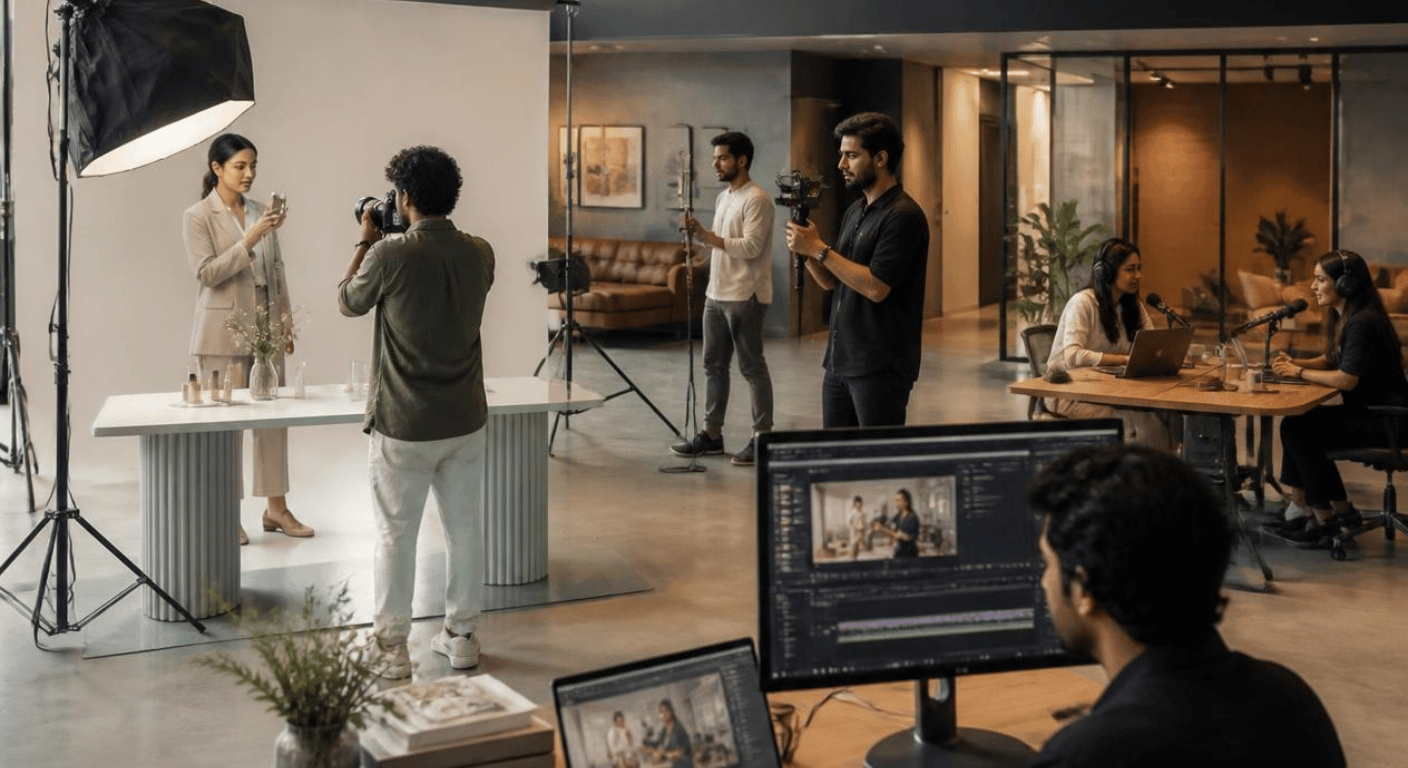
In today’s digital-first business environment, having a good product or service is only one part of building a successful brand. Businesses also need professional visuals, engaging content, a strong online presence, and consistent communication across multiple platforms. This is where choosing the right creative partner becomes important.
A creative partner can help a business transform ideas into professional photographs, videos, podcasts, websites, social media content, marketing campaigns, and other digital assets. However, not every studio or agency works in the same way. Some specialise in photography, others focus on video production, while some provide digital marketing or website development.
Choosing separate vendors for every requirement can create communication gaps, inconsistent branding, additional project management, and unnecessary delays. A connected creative team can simplify this process by understanding the business, its audience, visual identity, and long-term objectives.
For businesses in Mumbai and beyond, the right creative partner should therefore be evaluated not only on equipment or pricing, but also on experience, capabilities, communication, workflow, quality standards, and the ability to understand the business objective behind each project.
1. Understand What Your Business Actually Needs
Before choosing a creative partner, clearly identify what you need help with.
A business may require only professional product photography, while another may need a complete content and digital presence. A founder launching a podcast may require studio recording, video production, editing and distribution support. An e-commerce brand may need product photography, model photography, website development and digital marketing.
Start by listing your immediate and future requirements.
Consider these questions:
- Do you need professional photography?
- Do you need Reels, Shorts or promotional videos?
- Are you planning to launch a podcast?
- Do you need website or e-commerce development?
- Do you require SEO or digital marketing?
- Do you need regular content production?
- Will you require editing and post-production?
- Do you need one-time production or ongoing creative support?
Having a clear list makes it easier to compare creative partners based on actual business requirements rather than simply comparing prices.
A creative partner should also be able to understand why the content is being created. A product photograph for an Amazon listing has a different purpose from a lifestyle photograph designed for Instagram. Similarly, a corporate video, founder video and social media Reel require different creative approaches.
The clearer your objectives are, the easier it becomes for a creative team to recommend the right production approach.
2. Look for Relevant Experience
Experience is one of the most useful factors to examine when choosing a creative partner.
A studio may have excellent equipment, but experience determines how effectively that equipment is used. Creative production involves lighting, composition, direction, storytelling, editing, colour correction, sound, pacing and platform-specific requirements.
Look for examples that are relevant to your industry or project type.
For example, an e-commerce business may want to see:
- Product catalogue photography
- Lifestyle product photography
- Model photography
- Product videos
- Marketplace-ready content
A business launching a podcast may instead look for:
- Podcast studio setups
- Multi-camera recording
- Audio production
- Episode editing
- Thumbnail and branding work
- Distribution support
Experience across different industries can also help a creative team understand different customer audiences and communication styles.
MW Stuudio states that it has worked with more than 600 clients and has produced content for areas including e-commerce, real estate, food, fashion, healthcare, personal brands and other businesses.
The goal should not simply be to find a company with a large portfolio. Instead, examine whether its previous work demonstrates the quality, consistency and creative approach your project requires.
3. Evaluate the Quality of the Portfolio
A portfolio provides a direct view of what a creative partner can produce.
When reviewing a portfolio, look beyond whether the images or videos look attractive. Ask whether the work communicates the intended message effectively.
For photography, examine:
- Lighting quality
- Product presentation
- Colour accuracy
- Composition
- Background treatment
- Retouching quality
For video, consider:
- Camera quality
- Framing
- Lighting
- Audio quality
- Editing
- Colour grading
- Storytelling
For digital projects, examine:
- Website design
- Mobile responsiveness
- User experience
- Visual consistency
- Content structure
- Performance and functionality
A strong portfolio should demonstrate consistency rather than only a few impressive projects.
It is also useful to ask whether the creative partner has experience producing content for the platforms where you intend to publish it. A photograph created for print may require a different approach from an image designed for an e-commerce marketplace or social media campaign.
The right creative partner should understand both the creative and technical requirements of the final platform.
4. Check Whether the Team Can Handle Multiple Creative Requirements
Businesses often need more than one type of content.
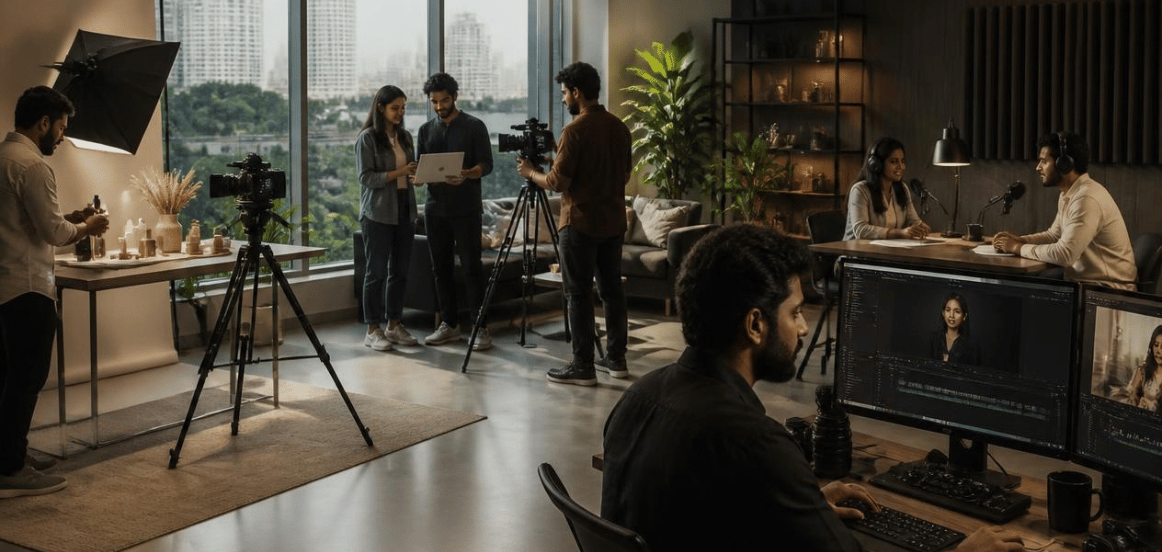
A product launch might require product photography, promotional videos, social media Reels, website banners, product descriptions and digital advertising. Managing each requirement through a different vendor can make the process complicated.
A creative partner with multiple capabilities can simplify communication and maintain visual consistency.
A connected creative team may provide:
- Photography: Product, fashion, food, jewellery, corporate and lifestyle photography.
- Video Production: Reels, promotional videos, corporate films, product videos and brand stories.
- Post-Production: Video editing, colour grading, sound design, motion graphics, captions and photo retouching.
- Digital Services: Website development, e-commerce development, SEO, digital marketing and content writing.
MW Stuudio describes these capabilities as part of its broader creative and digital service offering.
This does not mean every business needs every service. Instead, the advantage is having access to connected capabilities when the business grows or its content requirements expand.
A single team can also reduce the need to repeatedly explain your brand identity, audience and communication style to different vendors.
5. Consider the Production Process
A professional creative partner should have a clear process.
Creative projects can become difficult when there is no defined workflow. Miscommunication about concepts, deadlines, deliverables or revisions can affect the final result.
Before starting a project, understand how the creative team manages the work.
A typical process may include:
- Initial consultation
- Understanding the business objective
- Creative concept development
- Production planning
- Shooting or recording
- Editing and post-production
- Review and revisions
- Final delivery
The exact process will vary according to the project.
For example, a product photography project may require product preparation, styling, lighting setup, shooting, retouching and final export. A podcast production project may involve recording, audio editing, video editing, thumbnail creation and distribution support.
A structured workflow helps everyone understand what happens at each stage.
MW Stuudio states that its process has been refined across hundreds of projects and describes an approach covering the project from initial requirements through production and delivery.
6. Assess Communication and Collaboration
Creative work is highly collaborative.
Even an experienced team cannot produce the right result if it does not understand the client’s objectives. Communication should therefore be considered before choosing a creative partner.
During your initial discussion, observe whether the team asks meaningful questions.
For example:
- Who is your target audience?
- What is the purpose of the content?
- Where will the content be published?
- What action should the audience take?
- What brand style do you want?
- What are your deadlines?
- What are your expected deliverables?
These questions demonstrate that the creative team is thinking about the business objective rather than simply the production task.
Clear communication also helps with revisions. You should know who will coordinate the project, how feedback will be shared, and how changes will be handled.
A good creative relationship is not simply about receiving files. It is about creating an environment where ideas, feedback and business requirements can move smoothly between the client and the production team.
7. Compare Equipment, Technology and Technical Capabilities
Professional creative output depends on more than artistic direction. Technical equipment and production infrastructure also matter.
For photography, this may include professional cameras, lenses, lighting equipment, modifiers, backdrops and colour-calibrated editing systems.
For video production, consider cameras, lenses, lighting, audio equipment, stabilisation equipment and editing capabilities.
Podcast production may require acoustically treated rooms, quality microphones, mixers, monitoring systems and multi-camera setups.
MW Stuudio describes its podcast studio as acoustically treated and equipped with professional microphones, mixers, multi-camera video equipment, LED lighting and monitoring systems. It also describes professional lighting, photography and post-production workflows.
However, equipment should not be evaluated in isolation.
The most expensive camera does not automatically produce the right content. The important question is whether the creative team has the technical knowledge and experience to use its equipment effectively for your specific project.
8. Understand the Deliverables Before Starting
One common source of confusion in creative projects is unclear deliverables.
Before approving a project, make sure you understand exactly what you will receive.
Clarify details such as:
- Number of photographs or videos
- Video duration
- Final resolution
- Aspect ratios
- Editing requirements
- Retouching
- Captions or subtitles
- Thumbnail designs
- File formats
- Delivery timeline
- Number of revision rounds
For example, a social media campaign may require vertical videos in formats suitable for Instagram Reels and YouTube Shorts, while a website campaign may require horizontal banners and high-resolution photographs.
Similarly, product photography may require different image dimensions depending on the marketplace or e-commerce platform.
Getting these details confirmed before production reduces misunderstandings later.
It also allows you to compare proposals more accurately. A lower price may not represent a lower total cost if important deliverables are excluded.
9. Think About Long-Term Creative Requirements
A creative partner should not necessarily be selected only for one project.
Businesses continuously need fresh content.
A growing brand may initially require a product shoot, followed by social media videos, website updates, advertising creatives, campaign photography and seasonal content.
A founder may start with a few Reels and later launch a podcast or YouTube channel.
A company may begin with a business website and later need an e-commerce store, SEO and ongoing digital marketing.
Thinking about future requirements can help you select a creative partner capable of supporting the next stages of your business.
Consider the long-term questions:
- Can the team support recurring content?
- Can it maintain consistent brand visuals?
- Can it scale production when required?
- Can it support new platforms?
- Can it provide both production and digital services?
- Can it maintain communication as the project grows?
MW Stuudio positions itself as a connected creative and digital ecosystem, combining production capabilities with digital and web services.
The objective is not to commit to every possible service today. Instead, it is to choose a partner whose capabilities can grow alongside your requirements.
10. Avoid Choosing a Creative Partner Based Only on Price
Budget is naturally an important consideration, but price alone should not determine the decision.
Two creative proposals can have significantly different scopes.
One may include:
- Professional production equipment
- Creative direction
- Experienced crew
- Editing
- Retouching
- Multiple deliverables
- Project management
Another proposal may provide only the studio or basic production service.
This is why comparing the final number without comparing the scope can be misleading.
Instead, consider the overall value of the project.
Ask:
- What is included?
- What is excluded?
- How experienced is the team?
- What quality level can be expected?
- What are the delivery timelines?
- How many revisions are included?
- Does the team understand your industry?
- Can the content be used across multiple marketing channels?
The right approach is to compare proposals based on scope, quality, experience, communication and business requirements, rather than simply selecting the lowest quotation.
Conclusion
Choosing the right creative partner is not simply about finding a studio with professional cameras or an agency with attractive designs. It is about finding a team that understands your business, communicates clearly, produces consistently high-quality work and can support your evolving content requirements.
Start by defining your objectives, reviewing relevant portfolios and evaluating the team’s production capabilities. Then look carefully at its workflow, communication process, deliverables, technical infrastructure and long-term capabilities.
For businesses that require multiple creative services, a connected team can also reduce the complexity of managing different vendors for photography, video, post-production and digital services.
Ultimately, the best creative partnership is one where production quality and business objectives work together. When your creative team understands what you are trying to achieve, every photograph, video, podcast, website page and digital campaign can contribute to a more consistent and professional brand presence.