
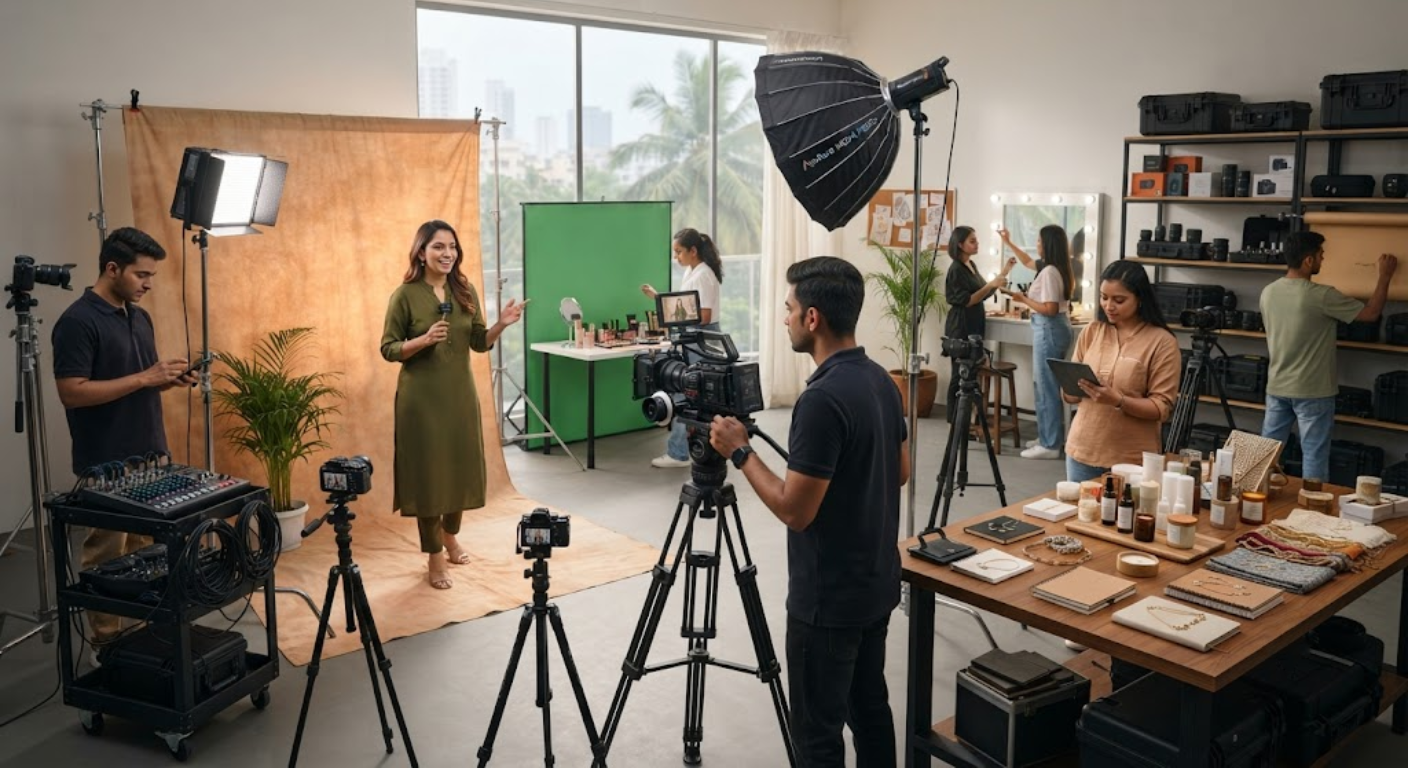
For businesses using Instagram and other short-form video platforms, creating reels consistently can become challenging when every video is planned and produced separately. One shoot may require cameras, lighting, locations, scripts, products, presenters, makeup, styling, editing and several other production requirements.
This is why many businesses choose to batch-produce reels in a single shoot day.
But how many reels should you actually aim to create in one day?
There is no universal number. A realistic target depends on the type of content, complexity of each reel, number of presenters, locations, wardrobe changes, products, scripts and level of production involved.
A simple talking-head shoot may produce significantly more videos than a highly scripted product campaign. Similarly, a business that plans its concepts in advance can usually create more usable content than a team trying to decide everything inside the studio.
The goal should not simply be to produce the maximum possible number of reels. The better objective is to create enough high-quality content to maintain consistency without sacrificing creativity, performance or production quality.
This guide explains how to determine the right number of reels for your business, how to plan a productive shoot day and how to turn one professional production session into a larger content library.
1. Why Businesses Should Consider Batch Reel Production
Creating one reel at a time may seem manageable initially, but it can become inefficient when social media requires regular publishing.
Every individual shoot may involve scheduling the team, preparing the location, setting up equipment, arranging products, preparing scripts and coordinating presenters. Repeating this process for every single reel can consume considerable time.
Batch production solves part of this problem by grouping multiple videos into one production session.
Instead of asking, “How can we shoot one reel today?”, businesses can ask, “How much useful content can we create from this production setup?”
A single shoot may include educational videos, product demonstrations, customer-focused content, founder videos, FAQs, behind-the-scenes clips and promotional reels.
Batch production also creates consistency. When multiple videos are recorded during the same production period, the visual style, lighting and overall brand presentation can remain more uniform.
However, batch production works best when the videos are planned before production begins.
The objective is not simply to fill a camera memory card. It is to create a collection of usable videos that support the business’s content strategy.
2. So, How Many Reels Can You Shoot in One Day?
For many businesses, 8 to 15 reels can be a practical starting range for a well-organized shoot day when the videos use relatively simple setups.
However, the actual number can vary considerably.
A basic talking-head format with one presenter and one setup may allow a team to record many short videos efficiently. A product demonstration requiring multiple angles, product preparation and detailed styling may take much longer.
A highly produced reel involving multiple locations, actors, props, costume changes or complex camera movements may require substantially more production time.
A useful way to think about production capacity is:
- Simple talking-head reels: potentially a larger batch
- Educational or expert reels: moderate batch size
- Product demonstration reels: moderate production volume
- Lifestyle or cinematic reels: smaller batch
- Highly scripted campaign videos: fewer videos per day
The number should therefore be treated as a planning estimate rather than a fixed production rule.
If quality starts dropping because the team is rushing through concepts, producing fewer reels is usually the better decision.
3. The Complexity of Your Reels Determines Your Production Capacity
Not every reel takes the same amount of time.
A 20-second talking-head video may require only a few minutes of actual recording once the lighting and camera are ready. A product reel may require several product placements, close-up shots, movements and retakes.
Consider the production complexity before deciding your target.
Simple reels generally involve:
- One person
- One camera setup
- One background
- Minimal props
- Short scripts
- Limited editing requirements
More complex reels may involve:
- Multiple people
- Several camera angles
- Product styling
- Multiple locations
- Wardrobe changes
- Props and set changes
- Special lighting
- Detailed direction
- Voiceovers or sound design
The more variables involved, the fewer reels you should schedule.
A common mistake is creating a very ambitious shoot schedule and then rushing the final concepts simply because the team wants to hit a predetermined number.
Instead, build your schedule around production complexity and quality.
4. Plan Your Reel Concepts Before the Shoot Day
The number of reels you can produce depends heavily on how much preparation happens before the cameras start recording.
If your team arrives at the studio without scripts, concepts or shot lists, significant production time may be lost discussing what to create.
Before the shoot, prepare a content list containing:
- Reel topic
- Objective
- Target audience
- Script or talking points
- Presenter
- Required products
- Props
- Location or setup
- Approximate duration
- Required camera angles
- Call-to-action
This makes the production process much smoother.
For example, a business selling skincare products could prepare separate concepts around product benefits, application demonstrations, ingredient education, common mistakes, FAQs and customer problems.
Once these concepts are documented, the production team can group similar videos together.
That means you may not need to repeatedly change lighting, backgrounds or camera positions.
5. Group Reels by Similar Production Setups
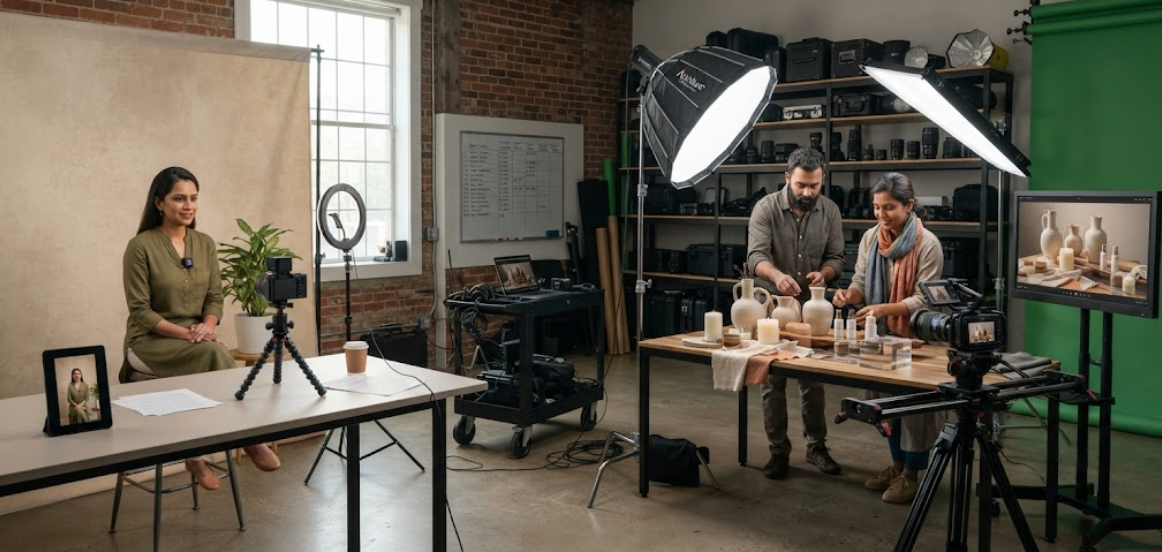
One of the most effective ways to increase the number of reels produced in a day is to group videos that use similar setups.
Suppose a business has ten educational reels featuring the founder. Instead of changing the environment after every video, the production team can record several scripts using the same camera, lighting and background.
Then the team can move to the next setup.
For example:
Setup A — Founder Videos
- Educational tips
- FAQs
- Industry advice
- Myth-busting
- Expert opinions
Setup B — Product Videos
- Product demonstration
- Features
- Benefits
- Usage instructions
- Close-up shots
Setup C — Lifestyle Content
- Customer scenarios
- Product-in-use scenes
- Brand storytelling
- Behind-the-scenes content
Grouping content reduces unnecessary setup and teardown time.
It also allows presenters and production teams to remain focused on one visual format for longer.
6. How to Structure an Efficient One-Day Reel Shoot
A productive reel shoot should have a clear schedule.
Instead of treating the entire day as one continuous recording session, divide it into production blocks.
A practical structure could look like:
Morning: Setup, testing and simple talking-head content
Late morning: Educational or founder-focused reels
Afternoon: Product demonstrations and lifestyle content
Late afternoon: Creative concepts, additional shots and B-roll
Final hour: Retakes, missing shots and behind-the-scenes footage
The exact schedule will depend on the project.
It is also important to leave buffer time.
Unexpected issues can happen during production. A script may need changes, a product may require another take or a presenter may need additional direction.
A schedule that has no flexibility can quickly become difficult to maintain.
The best production day is one where the team finishes the planned content while still having enough time to capture important additional footage.
7. Don’t Measure Success Only by the Number of Reels
Shooting 20 reels is not automatically better than shooting 10.
If half of the videos are repetitive, poorly delivered or unsuitable for the target audience, the larger number does not necessarily create more value.
Businesses should evaluate content based on usefulness.
A strong reel should ideally have a clear purpose.
It could:
- Educate the audience
- Answer a common question
- Demonstrate a product
- Build trust
- Introduce an expert
- Explain a service
- Address a customer problem
- Showcase a result
- Encourage an enquiry
- Strengthen brand recognition
This is why content quality should remain central to production planning.
It is better to leave a shoot with a smaller collection of strong, versatile videos than a large collection of rushed footage that requires extensive correction during editing.
The goal is usable content, not simply recorded content.
8. Include Different Types of Reels in Your Batch
A strong content batch should not contain twenty videos that all look and sound the same.
Variety helps businesses communicate different messages while keeping their social media presence interesting.
A monthly reel batch could include:
- Educational Reels — Explain industry topics or solve customer problems.
- Product Reels — Demonstrate products, features and benefits.
- Founder Reels — Build authority and personal connection.
- FAQ Reels — Answer common customer questions.
- Behind-the-Scenes Reels — Show the people and process behind the business.
- Testimonial Reels — Share customer experiences and outcomes.
- Tips Reels — Deliver quick, actionable advice.
- Promotional Reels — Highlight offers, launches or important services.
You do not need every format in every shoot.
Instead, choose formats that match your business and audience.
A service-based company may prioritize educational and founder content, while an e-commerce brand may need more product demonstrations and lifestyle videos.
9. Use B-Roll to Multiply Your Content Options
B-roll is one of the most useful assets to capture during a reel production day.
B-roll refers to supporting footage that can be used alongside the main talking-head or scripted content.
For example, a restaurant could capture:
- Food preparation
- Chef working
- Ingredients
- Close-up dishes
- Customers dining
- Staff interactions
- Interior details
- Packaging
- Delivery preparation
A real estate company could capture:
- Property exteriors
- Interior rooms
- Details
- Amenities
- Entry areas
- Lifestyle moments
- Neighborhood visuals
These clips can later be used in multiple reels.
You can also combine B-roll with voiceovers, educational videos, promotional messages and social media advertisements.
Therefore, when planning your reel quantity, don’t think only about the finished reels.
Think about the content library created during the shoot.
A well-planned shoot can generate primary videos as well as supporting footage that extends the usefulness of the production.
10. Turn One Shoot Day Into a Month of Content
The biggest advantage of batch reel production is not simply the number of videos recorded. It is the ability to build a consistent content pipeline.
Suppose a business creates ten strong reels during one production session.
Those videos could potentially be distributed across several weeks instead of being published immediately.
The business can also combine them with:
- Static posts
- Carousels
- Stories
- Blog content
- Product photography
- Customer testimonials
- Behind-the-scenes content
- Promotional campaigns
Some reels can also be adapted into different versions.
For example, a longer educational video could become a shorter reel, a quote graphic, a carousel topic or a blog idea.
This makes the original production investment more valuable.
A professional shoot should therefore be viewed as the creation of a content asset library, not simply a collection of individual videos.
With the right planning, one shoot can support a much larger monthly marketing system.
Conclusion
There is no single number of reels that every business should shoot in one day.
For many businesses, 8 to 15 reels can be a practical starting target when the content is well planned and production requirements are manageable. Simpler formats may allow a larger batch, while cinematic or highly complex productions may require significantly more time per video.
The most important factor is not how many reels your camera records. It is how many useful, high-quality and strategically relevant pieces of content your team can create.
Plan your concepts before production, group similar setups, prepare scripts, capture supporting B-roll and leave enough time for retakes and creative direction.
Most importantly, think beyond a single shoot day.
A well-planned reel shoot can become the foundation of an entire month’s content strategy, giving your business a consistent supply of videos while reducing the pressure of creating content from scratch every week.
The best production schedule is the one that balances quantity, quality, consistency and business objectives.