
A professional video podcast series can give a brand a consistent way to share expertise, start meaningful conversations, educate its audience, and create a library of long-form content. Unlike a single promotional video, a podcast series can become an ongoing content format that gives your audience a reason to return.
However, creating a professional video podcast requires more than placing two people in front of cameras and pressing record. The concept, audience, format, studio setup, questions, lighting, audio, camera angles, branding, editing, publishing, and content repurposing all influence the final result.
For brands considering a video podcast, the goal should not simply be to produce episodes. The goal should be to create a repeatable content system that remains consistent in quality and useful to the audience over time.
MW Stuudio provides podcast consultation, studio recording, audio and video production, episode editing, sound design, branding, thumbnails, show notes, and distribution support as part of its broader creative production ecosystem.
1. Define the Purpose of Your Video Podcast
Before choosing cameras, microphones, or a studio, define why your brand wants to create a podcast.
A professional video podcast can serve several purposes. It can help a business explain complex topics, showcase industry expertise, interview professionals, answer customer questions, discuss trends, share founder stories, or provide educational content.
The purpose should connect with an actual business or audience objective.
For example, a technology company may create a podcast discussing technology trends. A healthcare brand may interview specialists about common questions. A real estate company may discuss market developments and investment considerations. A founder-led business may use conversations to explain its journey and expertise.
A clear purpose also makes future episode planning easier.
Ask:
- What should the audience learn?
- Who is the podcast for?
- What subjects will the show cover?
- What makes these conversations useful?
- What action should viewers take after watching?
- How does the podcast support the broader brand?
The answers can become the foundation for the entire production strategy.
2. Choose a Specific Target Audience
A podcast becomes easier to build when the audience is clearly defined.
Instead of creating a show for “everyone,” identify the people most likely to benefit from your expertise.
Your audience could include business owners, startup founders, marketing professionals, investors, students, healthcare professionals, creators, customers, or industry specialists.
Understanding your audience influences everything from topic selection to episode length and presentation style.
For example, a podcast for experienced business owners can discuss advanced strategies, while a podcast for beginners may need simpler explanations and practical examples.
Consider creating an audience profile based on:
- Industry
- Professional role
- Experience level
- Common challenges
- Questions they frequently ask
- Information they want to learn
- Platforms they use
- Content formats they prefer
The stronger your audience definition, the easier it becomes to create relevant episodes.
3. Create a Strong Podcast Concept
Your podcast needs a clear identity.
A concept should communicate what the show is about without requiring a long explanation. Think about the subject area, format, tone, host, guests, and recurring themes.
For example, a business podcast could focus on:
- Founder conversations
- Industry interviews
- Customer education
- Marketing discussions
- Behind-the-scenes business stories
- Expert advice
- Product and technology discussions
- Career and leadership conversations
A strong concept also gives you boundaries. Without boundaries, episodes can become random discussions that are difficult for an audience to understand.
Create a simple podcast framework:
Topic → Audience → Format → Host → Guest → Episode structure → Publishing schedule
This framework can then be repeated for every episode.
4. Select the Right Video Podcast Format
There is no single format that every brand needs.
Your format should match your subject matter and production capabilities.
Popular formats include:
Interview Podcast
A host speaks with one guest about a particular subject.
Co-Host Podcast
Two regular hosts discuss topics, trends, experiences, or industry developments.
Expert Panel
Several professionals discuss one topic from different perspectives.
Educational Podcast
A host explains concepts, strategies, processes, or practical lessons.
Founder Podcast
Business founders discuss their journey, decisions, challenges, and experiences.
Customer or Case Study Podcast
Customers discuss their experiences and lessons learned.
Choosing one primary format makes the show easier to produce consistently.
You can experiment later, but your first episodes should establish a recognisable structure.
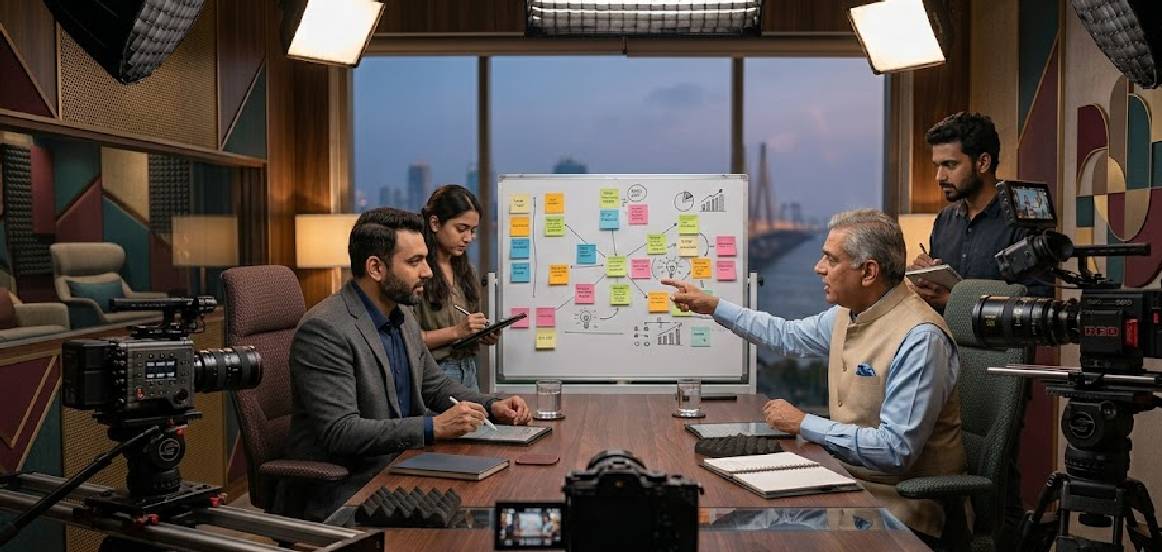
5. Build a Repeatable Episode Structure
A professional podcast series should have a repeatable structure.
A consistent structure helps the host, guest, production team, editor, and audience understand what to expect.
A typical episode could include:
- Opening introduction
- Host introduction
- Guest introduction
- Main discussion
- Key questions
- Practical examples
- Rapid-fire or closing questions
- Final takeaway
- Call to action
- Closing
The structure does not need to make conversations feel scripted.
Instead, it creates a framework around the conversation.
For example, the host can prepare five major questions while allowing the guest to answer naturally and develop interesting points.
This balance between preparation and natural conversation is important for professional podcast production.
6. Plan Topics That Can Support Multiple Episodes
A podcast series should not depend on random ideas.
Build several content pillars that can generate episodes over an extended period.
For example, a digital marketing podcast might have pillars such as:
- SEO
- Social media
- Branding
- Paid advertising
- Content marketing
- E-commerce
- Business growth
Each pillar can generate multiple conversations.
You can also create recurring episode categories such as:
Expert Interview: Interview an industry professional.
Founder Story: Explore the journey behind a business.
Deep Dive: Discuss one specific subject in detail.
Trend Discussion: Analyse relevant industry developments.
Customer Questions: Answer common questions from your audience.
This approach creates a content library rather than a collection of unrelated episodes.
7. Prepare Guests Before the Recording
A guest can significantly influence the quality of a podcast episode.
However, even experienced professionals may not automatically perform well in front of cameras.
Send guests useful information before recording.
Explain:
- Podcast topic
- Episode objective
- Expected duration
- Main discussion areas
- Sample questions
- Recording location
- Arrival time
- Clothing recommendations
- Camera expectations
- Microphone setup
- Whether short-form clips will be created
You can also ask the guest to prepare a few stories, examples, statistics, experiences, or key points they want to communicate.
The objective is not to make the guest memorise answers.
It is to make the guest comfortable enough to communicate naturally.
Professional podcast production services can also support preparation and consultation before recording. MW Stuudio, for example, describes podcast consultation as covering show positioning, audience definition, format, episode structure, branding, distribution, and growth planning.
8. Choose a Professional Recording Environment
The recording environment affects both audio and video quality.
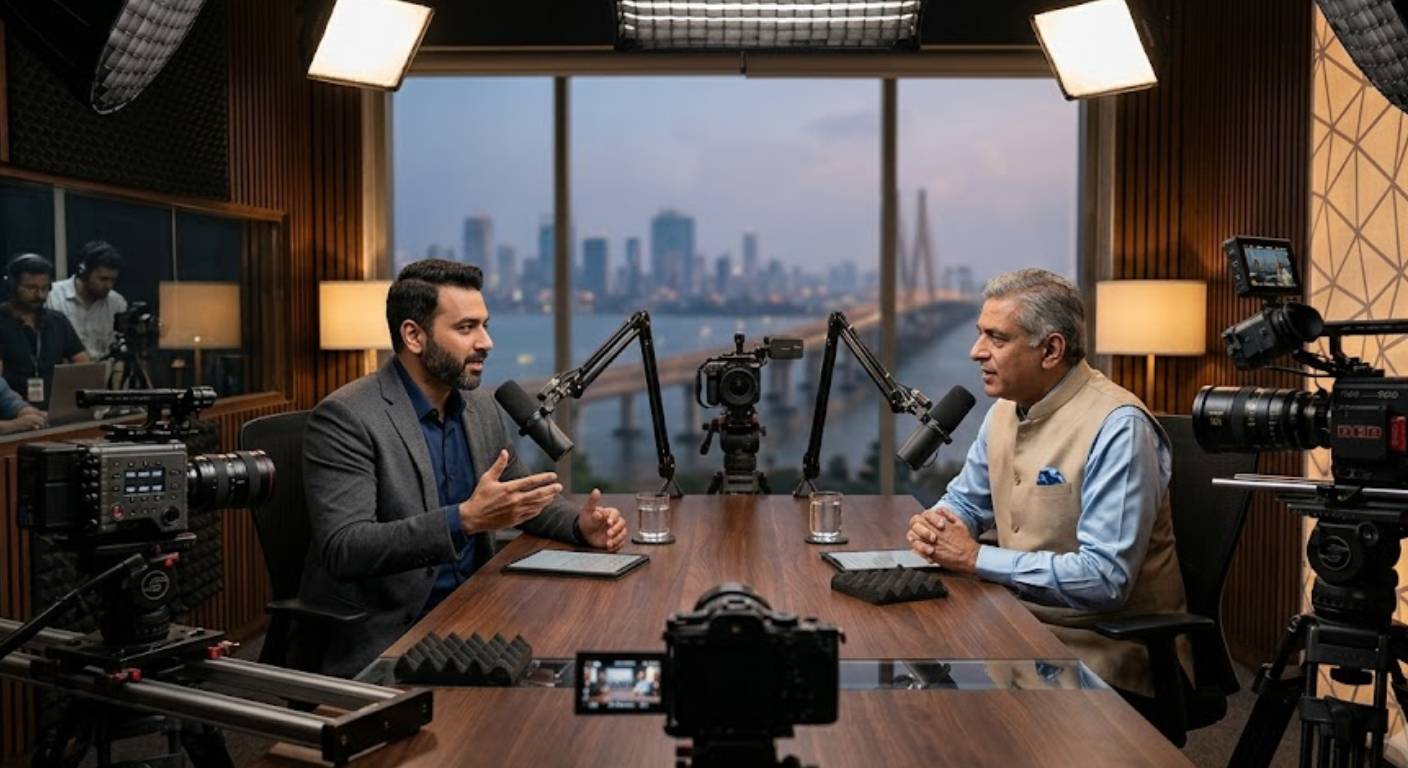
A professional podcast studio can provide controlled acoustics, lighting, camera positioning, backgrounds, and technical support.
This is particularly useful when a brand wants consistent production quality across multiple episodes.
A suitable studio should ideally provide:
- Acoustic treatment
- Professional microphones
- Camera systems
- Controlled lighting
- Suitable backgrounds
- Monitoring equipment
- Reliable recording workflow
- Space for hosts and guests
- Technical support when required
MW Stuudio’s current podcast setup includes broadcast-grade condenser microphones, professional audio interfaces, acoustic treatment, multi-camera video production, and studio-quality LED lighting.
The environment should support the brand rather than distract from the conversation.
9. Prioritise Professional Audio
Viewers may tolerate average video quality for a short period, but poor audio can quickly make a podcast difficult to follow.
Clear audio should therefore be one of the highest production priorities.
Professional podcast microphones help capture speech clearly, while appropriate microphone placement, acoustic treatment, gain control, and monitoring help reduce unwanted problems.
During production, pay attention to:
- Microphone distance
- Background noise
- Room reflections
- Consistent speaking levels
- Plosives
- Clothing noise
- Guest movement
- Monitoring levels
Post-production can then improve the recording through dialogue editing, level balancing, EQ, compression, noise reduction, and mastering.
MW Stuudio’s podcast production workflow includes these types of audio post-production processes.
10. Use Multi-Camera Video Production
One static camera can work for a simple podcast, but multiple camera angles can make a video podcast more visually engaging.
A multi-camera setup can capture:
- Host shot
- Guest shot
- Two-person wide shot
- Close-up reactions
- Conversation details
- Supporting cutaway shots
During editing, the producer can switch between these angles based on who is speaking or reacting.
The goal is not to change camera angles constantly.
Instead, camera changes should support the conversation and maintain visual rhythm.
MW Stuudio’s podcast setup supports multi-camera video podcast production, including single, dual, and triple-camera configurations described on its podcast studio service pages.
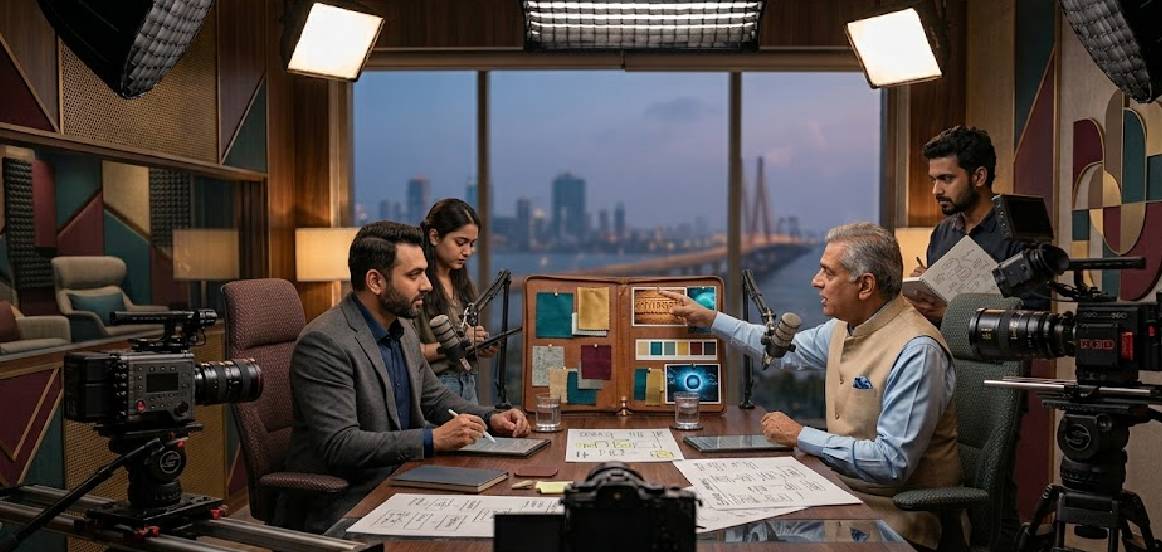
11. Create a Consistent Visual Identity
A podcast series should look like it belongs to the brand.
This means maintaining visual consistency across episodes.
Consider:
- Background design
- Brand colours
- Lighting style
- Host and guest framing
- Thumbnail design
- Intro and outro
- Lower-third graphics
- Typography
- Music
- Episode artwork
Consistency makes episodes easier to recognise when they appear across YouTube, social media, websites, and other channels.
However, branding should remain subtle.
The audience should focus on the conversation rather than feeling as though they are watching an advertisement.
A strong podcast identity should feel like an extension of the brand.
12. Invest in Professional Editing and Post-Production
Recording is only one part of creating a professional video podcast.
The raw footage usually needs editing before publication.
Professional post-production may include:
- Removing unnecessary pauses
- Tightening conversation flow
- Cleaning dialogue
- Balancing audio
- Noise reduction
- EQ and compression
- Colour correction
- Colour grading
- Multi-camera editing
- Lower thirds
- Intro and outro
- Subtitles
- Graphics
- Thumbnail creation
- Platform-specific exports
The objective should be to make the conversation easier to watch without removing its natural character.
For video podcasts, multi-camera editing can also remove repetitive visuals and create a more polished viewing experience.
MW Stuudio currently lists video podcast post-production services including multi-camera editing, colour grading, lower thirds, intro/outro sequences, subtitle integration, and platform exports.
13. Turn Each Episode Into Multiple Content Assets
One of the biggest advantages of a video podcast is the amount of content that can come from one recording session.
A single long-form episode can become:
- YouTube episode
- YouTube Shorts
- Instagram Reels
- LinkedIn clips
- Quote graphics
- Educational posts
- Blog articles
- Website content
- Email newsletter content
- Audiograms
- Short expert clips
- Guest promotional content
For example, a 45-minute interview might contain several useful answers that can stand independently as short videos.
This means the podcast should be planned with repurposing in mind before recording.
Ask the host and guest questions that can produce both a strong long-form discussion and useful short-form answers.
A well-planned production day can therefore create content for several weeks rather than producing only one published episode.
MW Stuudio also positions podcast production alongside Reel/video production, photography, post-production, SEO, digital marketing, and website development, allowing podcast content to connect with a broader content ecosystem.
14. Create a Consistent Publishing Workflow
A professional podcast should not depend on last-minute production.
Create a repeatable workflow from planning to publishing.
A practical workflow could be:
Topic Planning → Guest Selection → Questions → Recording → Editing → Review → Thumbnail → Show Notes → Short Clips → Publishing → Promotion
You can also batch record episodes.
For example, instead of recording one episode every week, a brand could record several episodes during one production session and release them according to a publishing calendar.
Batch recording can make the production process more efficient and create greater consistency.
MW Stuudio describes batch podcast recording as an approach where creators can record multiple episodes in a single session, with monthly and quarterly production approaches available for different publishing schedules.
The important part is to build a realistic schedule that the team can maintain.
Consistency is usually more sustainable than creating an ambitious schedule that becomes difficult to follow.
15. Build the Podcast Into Your Long-Term Brand Strategy
A video podcast should not exist separately from the rest of your marketing.
The strongest approach is to connect the podcast with your website, social media, SEO, email marketing, digital campaigns, and other content.
For example:
Podcast → YouTube → Short-form videos → Blog → Website → Newsletter → Social media → Lead generation
The podcast can also become a long-term knowledge library.
Over time, episodes can cover frequently searched questions, industry discussions, customer concerns, expert interviews, case studies, and educational subjects.
This gives your brand a growing collection of content that can continue to support communication with customers and prospects.
The podcast can also complement other forms of professional production. MW Stuudio’s broader creative ecosystem includes podcast production, photography, video and Reel production, post-production, website development, SEO, digital marketing, and content writing.
The key is to think beyond individual episodes.
Build a system where every recording contributes to a larger brand content library.
Conclusion
Creating a professional video podcast series for your brand requires more than professional cameras and microphones. It requires a clear concept, defined audience, repeatable format, strong episode planning, prepared guests, controlled recording conditions, professional audio, multi-camera production, consistent branding, thoughtful editing, and a reliable publishing workflow.
The biggest opportunity comes from treating the podcast as a long-term content system rather than a collection of individual videos.
One well-produced conversation can become a long-form YouTube episode, short-form videos, social media content, blog material, website resources, email content, and future discussion topics.
For brands, this approach can make the podcast more useful as part of a broader content strategy.
A professional studio can also simplify the production process by bringing recording, technical production, post-production, and content support into one workflow. MW Stuudio currently offers podcast consultation, studio recording, audio and video production, editing, sound design, branding, thumbnails, show notes, and distribution support, making podcast production part of its wider creative and digital ecosystem.
The goal should be simple: create conversations worth watching, produce them consistently, and turn every episode into a larger collection of useful brand content.