
Podcasting has become an increasingly useful content format for businesses, founders, creators, consultants, and professionals who want to communicate ideas in a deeper and more personal way. But while recording a podcast may appear simple, producing content that consistently looks and sounds professional requires much more than placing a camera and microphone in a room.
The recording environment has a direct impact on audio quality, lighting, camera composition, guest comfort, production consistency, and the final viewing experience. This is where a professional podcast studio can make a meaningful difference.
A professionally equipped studio gives brands access to controlled acoustics, professional microphones, lighting, cameras, production support, and post-production workflows. Instead of spending time solving technical problems, the host and guests can concentrate on the conversation and the content itself.
For brands, this can turn podcasting from an occasional recording activity into a repeatable content production system.
MW Stuudio, established in Borivali in 2019, has developed from a podcast and music studio into a broader creative ecosystem covering podcast production, photography, video production, post-production, website development, SEO, digital marketing, and content writing. Its current podcast services include studio recording, audio and video production, consultation, episode editing, sound design, branding, thumbnails, show notes, and distribution support.
1. A Professional Studio Creates a Controlled Recording Environment
One of the biggest advantages of using a professional podcast studio is control.
Home offices, meeting rooms, cafes, and ordinary commercial spaces can contain many unpredictable sources of sound. Air conditioners, traffic, fans, conversations, hard walls, furniture movement, and room reflections can all affect a recording.
A professional studio is designed around the recording process.
Acoustic treatment helps manage unwanted reflections, while the room layout can be designed specifically for microphones and cameras.
This matters because audio problems are often difficult to fix completely after recording.
A controlled environment allows the production team to focus on:
- Consistent room acoustics
- Microphone positioning
- Background noise control
- Speaker placement
- Camera positioning
- Lighting
- Overall visual composition
For a brand producing a recurring podcast, consistency becomes especially important.
If every episode is recorded in a different environment, the audio and visual character can change from episode to episode. A dedicated studio helps create a recognisable production standard.
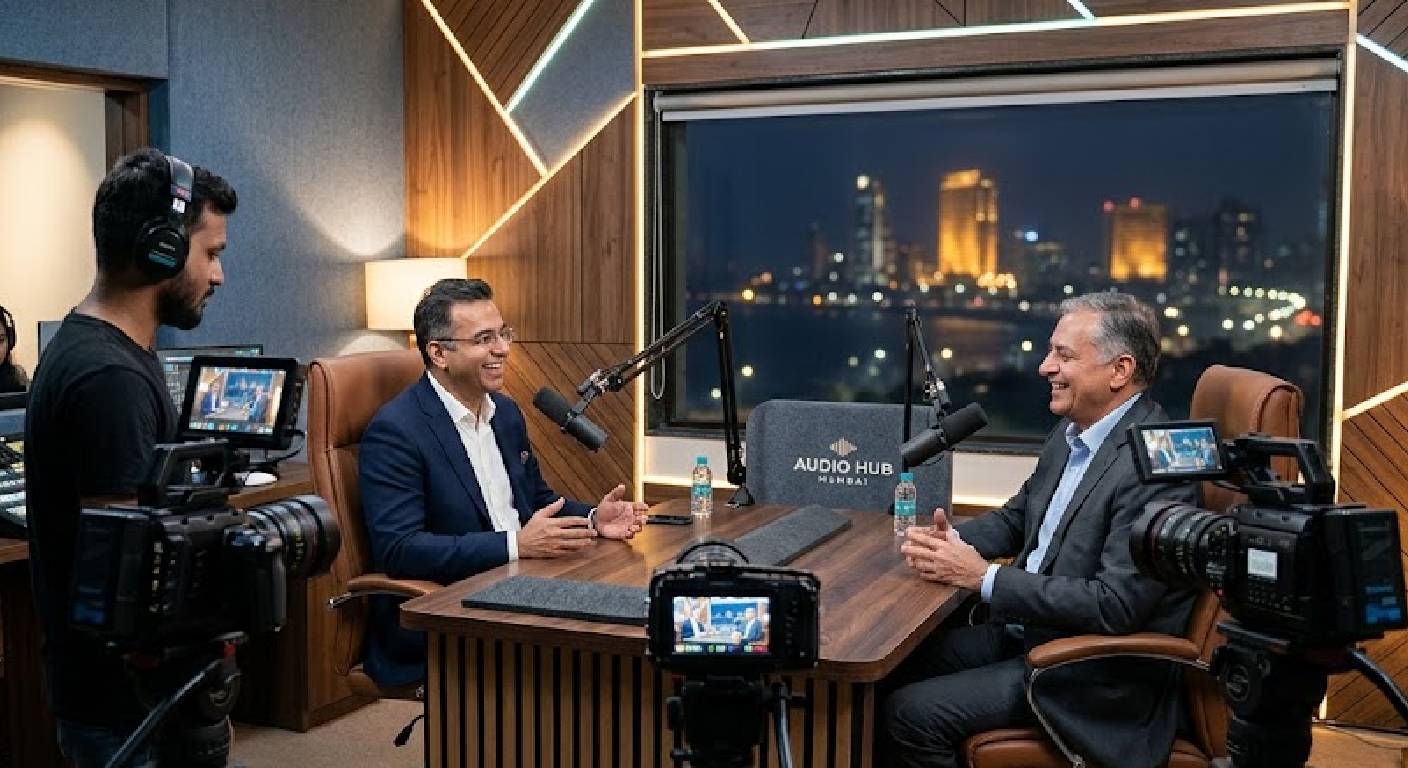
MW Stuudio describes its podcast setup as including acoustic treatment, professional audio interfaces, broadcast-grade microphones, multi-camera video production, and studio-quality LED lighting.
2. Better Audio Makes Conversations Easier to Follow
Audio is one of the most important elements of podcast quality.
A viewer may forgive a simple background or modest camera setup, but inconsistent or unclear speech can make a long conversation difficult to follow.
Professional microphones are designed to capture voices with greater clarity when positioned and configured correctly.
However, the microphone itself is only one part of the process.
The recording environment, microphone placement, gain levels, speaker position, room acoustics, and monitoring all contribute to the result.
During post-production, the audio can also be refined through processes such as:
- Dialogue editing
- Level balancing
- Noise reduction
- EQ
- Compression
- Mastering
- Removing unwanted pauses or distractions
This helps create a more consistent listening experience when multiple people are participating in the conversation.
MW Stuudio’s podcast post-production workflow includes dialogue editing, level balancing, noise reduction, EQ and compression, and mastering.
For brands, better audio quality can make long-form conversations easier to consume across podcast and video platforms.
3. Professional Lighting Improves the Visual Quality of Video Podcasts
A video podcast is not simply an audio recording with cameras pointed at the speakers.
Lighting strongly influences how the host, guest, background, and overall set appear on camera.
Poor lighting can create harsh shadows, uneven exposure, distracting highlights, or flat-looking footage.
A professional studio can control the lighting environment instead of depending on whatever natural or artificial light happens to be available.
A production team can adjust lighting according to:
- Host position
- Guest position
- Skin tones
- Background
- Camera angle
- Brand aesthetic
- Desired mood
- Episode format
This can help create consistent visuals from one episode to another.
Professional LED lighting and controlled studio setups are part of MW Stuudio’s current podcast production environment.
For brands publishing a regular video podcast, consistent lighting can also contribute to a recognisable visual identity.
4. Multi-Camera Production Creates a More Engaging Viewing Experience
A long podcast conversation can contain several minutes of discussion without significant movement.
If viewers see exactly the same camera angle throughout an entire episode, the visual experience can become repetitive.
Multi-camera production provides additional perspectives.
A typical setup could include:
- Wide two-person shot
- Host close-up
- Guest close-up
- Additional reaction or detail shots
The editor can then switch between angles according to the conversation.
For example, when the guest answers a question, the edit can move to the guest’s camera. When the host responds, the host camera can be used. A wider shot can establish the overall conversation.
The purpose is not to create unnecessary visual movement.
The purpose is to support the natural flow of the conversation.
MW Stuudio currently offers multi-camera podcast video production, including different camera configurations for different podcast formats.
5. A Professional Set Strengthens Brand Presentation
Your podcast environment becomes part of your brand’s visual identity.
When someone watches several episodes, the background, lighting, seating arrangement, colour palette, camera framing, and graphics can become recognisable elements of the show.
A professional studio gives you more control over these details.
The set can be designed around the personality of the brand.
A technology company may prefer a modern minimal environment.
A consulting company may choose a sophisticated corporate setup.
A creative brand may prefer a more expressive and visually interesting environment.
The important point is that the environment should support the conversation instead of competing with it.
A professional-looking set can also make the podcast feel like a deliberate brand initiative rather than an improvised recording.
6. Better Camera Composition Makes the Content Look More Professional
Camera quality alone does not create professional-looking video.
Composition matters just as much.
The production team needs to consider:
- Camera height
- Framing
- Headroom
- Subject position
- Background elements
- Lens choice
- Depth of field
- Eye line
- Camera angle
For a two-person conversation, each camera should have a clear purpose.
The host should be framed consistently. The guest should have enough visual space. The wide camera should show the relationship between participants.
The background should also be intentional.
Unnecessary objects, distracting furniture, cables, clutter, or inconsistent lighting can reduce the visual quality of an otherwise good recording.
A professional studio provides the physical space and technical setup required to control these elements.
7. Professional Equipment Reduces Technical Problems
Technical problems can interrupt a recording and affect the final content.
A microphone may not be connected correctly. A camera may have the wrong settings. A memory card may be full. Lighting may be inconsistent. Audio levels may be too low. A guest may be positioned incorrectly.
Professional podcast production reduces these risks through preparation and technical monitoring.
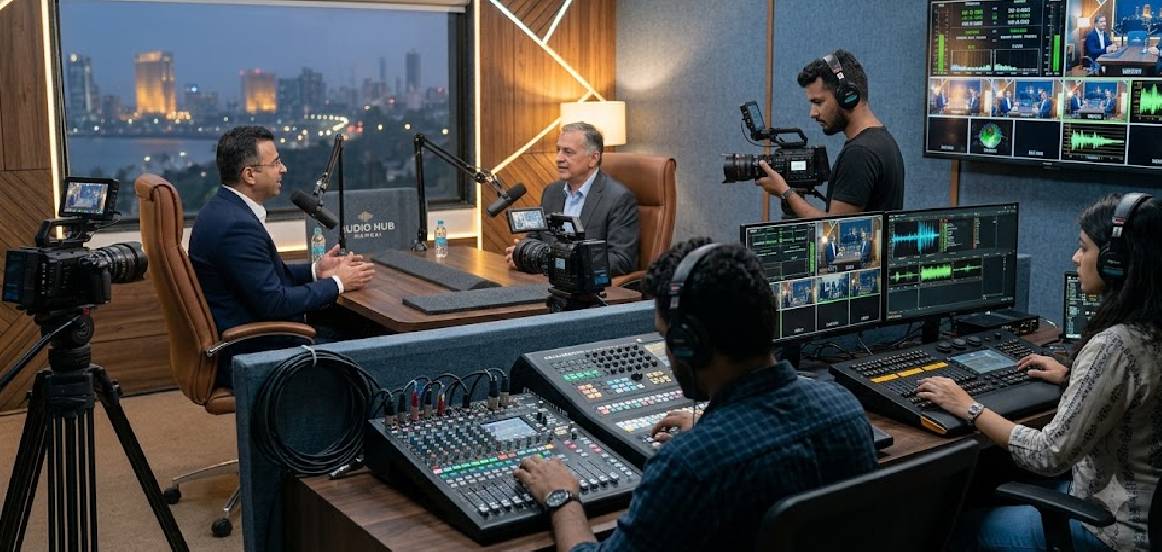
Before the recording begins, the production team can check:
- Microphone connections
- Audio levels
- Camera settings
- Memory storage
- Lighting
- White balance
- Framing
- Recording formats
- Monitoring
- Teleprompter requirements
MW Stuudio’s managed podcast production workflow includes setting up cameras, balancing lighting, calibrating and testing microphones, and preparing the teleprompter before recording. During the session, its workflow includes sound monitoring, camera operation, and technical direction.
This preparation allows the host and guest to focus more on the discussion.
8. A Professional Studio Helps Hosts and Guests Feel More Prepared
The quality of a podcast depends heavily on the people participating in it.
A guest who feels uncomfortable can struggle to communicate naturally.
A host who is distracted by technical problems may lose focus on the conversation.
A professional studio environment can provide a more structured recording experience.
The team can explain:
- Where to sit
- How to use the microphone
- Where to look
- How the cameras are positioned
- When recording begins
- How the conversation will be structured
- What happens after recording
A teleprompter can also be useful when the host needs to deliver an introduction, sponsor message, important statement, or structured segment.
The goal should not be to make the conversation feel artificial.
Instead, professional preparation should make the participants comfortable enough to speak naturally.
9. Professional Post-Production Improves the Final Content
Recording high-quality footage is only the beginning.
Raw podcast footage usually requires editing before publication.
Professional post-production can transform a long recording into a polished episode.
The editing workflow may include:
- Removing unnecessary pauses
- Tightening conversation flow
- Cleaning dialogue
- Balancing audio
- Multi-camera editing
- Colour correction
- Colour grading
- Adding lower thirds
- Adding intro and outro
- Subtitles
- Motion graphics
- Thumbnail creation
- Platform-specific exports
The goal should be to improve clarity without making the conversation feel overly edited.
For video podcasts, professional editing can also ensure that the host and guest remain visually consistent across different camera angles.
MW Stuudio’s current podcast post-production service includes multi-camera editing, colour grading, lower thirds, intro and outro sequences, subtitle integration, and platform exports.
10. Consistent Production Quality Strengthens Brand Identity
One professionally recorded episode can look good.
A professional podcast series needs every episode to look good.
Consistency is therefore one of the most important benefits of a dedicated production environment.
If Episode 1 has bright lighting, Episode 2 has dark lighting, Episode 3 has a different background, and Episode 4 has poor audio, the show can feel disconnected.
A professional podcast studio allows brands to establish repeatable production standards.
These standards can cover:
- Camera settings
- Lighting configuration
- Audio setup
- Background
- Seating
- Framing
- Graphics
- Intro and outro
- Colour treatment
- Subtitle style
- Thumbnail design
This consistency helps create a recognisable content identity.
Over time, audiences may begin to associate the visual and audio style with the brand itself.
11. A Studio Can Make Batch Content Production More Practical
Creating content consistently is often one of the biggest challenges for businesses.
Recording one podcast every week can require repeated preparation, travel, setup, sound checks, camera setup, and production coordination.
Batch recording can make the process more organised.
For example, a brand could schedule one full-day studio session and record several episodes during the same production day.
This can create a content bank for several weeks or months.
A batch approach can involve:
Planning → Guest scheduling → Recording → Editing → Content repurposing → Scheduled publishing
MW Stuudio describes monthly batch recording approaches where creators can record multiple episodes during a full-day session, as well as larger quarterly batch approaches.
The exact number of episodes will depend on the format, guest availability, episode length, preparation, and production schedule.
The important advantage is that production becomes a planned system rather than a series of isolated recording days.
12. One Podcast Recording Can Produce Multiple Content Formats
A professional podcast can become much more valuable when the recording is planned for repurposing.
A single long-form conversation can produce several additional content assets.
For example:
- Full YouTube episode
- Short video clips
- Instagram Reels
- YouTube Shorts
- LinkedIn clips
- Quote posts
- Educational social posts
- Blog articles
- Newsletter content
- Website resources
- Audiograms
- Guest promotional clips
This means the value of a podcast is not limited to the final episode.
The production team can identify strong moments during editing and convert them into shorter pieces of content.
A professional studio can also make this easier because the original recording is already produced with suitable lighting, sound, camera angles, and framing.
MW Stuudio’s broader service ecosystem combines podcast production with photography, video, Reels, post-production, content writing, websites, SEO, and digital marketing.
13. Professional Podcast Production Saves the Brand From Managing Every Technical Detail
Businesses often underestimate how much work is involved in producing a podcast.
Someone needs to prepare the room.
Someone needs to set up microphones.
Someone needs to position cameras.
Someone needs to check lighting.
Someone needs to monitor audio.
Someone needs to manage recording files.
Someone needs to edit the episode.
Someone needs to prepare thumbnails and captions.
Someone needs to create show notes.
Someone needs to prepare platform-specific files.
Managing all of these tasks internally can become time-consuming, particularly when podcast production is not the team’s primary expertise.
A managed studio can take responsibility for much of the technical workflow.
This allows founders, marketing teams, hosts, and guests to spend more time on the content itself.
MW Stuudio offers both studio-rental-only and full-production options, allowing experienced creators to use the space independently while businesses can also choose managed production support.
14. A Professional Studio Can Connect Podcasting With Your Wider Content Strategy
Podcasting should not operate separately from the rest of your brand’s content.
The podcast can become one part of a larger content ecosystem.
For example:
Podcast Episode → YouTube → Short Videos → Blog → Social Media → Newsletter → Website
The same production day can also potentially include other forms of content.
A brand might record podcast episodes and then use the same studio visit for:
- Founder videos
- Product videos
- Professional portraits
- Social media Reels
- Website photography
- Short educational videos
This approach can make the content production process more connected.
MW Stuudio specifically describes combining podcast recording with photography and other video content in the same visit, while its broader ecosystem also includes digital marketing and website development.
The result is a more organised content library where different assets can support one another.
15. A Professional Podcast Studio Supports Long-Term Content Quality
The biggest benefit of a professional podcast studio may not be one individual episode.
It is the ability to maintain a consistent production standard over time.
When a brand creates ten, twenty, or fifty episodes, small production inconsistencies can become obvious.
A professional studio can provide a repeatable environment for:
- Audio quality
- Lighting
- Camera production
- Set design
- Editing
- Branding
- Episode delivery
- Content repurposing
This creates a foundation for a long-term podcast strategy.
It also allows brands to improve their process over time.
After several episodes, the team can identify which topics perform well, which guests create strong conversations, which clips are most useful, and which production formats are easiest to maintain.
The podcast can then evolve based on actual experience rather than assumptions.
MW Stuudio’s broader mission is built around creating a connected creative ecosystem where podcast production, photography, video, post-production, web development, SEO, digital marketing, and content services can work together.
The result is not simply a collection of podcast episodes.
It can become a long-term content library that supports the brand’s communication across multiple channels.
Conclusion
A professional podcast studio can improve a brand’s content quality by giving the production team greater control over audio, lighting, cameras, acoustics, composition, branding, editing, and overall workflow.
The benefit is not simply that the final video looks more polished.
A controlled production environment can make the entire content process more organised and repeatable.
Better microphones can support clearer conversations. Professional lighting can create consistent visuals. Multi-camera production can make long conversations more engaging. Technical monitoring can reduce recording problems. Post-production can turn raw footage into polished episodes. Batch recording can make consistent publishing easier. And content repurposing can turn one conversation into multiple useful assets.
For businesses, this means a podcast can become more than another social media activity.
It can become a long-term content platform.
MW Stuudio currently provides podcast consultation, studio recording, audio and video production, episode editing, sound design, branding, thumbnails, show notes, and distribution support. Its wider creative ecosystem also connects podcast production with photography, video production, post-production, website development, SEO, digital marketing, and content writing.
The objective should not simply be to record a podcast.
The objective should be to create a consistent, professional content system that gives your brand useful conversations and reusable content for the long term.