
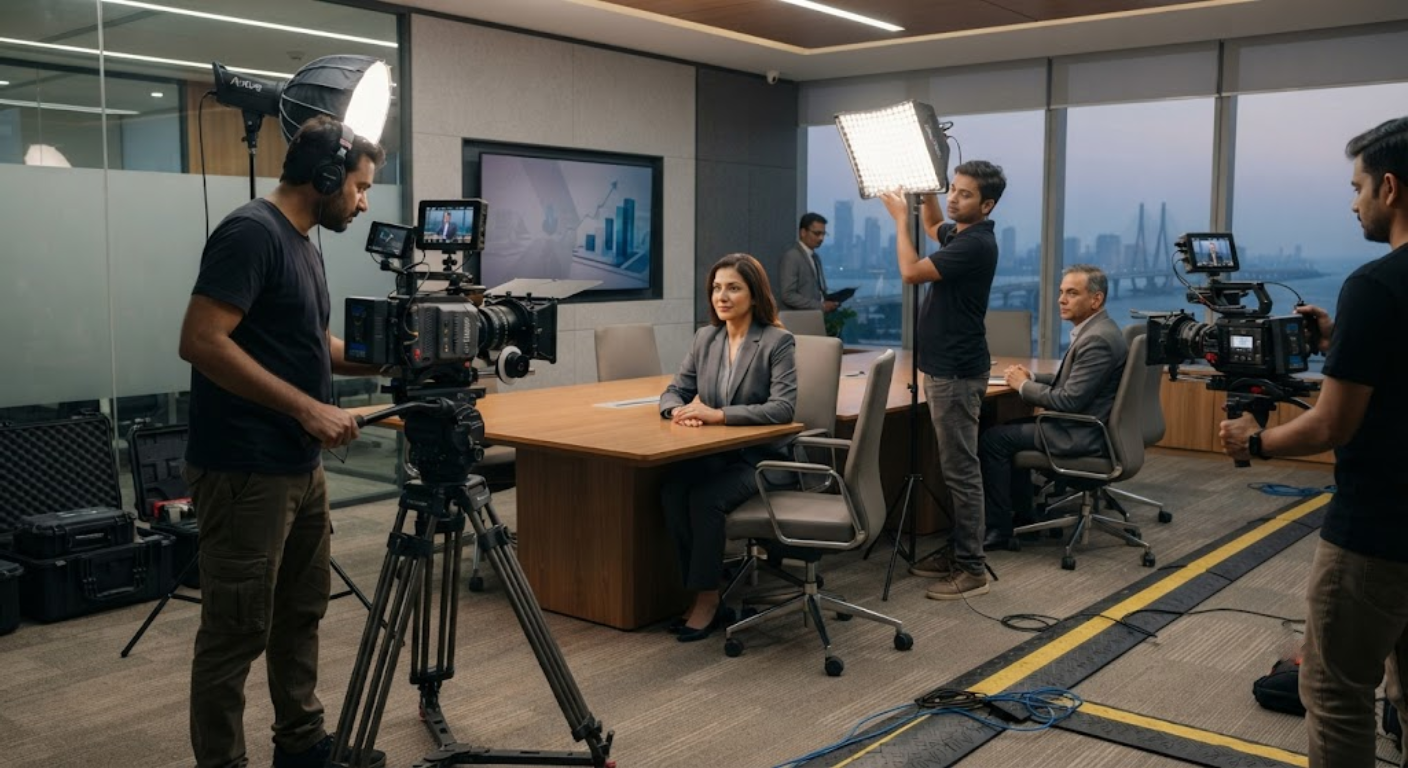
Corporate video production has become an important part of how businesses communicate with customers, employees, investors, partners and potential clients.
A corporate video is no longer limited to a traditional company-profile film played during meetings. Businesses in Mumbai now use video across websites, social media, presentations, recruitment campaigns, product launches, internal communication, sales presentations, events and digital advertising.
For many companies, video provides an opportunity to explain complex information quickly while also showing the people, facilities, products and culture behind the business.
A manufacturing company can use video to demonstrate its production capabilities. A real estate company can showcase projects and customer experiences. A professional services firm can use leadership interviews to establish expertise. A startup can introduce its founders and explain its product.
The possibilities are extensive.
At the same time, producing a professional corporate video requires considerably more planning than simply placing a camera in front of an employee.
A successful production normally involves:
- Business objectives
- Audience research
- Concept development
- Scriptwriting
- Storyboarding
- Location planning
- Interview preparation
- Camera setup
- Lighting
- Audio recording
- Direction
- Production management
- Video editing
- Sound design
- Graphics
- Colour correction
- Captions
- Final delivery
Mumbai is particularly suitable for corporate video production because businesses have access to professional production crews, studios, creative talent, commercial locations and a wide range of production resources.
However, having many options also makes selecting the right production partner more important.
Recent corporate-video guidance increasingly emphasizes treating video as an ongoing content system rather than a one-time project, while AI is being used to assist tasks such as transcription, captions and content repurposing rather than replacing the complete production process.
This guide explains everything Mumbai businesses should understand before planning corporate video production in 2026.
1. What Is Corporate Video Production?
Corporate video production is the process of creating professional video content for a specific business purpose.
The objective may be to introduce a company, explain a service, showcase products, communicate with employees, support sales, build brand awareness or demonstrate expertise.
Unlike casual social media videos, corporate productions are generally planned around a defined business objective.
For example, a company profile video may explain:
- Who the company is
- What it does
- Where it operates
- What makes it different
- Who it serves
- Why customers should trust it
A corporate video can therefore combine interviews, workplace footage, product demonstrations, customer testimonials, graphics and supporting visuals.
The production process normally has three broad stages:
Pre-production: planning, scripting, locations, schedules and preparation.
Production: filming interviews, products, employees, locations and supporting footage.
Post-production: editing, sound design, graphics, colour correction, captions and final delivery.
The complexity of each stage depends on the purpose of the video.
A simple founder interview may require considerably less production than a multi-location corporate brand film.
The important principle is to define the business purpose first and production requirements second.
2. Types of Corporate Videos Mumbai Businesses Can Produce
Not every company requires the same type of corporate video.
The most effective format depends on the intended audience and business objective.
Common corporate video formats include:
- Company Profile Videos: Introduce the business, its history, services, capabilities and values.
- Brand Films: Communicate the company’s identity, vision and story through a more emotional narrative.
- Founder Videos: Position founders and leadership teams as credible experts.
- Product Videos: Demonstrate how a product works and explain its benefits.
- Service Explainer Videos: Simplify complex services for potential customers.
- Customer Testimonials: Allow existing customers to communicate their experiences.
- Corporate Event Videos: Capture conferences, launches, seminars and business events.
- Training Videos: Educate employees, partners or customers.
- Recruitment Videos: Showcase company culture and attract potential employees.
- Factory or Facility Videos: Demonstrate infrastructure, manufacturing capabilities and operational processes.
- CSR Videos: Document social initiatives and community programs.
- Internal Communication Videos: Help leadership communicate important company information.
- Social Media Corporate Videos: Convert corporate messaging into shorter formats for digital platforms.
A single corporate project can also produce multiple versions.
For example, a company may commission one main corporate film and then create shorter clips for LinkedIn, Instagram, YouTube and sales presentations.
This makes the original production investment more useful.
3. Why Businesses Need Professional Corporate Videos in 2026
Business communication has become increasingly visual.
Customers often want to understand a company before contacting its sales team. Employees want to understand company culture. Potential partners want to evaluate credibility. Investors and stakeholders want concise information.
Video can bring these elements together in a format that is easier to consume across multiple platforms.
A professional corporate video can help a company:
- Communicate its story clearly
- Introduce leadership
- Explain complex services
- Demonstrate products
- Showcase facilities
- Build credibility
- Support sales presentations
- Improve website content
- Create social media assets
- Support recruitment
- Strengthen brand identity
The biggest advantage is not simply production quality.
The video should make the business easier to understand.
For example, a company may have an excellent website containing detailed information about its services, but a well-planned two-minute video can provide an immediate overview of the business.
In 2026, companies are also increasingly thinking about how one production can generate multiple assets rather than creating completely separate content for every platform. Current industry discussions describe this shift toward higher-volume, multi-format video production and treating video as an ongoing business function.
Therefore, businesses should plan corporate video production with distribution and repurposing in mind from the beginning.

4. How to Plan a Corporate Video Before the Shoot
The quality of the final video depends heavily on what happens before the cameras start recording.
Poor planning can result in missed shots, unclear messaging, unnecessary expenses and lengthy editing.
A strong pre-production process starts with a clear brief.
Important questions to answer:
- Who is the target audience?
- What is the main objective?
- What should viewers understand after watching?
- What action should viewers take?
- Where will the video be published?
- What duration is appropriate?
- Who needs to appear on camera?
- Which locations need to be filmed?
- What products or facilities need to be shown?
- Are graphics or animation required?
- Which languages are required?
- What final formats are needed?
The production team can then develop a script, interview questions, storyboard or shooting plan.
Location planning is equally important.
If the video includes an office, factory, showroom or project site, the production team should understand the environment before the shoot.
This can help identify lighting conditions, noise sources, access limitations, available space and important visual opportunities.
Pre-production is therefore not simply administrative work.
It is where many production problems can be prevented.
5. Corporate Video Production Process: From Concept to Final Video
A professional corporate video normally follows a structured production workflow.
1. Discovery and Brief
The production team understands the business, audience, message, objectives and deliverables.
2. Concept Development
The team develops the creative direction, story structure and visual approach.
3. Script and Interview Planning
The script or interview framework is prepared and reviewed.
4. Pre-Production
Locations, schedules, talent, equipment, crew and logistics are finalized.
5. Production
The team records interviews, B-roll, product demonstrations, workplace footage and other required material.
6. Editing
The selected footage is organized into a coherent narrative.
7. Graphics and Sound
Motion graphics, titles, captions, music, sound design and voice-over can be added where required.
8. Review and Revisions
The client reviews the draft and provides feedback according to the agreed revision process.
9. Colour and Audio Finishing
The final video receives colour correction or grading and audio finishing.
10. Delivery
Final files are exported according to the required platforms and specifications.
A clearly defined workflow reduces confusion between the business and production team.
It also helps everyone understand who is responsible for each stage.
6. Camera, Lighting and Audio Equipment for Corporate Videos
Professional corporate video quality depends on more than the camera itself.
The complete production setup contributes to the final result.
A professional production may use:
- Cinema or professional mirrorless cameras
- High-quality lenses
- Tripods
- Gimbals
- Professional LED lighting
- Softboxes
- Reflectors
- Audio recorders
- Wireless microphones
- Shotgun microphones
- Monitoring equipment
- Teleprompters
- Professional backgrounds
- External recording systems
Multiple cameras can be useful for leadership interviews, podcasts and testimonials because they provide different angles during editing.
Lighting is equally important.
A well-lit interview can look professional without appearing artificial. The lighting should suit the person’s environment, clothing and brand requirements.
Audio deserves special attention.
Viewers may tolerate a simple visual setup, but inconsistent or unclear sound can make a corporate video feel unprofessional.
For interview-based productions, microphones should be positioned carefully and the environment should be checked for unwanted background noise.
The best equipment is ultimately the equipment that serves the production objective.
7. How Much Does Corporate Video Production Cost in Mumbai?
Corporate video production pricing can vary substantially because every project has a different scope.
There is no single price that applies to every corporate video.
The final investment can depend on:
Major cost factors
- Number of shooting days
- Number of locations
- Production crew size
- Camera and lighting requirements
- Scriptwriting
- Creative direction
- Actors or presenters
- Voice-over
- Travel
- Set design
- Equipment requirements
- Motion graphics
- Animation
- Music licensing
- Editing complexity
- Number of final videos
- Number of revisions
- Language versions
- Social-media cutdowns
For example, a simple interview video recorded in one studio will normally require fewer resources than a multi-location corporate film involving several employees, locations, actors, graphics and extensive post-production.
Some current Mumbai market guides publish broad indicative ranges, but prices vary significantly depending on scope, so businesses should treat online figures as benchmarks rather than fixed quotations.
The best approach is to provide the production company with a detailed brief and request a written quotation.
The quotation should clearly explain what is included and what may be charged separately.
This makes different proposals easier to compare.
8. How to Choose the Right Corporate Video Production Company in Mumbai
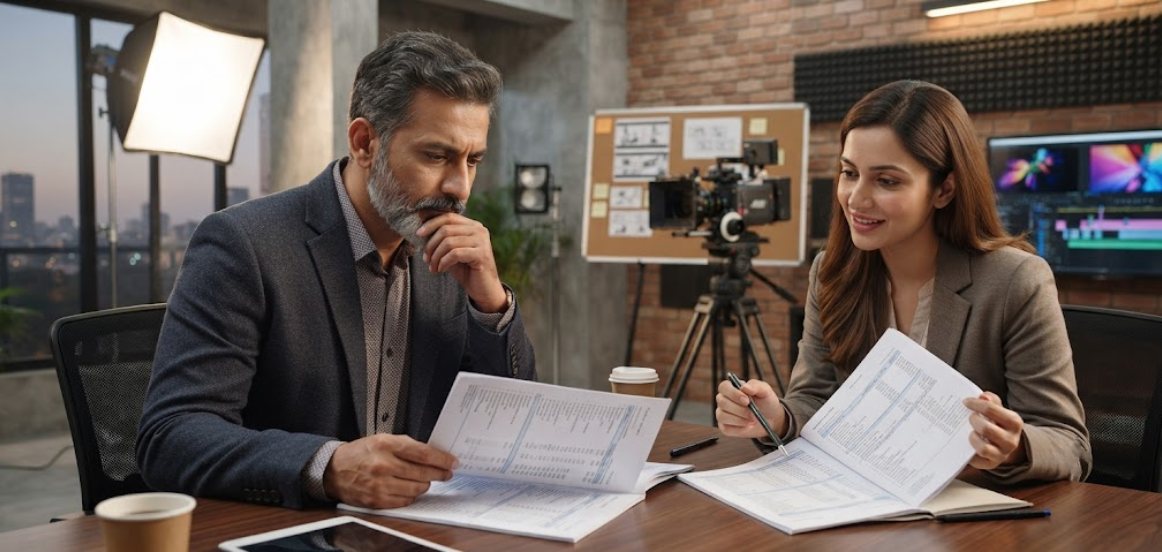
Choosing a production company should involve more than looking at its website.
A strong portfolio is important, but businesses should also evaluate whether the production team understands their specific industry and communication objectives.
Check these areas before hiring:
- Relevant Portfolio: Look for videos similar to your business requirements.
- Production Quality: Evaluate camera work, lighting, audio and editing.
- Creative Understanding: Check whether the company can turn business information into an engaging story.
- Pre-Production: Ask how scripts, locations and schedules are planned.
- Production Team: Understand who will actually work on the shoot.
- Post-Production: Check editing, graphics, sound and revision processes.
- Communication: Ensure there is a clear project contact.
- Deliverables: Confirm exactly what final files you will receive.
- Timeline: Establish realistic deadlines before production begins.
- Budget: Compare complete scope rather than only the base price.
- Rights and Usage: Clarify ownership and licensing requirements for footage, music, graphics and talent.
You should also ask to see recent work rather than relying only on older showcase projects.
A production partner should be able to explain why a particular approach is suitable for your business.
That is often more valuable than simply offering expensive equipment.
9. How Corporate Videos Can Be Repurposed Into Multiple Content Assets
One of the biggest opportunities in modern corporate video production is content repurposing.
Instead of creating one long video and using it once, businesses can plan the production to generate multiple pieces of content.
One corporate production can potentially create:
- Main corporate film
- Founder interview
- Leadership clips
- Short educational videos
- Customer testimonial clips
- Instagram Reels
- YouTube Shorts
- LinkedIn videos
- Behind-the-scenes footage
- Product clips
- Website videos
- Recruitment content
- Social media photographs
- B-roll library
For example, a 90-minute leadership interview may contain several useful answers.
Instead of using the entire interview only once, the editing team can identify individual topics and create shorter clips.
Similarly, a factory shoot can produce footage for a company profile, recruitment campaign, product video and social media content.
This approach can make professional production more efficient.
The important part is to plan these deliverables before filming.
The production team can then capture appropriate framing, B-roll, interview questions and supporting footage.
This is particularly useful for businesses that need consistent content throughout the year.
10. Corporate Video Editing, Graphics and Post-Production
Filming creates the raw material.
Post-production turns that material into a finished communication asset.
The editing process may include:
- Footage selection
- Narrative editing
- Interview editing
- B-roll integration
- Audio cleanup
- Music
- Sound design
- Colour correction
- Colour grading
- Motion graphics
- Animated elements
- Lower thirds
- Subtitles
- Captions
- Logo animation
- Voice-over
- Thumbnail creation
- Social-media versions
Graphics should support the message rather than distract from it.
For example, a company explaining a complex process may benefit from simple motion graphics that make the information easier to understand.
Subtitles can also make corporate videos more accessible across different viewing environments and platforms.
AI-assisted tools can help accelerate certain post-production tasks such as transcription, captioning and content repurposing, but human editorial judgment remains important for storytelling, brand consistency and quality control.
Before production, agree on the revision process.
A clear workflow might include:
Rough Cut → Client Review → Fine Cut → Final Master
This prevents endless changes and keeps the project moving.
11. Common Corporate Video Production Mistakes to Avoid
Even a well-funded production can underperform if the planning is weak.
Common mistakes include:
1. Starting with the camera instead of the objective
Businesses sometimes begin by discussing cameras, lenses and production equipment before deciding what the video needs to achieve.
2. Trying to say everything
A corporate film should not become a five-minute list of every service the company provides.
Choose the most important message.
3. Using overly complicated language
Corporate communication can easily become filled with technical terminology and formal statements.
The audience should understand the message quickly.
4. Ignoring audio
Poor sound can immediately reduce perceived production quality.
5. Not planning B-roll
Interview footage becomes much more engaging when supported by relevant workplace, product or service footage.
6. Forgetting mobile formats
If social media is part of the distribution strategy, vertical versions should be considered before filming.
7. No clear approval process
Multiple decision-makers can create endless revisions if responsibilities are not defined.
8. Choosing production based only on price
A cheaper quote may exclude important production or post-production services.
9. Producing only one final asset
A major corporate shoot can potentially generate many useful content pieces.
10. Failing to plan distribution
The production should be designed around where the final video will actually be used.
The strongest corporate video projects treat production as a combination of strategy, storytelling and execution.
12. Building a Corporate Video Strategy for 2026 and Beyond
Corporate video should increasingly be treated as an ongoing business content system rather than a one-time marketing activity.
A company might begin with a corporate profile video and later expand into leadership content, product videos, recruitment videos, customer testimonials and educational content.
A practical strategy can begin with three levels.
Level 1: Core Brand Content
Create foundational videos that explain:
- Who you are
- What you do
- What makes you different
- Who you serve
Level 2: Trust-Building Content
Add:
- Founder videos
- Customer testimonials
- Case studies
- Employee stories
- Behind-the-scenes content
- Expert interviews
Level 3: Ongoing Marketing Content
Create:
- Reels
- Short-form videos
- Product demonstrations
- Educational videos
- Social media clips
- Website videos
- Event content
- Campaign videos
This creates a content ecosystem rather than a single corporate film.
For Mumbai businesses, a professional studio can also make it easier to combine video production with photography, podcast recording, product shoots, Reels and post-production.
The objective is not simply to produce more videos.
The objective is to create better, more useful content that supports measurable business goals.
As video production becomes more frequent, businesses should develop repeatable workflows for planning, filming, editing, approval and distribution. This aligns with the broader 2026 shift toward treating video as an ongoing business function rather than isolated projects.
Ultimately, successful corporate video production depends on five things:
Clear objective + strong storytelling + professional production + efficient post-production + strategic distribution.
When these elements work together, corporate video can become a valuable part of a company’s marketing and communication strategy.
Conclusion
Corporate video production in Mumbai has evolved from traditional company-profile films into a broader business communication and content strategy.
Businesses can now use professional video for websites, social media, sales presentations, recruitment, product marketing, leadership communication, customer testimonials, events and internal communication.
The key is to start with the business objective.
Before booking a production team, define:
- Target audience
- Main message
- Video purpose
- Distribution platforms
- Required locations
- People appearing on camera
- Desired deliverables
- Production timeline
- Budget
- Post-production requirements
Then select a production partner based on relevant experience, creative understanding, technical capabilities, production support and transparent deliverables.
Most importantly, think beyond one final video.
A well-planned corporate shoot can create a library of photographs, interviews, B-roll, short-form videos, testimonials and other assets that can support marketing throughout the year.
For Mumbai businesses in 2026, professional corporate video production is therefore not simply about making a polished video.
It is about creating useful visual communication that explains your business, builds trust and supports your broader digital growth strategy.