
Podcasting has become much easier to start.
You no longer need a traditional broadcast studio or a large production company to publish your own show. A decent microphone, laptop, headphones and recording software can technically be enough to create your first episode.
But there is an important difference between being able to record a podcast and producing a professional podcast.
That difference is at the centre of one of the biggest decisions new podcasters face:
Should you record your podcast at home or book a professional podcast studio?
There is no universal answer.
A home setup can provide flexibility, privacy and lower upfront costs. It can be an excellent choice for someone experimenting with podcasting, recording a solo show or developing an audio-first format.
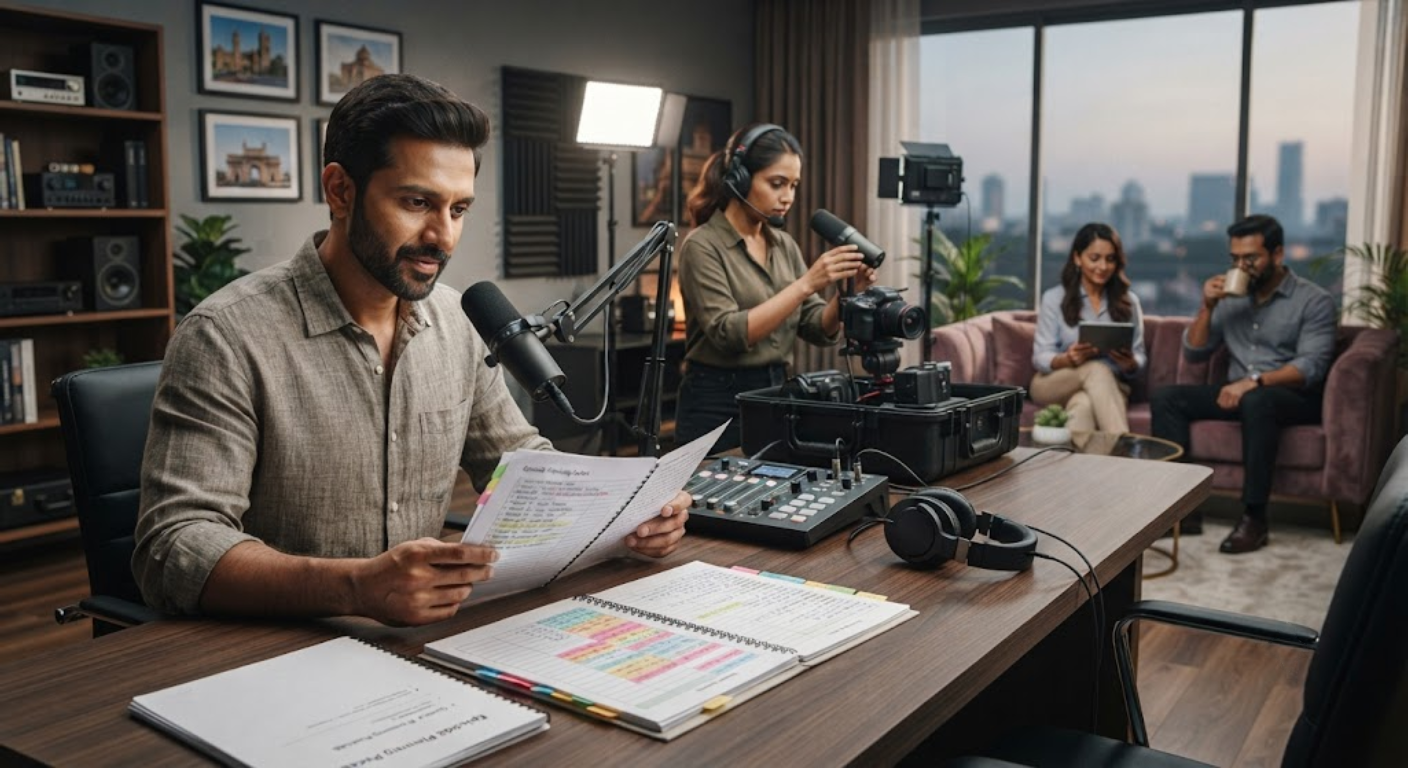
A professional podcast studio, on the other hand, provides controlled acoustics, professional recording equipment, consistent lighting, video production capabilities and technical support. These advantages become increasingly important when your podcast represents a business, personal brand, YouTube channel or professional media project.
The decision becomes even more important when you consider video.
Modern podcasts are often distributed across YouTube, Instagram, LinkedIn and other platforms. A single conversation can become a long-form video, multiple short clips, Reels, Shorts and other content assets.
That means your recording environment is no longer responsible only for audio quality. It can also affect your visual identity.
MW Stuudio in Borivali offers both professional studio rental and a fully managed studio-plus-production package. Its podcast studio includes acoustic treatment, professional microphones, multi-camera video capability, controlled LED lighting, high-speed internet and monitoring systems.
So which option is better?
The answer depends on your goals, experience, budget and expected production quality.
This guide compares the two options in detail.
1. What Is a Professional Podcast Studio?
A professional podcast studio is a purpose-built recording environment designed to produce controlled audio and, increasingly, professional video.
Unlike a typical room at home, a podcast studio is designed around the technical requirements of spoken-word recording.
A professional environment can include:
- Acoustic treatment
- Sound isolation
- Broadcast-quality microphones
- Audio mixers and interfaces
- Monitoring headphones
- Professional cameras
- Studio lighting
- Production monitors
- Recording systems
- Technical operators
- Post-production facilities
The exact equipment varies from studio to studio.
However, the key advantage is control.
When recording at home, you have to work around the room you already have.
In a professional studio, the room is designed around your recording requirements.
This can make a noticeable difference when recording interviews, business discussions or video podcasts where consistency matters.
For example, MW Stuudio describes its Mumbai podcast studio as a soundproofed and acoustically treated recording environment equipped with broadcast-grade microphones, professional mixers, multi-camera video, LED lighting, remote guest connectivity and real-time monitoring.
This type of environment is particularly useful for creators who want professional production without building and maintaining the entire infrastructure themselves.
2. What Does a Home Podcast Setup Usually Include?
A home podcast setup can be surprisingly simple.
For a basic solo podcast, you might need only:
- A microphone
- Headphones
- Laptop or computer
- Recording software
- Quiet room
- Stable internet connection
As your podcast becomes more ambitious, the setup can grow.
You may eventually add:
- Audio interface
- Microphone arms
- Additional microphones
- Acoustic panels
- Cameras
- Tripods
- LED lights
- Background lighting
- Teleprompter
- External storage
- Editing software
The advantage is that you can build the setup gradually.
You do not have to purchase everything on the first day.
This makes home recording attractive for beginners.
However, there is another side to the equation.
When you build a professional home setup, the total cost can become much higher than the original microphone purchase suggests.
You are not only buying equipment.
You are also investing in the room, acoustic improvements, lighting, cameras, cables, storage, maintenance and your own time.
This is why the home-versus-studio decision should consider total cost of ownership, not simply the price of one microphone.
3. Audio Quality: Home Setup vs Professional Studio
Audio quality is one of the biggest differences between the two approaches.
Many beginners assume that buying an expensive microphone automatically produces professional audio.
It does not.
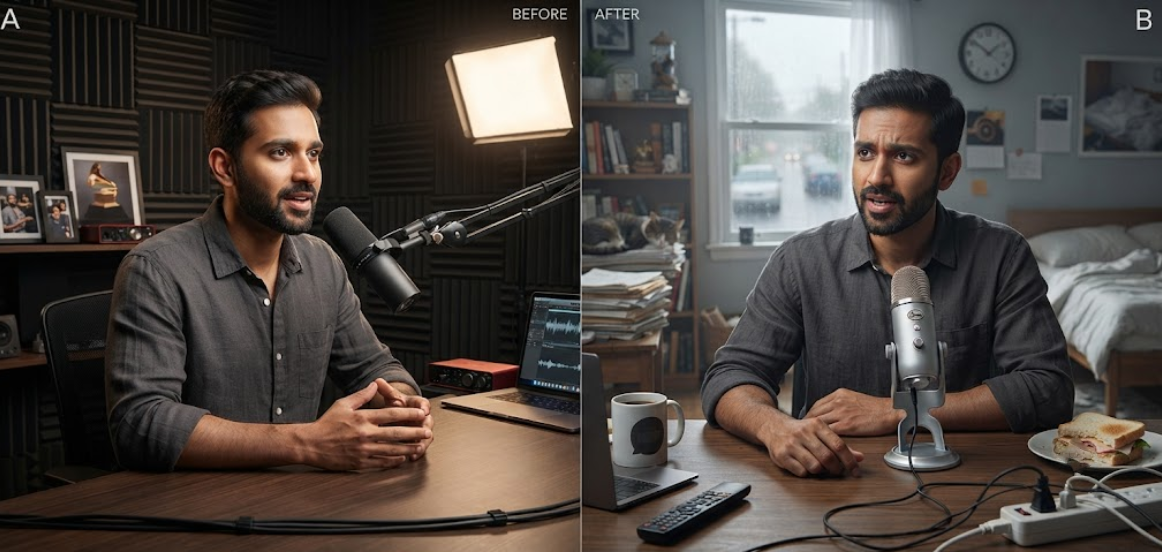
The microphone captures the sound of the room as well as your voice.
If the room has hard walls, windows, reflective surfaces, ceiling reflections or background noise, those characteristics can become part of the recording.
This is why a moderately priced microphone in a well-treated room can sometimes sound better than a premium microphone placed in a poor acoustic environment.
A professional podcast studio is designed to control these factors.
At home, you may have to deal with:
- Traffic
- Construction
- Neighbours
- Air conditioners
- Fans
- Elevators
- Doorbells
- Household conversations
- Pets
- Street sounds
Some of these sounds may happen unpredictably.
That creates a major problem when recording interviews.
Imagine a guest delivering an important answer when a vehicle horn suddenly enters the recording.
You can edit around it, but you cannot always remove it perfectly.
A controlled studio environment reduces this risk.
For professional podcasts, audio consistency is one of the strongest reasons to consider studio recording.
4. Acoustic Treatment and Soundproofing
Acoustics deserve special attention because they are frequently misunderstood.
Acoustic treatment controls how sound behaves inside a room.
Soundproofing focuses on reducing sound transmission between the recording space and the outside environment.
A home room may have some acoustic treatment but still allow outside noise to enter.
For example, adding foam panels to a wall does not automatically make a room soundproof.
Mumbai’s urban environment makes this particularly relevant.
Apartments and offices can have shared walls, traffic noise, construction activity, building systems and unpredictable human activity.
For an occasional home recording, you may be able to work around these challenges.
For a professional podcast published every week, they can become frustrating.
A purpose-built studio provides greater environmental control.
MW Stuudio’s podcast space is described as soundproofed and acoustically treated, specifically to create a controlled recording environment.
This is one of the areas where professional studios have a clear advantage.
5. Video Quality: Where the Difference Becomes Bigger
If your podcast is audio-only, a home setup can potentially compete more easily with a professional studio.
But video changes the equation.
Video podcasts require you to think about:
- Camera quality
- Framing
- Background
- Lighting
- Skin tones
- Camera angles
- Exposure
- White balance
- Audio-video synchronization
- Editing
A single webcam may be sufficient for a basic online conversation.
But if you want a professional YouTube podcast, your visual production needs more consideration.
Multiple cameras can make conversations significantly more engaging.
For example:
Camera 1: Host
Camera 2: Guest
Camera 3: Wide shot
This gives the editor flexibility to change perspectives while keeping the conversation visually dynamic.
MW Stuudio offers single, dual and triple-camera podcast configurations within its production offering.
For a creator who wants professional YouTube content without purchasing and operating multiple cameras, a studio can be considerably more convenient.
6. Lighting: A Major Difference for Video Podcasts
Lighting is often overlooked when people build a home podcast.
A room may look bright to your eyes but still look poor on camera.
You may experience:
- Harsh shadows
- Uneven facial lighting
- Overexposed windows
- Dark backgrounds
- Changing daylight
- Different skin tones between cameras
Natural light can also change throughout a recording session.
A podcast episode recorded at 10 AM may look very different from one recorded at 5 PM.
That creates visual inconsistency across episodes.
Professional studios solve this through controlled lighting.
MW Stuudio describes a controlled studio-quality LED lighting environment designed to maintain consistency across recording sessions regardless of the time of day or outside weather.
For a recurring video podcast, consistency can be more important than simply having bright lighting.
Your audience should feel that every episode belongs to the same show.
7. Equipment Investment: Is Building a Home Studio Really Cheaper?
This is where the financial comparison becomes interesting.
At first glance, home recording appears much cheaper.
You can buy a microphone, plug it into a laptop and start recording.
But professional home production requires more equipment.
A serious home video podcast may require:
- Multiple microphones
- Audio interface
- Headphones
- Camera or cameras
- Camera lenses
- Tripods
- Lighting
- Light stands
- Acoustic treatment
- Cables
- Memory cards
- External storage
- Editing software
- Backup equipment
And then there is the cost of your time.
You need to:
- Set everything up
- Test microphones
- Check camera framing
- Adjust lighting
- Record
- Monitor audio
- Transfer files
- Edit
- Back up data
- Publish
A studio can centralise much of this.
For experienced creators who already own equipment, home recording can remain highly economical.
For beginners who need to purchase everything from scratch, professional studio sessions can sometimes provide better production value without requiring a major capital investment.
The right question is therefore not:
“Is a studio more expensive than a microphone?”
It is:
“How much would it cost me to reproduce the same production quality at home?”
8. Convenience and Time: The Hidden Cost of Home Recording
Money is not the only resource involved in podcast production.
Time matters too.
A home setup requires preparation before almost every recording.
You may need to:
- Rearrange furniture
- Close windows
- Turn off noisy appliances
- Set up microphones
- Position cameras
- Adjust lights
- Check batteries
- Clear storage
- Test recording levels
- Troubleshoot software
After recording, you have to reverse the process or leave the equipment permanently installed.
This becomes especially frustrating when recording multiple episodes.
A professional studio can reduce that preparation burden.
MW Stuudio’s full production package, for example, includes pre-session setup of cameras, lighting, microphones and monitoring so clients can arrive ready to record. During the session, its production team monitors audio, cameras and technical elements.
For busy founders, executives and professionals, this can be a major advantage.
Your time should be spent preparing your conversation, not troubleshooting a microphone cable.
9. When a Home Podcast Setup Makes More Sense
A home setup can be the right decision in several situations.
1. You Are Testing Your Podcast Idea
If you are unsure whether you will publish consistently, starting at home can reduce your initial commitment.
You can test your concept before investing in professional production.
2. You Produce a Solo Audio Podcast
If your podcast is primarily audio and you have a reasonably quiet room, a home setup may be perfectly adequate.
3. You Already Own Professional Equipment
Experienced creators may already have microphones, cameras, lighting and editing systems.
In that situation, paying for studio equipment you do not need may not make financial sense.
4. You Need Maximum Scheduling Flexibility
Home recording allows you to record whenever your environment is suitable.
This can be useful for creators with unpredictable schedules.
5. You Have a Properly Designed Home Studio
If you have invested in acoustic treatment, sound isolation, professional lighting and reliable equipment, your home may function as a legitimate production space.
The important point is that a home setup should be judged by its actual output, not by the fact that it is located at home.
10. When a Professional Podcast Studio Is the Better Choice
There are also situations where a professional studio provides a significant advantage.
1. You Want Broadcast-Quality Production
If production quality is central to your brand, professional equipment and acoustics can make a meaningful difference.
2. You Are Recording Guests
Interview podcasts are more complicated than solo recording.
You need multiple microphones, seating, camera angles and technical monitoring.
3. You Want Video Content
Professional video requires greater attention to lighting, cameras and visual consistency.
4. You Are Building a Business Podcast
When your podcast represents a company or executive brand, poor production can affect how the audience perceives the organisation.
5. You Need Consistent Episodes
A professional studio can provide a repeatable recording environment.
6. You Do Not Want to Manage Technical Production
If you would rather focus on the conversation than microphones, cameras and editing software, a production team can save significant time.
7. You Want Repurposed Content
If each recording needs to generate Reels, Shorts and other social-media assets, professional post-production can streamline the process.
MW Stuudio’s full-production service covers setup, recording, monitoring and post-production, while its studio-rental option is designed for creators who already have their own production workflow.
Final Verdict: Podcast Studio vs Home Setup
So, which is better?
It depends on what you are trying to achieve.
If your goal is simply to start a podcast and test an idea, a home setup can be an excellent starting point.
You can learn the basics, experiment with formats and discover what your audience responds to without committing to professional studio production immediately.
But if your podcast is becoming a serious personal brand, business channel or video content property, a professional studio can offer significant advantages.
The biggest differences are not necessarily the microphone.
They are:
Acoustics.
Consistency.
Lighting.
Camera production.
Technical support.
Post-production.
Time saved.
A professional studio removes many variables that can otherwise affect your content.
This becomes particularly important when you publish frequently.
Your audience should not hear traffic noise in one episode and perfect audio in another.
They should not see one episode recorded in a dark room and another filmed in bright daylight.
Consistency builds credibility.
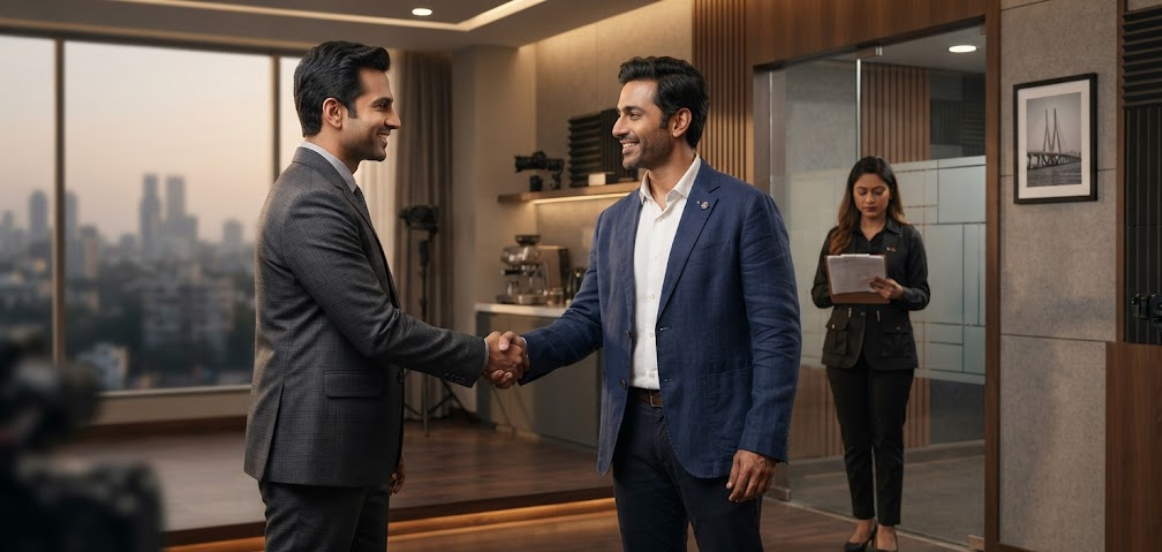
For creators in Mumbai, a professional podcast studio can also make it easier to bring guests into a controlled environment and create long-form and short-form content from the same session.
MW Stuudio provides two approaches: Studio Rental Only for experienced creators who bring their own production equipment and Studio Space + Production for clients who want the production team to manage the technical workflow from setup through final delivery.
That flexibility is useful because not every podcaster needs the same level of support.
Conclusion
The debate between a podcast studio vs home setup is ultimately a question of goals rather than simply cost.
A home setup gives you convenience, flexibility and control over your schedule. It can be ideal for beginners, solo creators and experienced podcasters who already have professional equipment.
A professional studio provides controlled acoustics, professional equipment, lighting, video capabilities and technical support. It becomes especially valuable when your podcast represents your business or personal brand.
Before making your decision, consider four questions:
What quality does my audience expect?
How often will I publish?
How much technical work am I willing to manage?
What content do I want to create beyond the podcast episode itself?
If your answer involves professional video, multiple guests, social-media clips and consistent brand presentation, a professional podcast studio may provide better overall value.
If you are experimenting with a new idea, a well-planned home setup may be the smarter place to begin.
And if your needs change, you can always move from one approach to the other—or combine both.
The best podcast setup is ultimately the one that allows you to focus on what matters most:
creating conversations your audience wants to hear and content your brand is proud to publish.