
Product photography is essential for e-commerce, but photographs cannot always communicate everything a potential customer wants to know.
A product video can show movement, size, texture, functionality, packaging, usage and real-world context within a few seconds. Instead of asking customers to imagine how a product works, video can demonstrate it.
This makes product video production an important part of modern marketing for e-commerce brands, D2C businesses, manufacturers, retailers and companies selling products through websites, marketplaces and social media.
For Mumbai businesses, professional product video production can also help create a consistent library of content that works across product pages, Instagram Reels, YouTube, advertisements, marketplaces and other digital channels.
The important point, however, is that a beautiful product video is not automatically a sales video.
A video designed to sell needs a clear objective, strong visual storytelling, useful product information, professional production and a logical next step for the viewer.
This guide explains how businesses can plan and produce product videos that do more than simply show the product—they help customers understand why they should consider buying it.
1. Why Product Videos Matter for Modern Businesses
Online customers cannot physically touch, hold or test most products before purchasing them.
This creates a gap between the physical shopping experience and the digital shopping experience.
Product videos can help reduce that gap.
A photograph can show what a product looks like from one angle. A video can demonstrate how it opens, moves, folds, operates, fits, pours, connects, shines, feels or performs.
Google also recommends product videos as a way to give shoppers deeper product information, and videos can create additional opportunities for discovery through Google Search.
For example, consider a skincare product.
A product photograph can show the packaging. A product video can show the bottle being opened, the texture of the product, the amount used and how it is applied.
The same principle works across categories.
Product videos can be particularly useful for:
- E-commerce products
- Fashion and apparel
- Jewellery
- Cosmetics and skincare
- Food and beverages
- Electronics
- Home products
- Furniture
- Fitness products
- Consumer goods
- Packaging products
- Lifestyle products
The goal is not necessarily to make every video cinematic or complicated.
The goal is to make the product easier to understand and more desirable.
2. Start With the Buying Decision, Not the Camera
One of the biggest mistakes brands make is starting product video production by thinking about cameras, lenses and lighting before deciding what the video needs to accomplish.
A better approach is to start with the customer.
Ask:
What does the customer need to understand before purchasing this product?
The answer should influence the entire video.
For example:
A jewellery brand may need to communicate craftsmanship, scale, shine and how the piece looks when worn.
A kitchen appliance may need to demonstrate functionality.
A skincare brand may need to show texture, application and usage.
A fashion brand may need to show fit, movement and fabric details.
A food brand may need to communicate freshness, texture and serving experience.
A technology product may need to demonstrate features and usability.
The production style should therefore follow the product’s selling proposition.
Before shooting, define:
- The target customer
- The main product benefit
- The biggest customer question
- The most important feature
- The desired emotional response
- The platform where the video will appear
- The action you want viewers to take
This prevents the final video from becoming a collection of attractive shots without a clear commercial purpose.
A product video should answer a simple question:
“Why should I care about this product?”
3. Choose the Right Type of Product Video
There is no single product video format that works for every business.
Different products require different visual approaches.
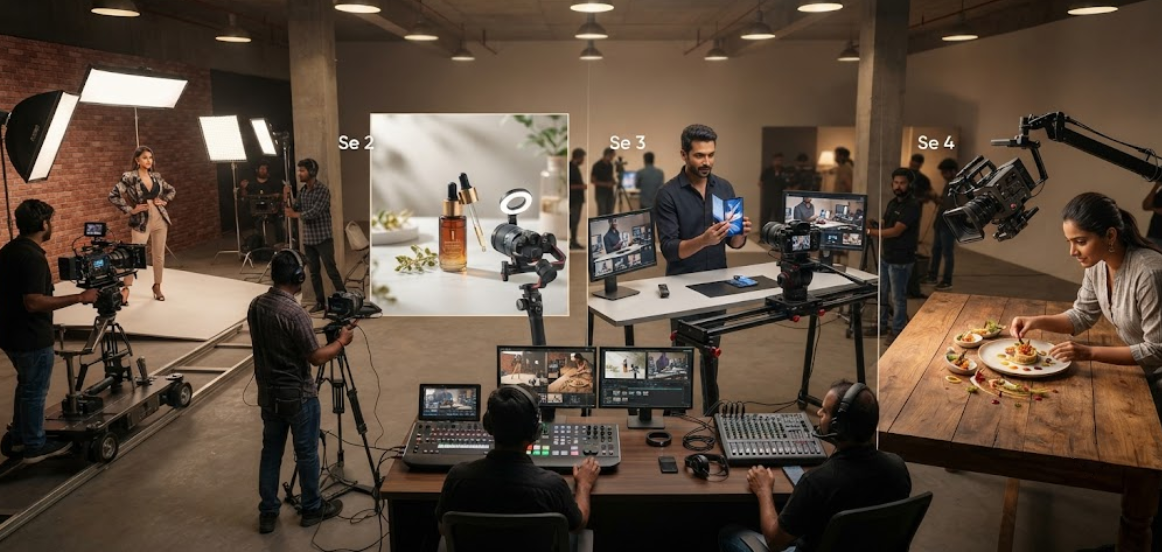
1. Product Demonstration Videos
These focus on how the product works.
They are useful for electronics, appliances, tools, beauty products, kitchen products and other functional items.
2. Product Lifestyle Videos
These place the product inside a realistic environment.
For example, a furniture product can be shown inside a modern home, while a fashion product can be shown being worn by a model.
3. Product Advertisement Videos
These are designed around a strong marketing message.
They often combine product visuals, lifestyle footage, close-ups, graphics, voice-over and a clear call to action.
4. Short Product Reels
These are designed for platforms where viewers consume short-form vertical content.
The opening seconds are particularly important because the viewer can quickly scroll away.
5. Unboxing Videos
These focus on packaging, presentation and the customer experience of receiving the product.
6. Feature Videos
These highlight specific product features or benefits.
7. 360-Degree Product Videos
These allow viewers to understand the product from multiple angles and can be particularly useful for physical products where shape and design matter.
4. Plan the Product Video Before the Shoot
Professional product videos are usually won during the planning stage.
The actual camera shoot is only one part of the production process.
A proper pre-production plan helps the team determine exactly what needs to be captured.
Start with a creative brief.
The brief should establish the product, audience, message, platform and desired outcome.
Then create a shot list.
A product shot list might include:
- Hero product shot
- Front view
- Side view
- Back view
- Detail close-up
- Texture shot
- Product in use
- Feature demonstration
- Packaging shot
- Lifestyle shot
- Hand interaction
- Before-and-after sequence
- Final product beauty shot
- Call-to-action frame
The exact list depends on the product.
A jewellery shoot, for example, may require macro details, model shots and movement. A food product may require preparation, pouring, cutting or serving shots.
A technical product may require demonstrations and explanatory sequences.
Planning also prevents unnecessary reshoots.
5. Use Lighting to Make the Product Look Its Best
Lighting has a major influence on product video quality.
Even an excellent product can look ordinary when it is poorly lit.
Professional product video production uses lighting to control highlights, shadows, reflections, texture and depth.
This is particularly important for reflective products.
Jewellery, glass, metal, cosmetics packaging and electronics can create unwanted reflections that need to be carefully managed.
Lighting should also reflect the brand and product category.
For example:
A jewellery video may require precise highlights and controlled reflections.
A food video may need to reveal texture and freshness.
A skincare video may require clean and detailed close-ups.
A fashion product may require lighting that accurately reveals fabric texture and colour.
A technology product may benefit from structured lighting that highlights shape and materials.
Professional lighting is therefore not simply about making the scene bright.
It is about making the product visually understandable.
The viewer should immediately be able to see:
What the product is, what it looks like and what makes it interesting.
6. Show the Product in Use
One of the most valuable things video can provide is context.
Instead of simply showing a product sitting on a table, show what happens when someone uses it.
This makes the video more informative and relatable.
For example:
A handbag can be shown being carried.
A chair can be shown being used.
A skincare product can be shown during a skincare routine.
A kitchen product can be shown preparing food.
A fitness product can be shown during exercise.
A piece of jewellery can be shown being worn.
A mobile accessory can be shown attached to a device.
A clothing product can be shown in movement.
This type of content answers practical questions that static photography may not fully address.
It can also help customers imagine themselves using the product.
7. Create Videos for Different Platforms
A common mistake is creating one video and expecting it to work perfectly everywhere.
Different platforms have different viewing behaviours.
A product video for an e-commerce product page may be horizontal or square depending on the platform.
Instagram Reels and many short-form platforms generally require vertical video.
YouTube may support longer demonstrations and product explainers.
Advertising campaigns may require several aspect ratios and durations.
Therefore, product video production should consider content distribution from the beginning.
A single shoot can potentially generate multiple versions.
For example, a brand could create:
- A 30–60 second product demonstration
- A short vertical Reel
- Several feature-focused clips
- A product-page video
- A lifestyle advertisement
- A short teaser
- A behind-the-scenes clip
- A longer YouTube demonstration
This approach makes the production investment more useful because the same shoot can create a broader content library.
8. Make the First Few Seconds Count
A product video has to earn the viewer’s attention quickly.
This is especially important for social media and advertising.
Instead of beginning with a long brand introduction, consider opening with the product or the problem it solves.
For example:
Problem: “Struggling with limited kitchen space?”
Then immediately demonstrate the product solving that problem.
Or:
Product: Start with a visually impressive close-up of the product being used.
Or:
Benefit: Demonstrate the most important benefit immediately.
The opening should create curiosity.
Strong product videos often follow a simple structure:
Attention → Problem → Product → Benefit → Proof → Action
Not every product requires exactly this structure, but the principle is useful.
The viewer should quickly understand why continuing to watch is worthwhile.
9. Focus on Product Details Customers Cannot See in Photos
Product video becomes especially valuable when it reveals details that photographs cannot communicate easily.
These details can include:
- Product movement
- Material texture
- Size and scale
- Flexibility
- Functionality
- Packaging
- Assembly
- Usage
- Sound
- Weight perception
- Product interaction
- Real-world application
For example, a furniture brand can show how a chair reclines.
A jewellery brand can show how a necklace moves when worn.
A cosmetic brand can show product texture.
A food brand can show the inside texture of a product.
A consumer electronics brand can demonstrate buttons, ports and functions.
A fashion brand can show fabric movement.
The video should therefore be designed around information value, not just visual beauty.
The viewer should finish the video knowing something they did not know before.
10. Edit the Video for Clarity and Conversion
Shooting good footage is only half the process.
Editing determines how that footage is experienced.
A product video should move at a pace appropriate for its platform and audience.
The editor may use:
- Clean cuts
- Product close-ups
- Slow-motion details
- Speed changes
- Transitions
- On-screen information
- Voice-over
- Music
- Sound effects
- Captions
- Motion graphics
- Product specifications
- Brand elements
However, editing should not become unnecessarily complicated.
Too many transitions, effects or graphics can distract from the product.
The most important information should remain easy to understand.
For e-commerce videos, concise editing is particularly useful because customers may be comparing several products.
Google’s current guidance also emphasizes high-quality video that is clear and useful, while Google Merchant Center recommends product videos that show products in use and have coherent structure, concise editing and smooth camera movement.
Conclusion
Product video production in Mumbai has become an important content requirement for brands that want to communicate products more effectively online.
Photos remain essential, but video adds another dimension.
It can demonstrate functionality, show movement, communicate scale, reveal texture, present products in real-world situations and answer questions that static images cannot always address.
The most successful product videos are not necessarily the most complicated ones.
They are the videos that understand the customer, communicate the product clearly and give viewers a reason to take the next step.
A strong production process begins with strategy, continues through scripting and shot planning, uses professional lighting and cinematography, and finishes with editing designed for the platform where the video will be consumed.
For Mumbai businesses, e-commerce brands and D2C companies, investing in a planned product video shoot can also create a reusable library of content for websites, marketplaces, social media and advertising.
Ultimately, the objective is simple:
Don’t just show the product. Show customers why the product matters.