

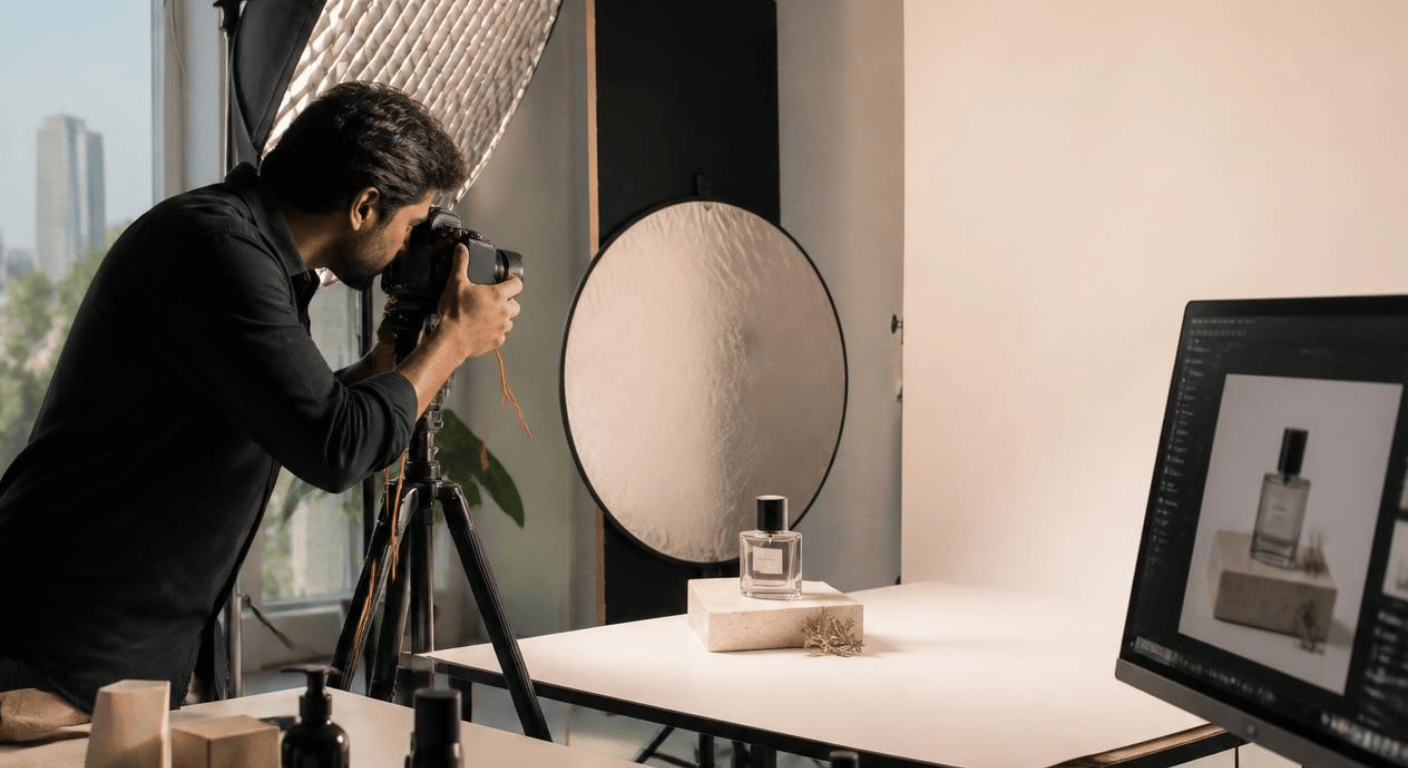
E-commerce has changed the way customers discover, compare and purchase products. A customer can now browse hundreds of products within minutes, compare prices, read reviews and make a purchase without ever physically seeing the product.
This creates a major challenge for online brands: how do you make a customer understand and trust a product through a screen?
One of the most important answers is professional product photography.
When customers cannot physically touch, hold or examine a product, images become one of their primary sources of information. Product photographs communicate the product’s appearance, size, shape, colour, texture, finish and overall presentation.
For an e-commerce brand, product photography is therefore not simply about making a website look attractive. It is part of the product communication and purchasing experience.
A professionally photographed product can help create a consistent visual identity, communicate important product details and make an online store appear more credible. Poor-quality images, on the other hand, can make even a good product appear less appealing or difficult to understand.
This is particularly important for brands selling on their own websites as well as marketplaces and social commerce platforms. Different channels may require different image formats, backgrounds, dimensions and visual styles.
Professional product photography can help businesses create a library of visual assets that can be used across product pages, websites, advertisements, social media, catalogues and other marketing channels.
MW Stuudio offers product photography as part of its broader creative production services, alongside model photography, video production, post-production and digital services. Its website describes experience across categories including e-commerce, fashion, food, jewellery, real estate and other commercial sectors. (mwsindia.in)
This article explains why professional product photography matters for e-commerce brands and what businesses should consider when planning a professional product shoot.
1. Product Images Create the First Impression
For many e-commerce customers, the product image is one of the first things they notice.
Before reading the complete description, checking specifications or scrolling through reviews, customers often look at the product photograph.
This means the visual presentation can influence how customers perceive the product and the brand.
A clean, professionally produced photograph can communicate:
- Attention to detail
- Product quality
- Brand professionalism
- Consistency
- Reliability
- Premium positioning
This does not mean every product needs an expensive or highly stylised photoshoot.
The photography style should match the product and target audience.
A luxury jewellery brand may require dramatic lighting and detailed close-ups. A stationery brand may benefit from bright, clean catalogue photography. A fashion brand may need both model photography and product-focused images.
The important point is consistency.
When all products on an e-commerce website follow a coherent visual style, the store can feel more organised and professional.
For growing brands, establishing this visual consistency early can also make future product launches easier.
2. Professional Photography Helps Customers Understand the Product
Online customers cannot physically examine a product.
They cannot pick it up, rotate it, feel its texture or inspect its finish.
High-quality product photography helps bridge this gap.
A strong product image should reveal meaningful details rather than simply making the product look attractive.
Depending on the product, customers may want to see:
- Front view
- Back view
- Side view
- Close-up details
- Texture
- Material
- Product dimensions
- Functional features
- Packaging
- Product in use
For example, a customer purchasing a handbag may want to see the interior, stitching, handles, material and dimensions.
Someone purchasing jewellery may want close-up images showing the finish, stones, chain details and clasp.
An electronics customer may need to understand ports, controls and physical dimensions.
Professional product photography can therefore become a form of visual product information.
The objective is to reduce uncertainty by showing customers the product as clearly and accurately as possible.
3. High-Quality Images Can Strengthen Brand Trust
Trust is particularly important in e-commerce.
A customer is purchasing something without physically visiting a store. The website, product page, reviews, descriptions and photographs must collectively provide enough confidence to make the purchase.
Professional photography can contribute to that visual trust.
Consider the difference between a product photographed casually with inconsistent lighting and a product photographed professionally with controlled lighting, accurate colour and careful composition.
The second presentation can communicate greater attention to detail.
Professional product photography can help communicate:
- Consistent visual quality
- Product authenticity
- Attention to detail
- Brand identity
- Professional presentation
- Product transparency
This is especially important for new brands.
A customer may not know the company yet. The quality of its website and product presentation can therefore become part of the customer’s first interaction with the brand.
Professional photography cannot guarantee a sale, but it can help create a more credible and informative product presentation.
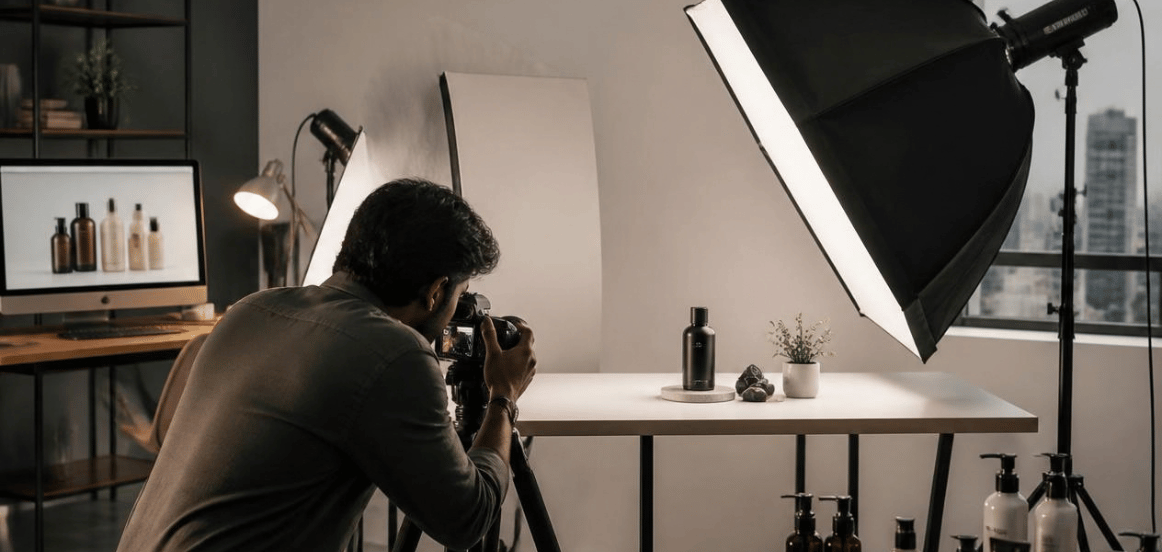
4. Consistent Product Photography Creates a Stronger E-Commerce Store
Imagine visiting an online store where every product has a different background, lighting style, image ratio and colour treatment.
Even if the products themselves are excellent, the website may feel inconsistent.
Now imagine the same store where every product follows a clear photography system.
The backgrounds, lighting, framing and image dimensions are consistent.
The overall shopping experience becomes more organised.
A product photography system can define:
- Background style
- Lighting direction
- Camera angle
- Product positioning
- Image ratio
- Colour treatment
- Shadow style
- Retouching approach
- Number of images per product
Creating these standards is particularly useful for growing e-commerce businesses.
When new products are added, photographers can follow the same visual guidelines.
This creates consistency across the catalogue and makes the brand easier to recognise.
For brands with hundreds of SKUs, establishing a repeatable photography workflow can also make future product shoots more efficient.
5. Different Products Need Different Photography Techniques
There is no single product photography style that works for every category.
A photographer needs to understand the characteristics of the product and the way customers interact with it.
Jewellery may require macro photography and controlled reflections.
Food photography may focus on texture, freshness and styling.
Fashion products may require model photography.
Electronics may benefit from clean technical shots and lifestyle scenes.
Home décor may require environmental photography to show scale and context.
Common product photography approaches include:
- White-background photography for clean catalogue presentation.
- Lifestyle photography showing products in real-world environments.
- Model photography for apparel, accessories and wearable products.
- Creative photography for campaigns and advertising.
- Detail photography for texture, craftsmanship and small product features.
- 360-degree photography where customers benefit from seeing multiple angles.
The correct approach depends on the product, platform and marketing objective.
A professional studio can help determine which visual style is appropriate rather than using the same setup for every product category.
MW Stuudio lists product photography, model photography and commercial photography among its creative services. (mwsindia.in)
6. Product Photography Supports Multiple Marketing Channels
One professional product shoot can create visual assets for more than just the product page.
E-commerce brands often need images for multiple platforms.
Product photographs can be used for:
- E-commerce websites
- Amazon and other marketplaces
- Google Shopping
- Digital advertisements
- Email campaigns
- Brochures
- Catalogues
- Website banners
- Promotional campaigns
This makes professional photography a reusable content investment.
For example, a brand could photograph a new product using both clean catalogue shots and lifestyle images.
The catalogue images can be used on product pages, while lifestyle images can be used in social media campaigns and advertising.
The same visual assets can therefore support multiple stages of the customer journey.
When planning a photoshoot, brands should think beyond the immediate requirement and consider how the photographs can be repurposed.
7. Lifestyle Photography Helps Customers Visualise the Product
Catalogue photography answers the question:
“What does the product look like?”
Lifestyle photography can help answer:
“What will this product look like in my life?”
This difference is particularly important for certain categories.
For example:
A furniture brand can show a chair inside a beautifully designed room.
A jewellery brand can show a necklace worn by a model.
A fashion brand can show clothing in a realistic setting.
A food brand can show the product served in an appealing environment.
Lifestyle images provide context.
They can communicate scale, usage, atmosphere and brand personality.
Lifestyle photography can demonstrate:
- Product usage
- Product scale
- Environment
- Styling
- Brand personality
- Customer experience
However, lifestyle photography should generally complement rather than completely replace clear product photographs.
Customers still need straightforward images that allow them to inspect the actual product.
Combining catalogue and lifestyle photography can provide a more complete visual experience.
8. Professional Retouching Can Improve the Final Presentation
Photography does not always end when the camera stops recording.
Post-production is an important part of commercial product photography.
Professional retouching can correct technical issues while maintaining an accurate representation of the product.
Depending on the project, post-production may include:
- Background cleanup
- Dust removal
- Colour correction
- Exposure adjustment
- Shadow refinement
- Reflection control
- Skin retouching for model photography
- Image cropping
- Background removal
- Colour consistency
- Final export preparation
The objective should not be to make a product look unreal.
For e-commerce, accuracy matters.
If the product colour appears significantly different online from the actual product, customers may become disappointed after receiving it.
Professional post-production should therefore balance visual appeal with accurate product representation.
MW Stuudio provides post-production services alongside photography and video production, supporting the editing and finishing stages of commercial content. (mwsindia.in)
9. Good Photography Can Support Better Product Pages
Product photography works best when it is part of a well-designed product page.
A customer typically needs several types of information before purchasing:
- Product photographs
- Product title
- Description
- Price
- Specifications
- Size or dimensions
- Materials
- Delivery information
- Returns policy
- Reviews
Images should work together with this information.
For example, if a product has an unusual feature, the photograph can highlight it while the product description explains it.
If size is important, an image can show the product in context.
If texture is important, a close-up photograph can provide visual evidence.
This makes photography part of the broader customer experience rather than an isolated design element.
For e-commerce businesses, the question should therefore not simply be:
“Do we have product photos?”
It should be:
“Do our product photos answer the customer’s most important questions?”
10. Professional Photography Can Help E-Commerce Brands Build a Recognisable Visual Identity
Successful brands are often recognised through their visual language.
Think about the colours, photography style, composition and product presentation customers associate with a brand.
Product photography contributes to this visual identity.
A brand may choose:
- Minimal white backgrounds
- Warm lifestyle photography
- Dark luxury photography
- Bright colourful compositions
- Natural environmental photography
- Editorial fashion styling
The important thing is consistency.
When the same photography language appears across product pages, social media, advertisements and campaigns, customers can begin to associate that visual style with the brand.
A strong photography identity should consider:
- Backgrounds
- Lighting
- Composition
- Props
- Colour palette
- Camera angles
- Retouching
- Model styling
- Brand mood
This becomes particularly important when a business has multiple products and marketing channels.
Professional photography can therefore become part of brand-building rather than simply product documentation.
Conclusion
Professional product photography has become an important part of e-commerce because customers cannot physically interact with products before purchasing them.
High-quality images can help customers understand what a product looks like, inspect important details and visualise how it can be used. Consistent photography can also contribute to a stronger brand identity and a more professional online shopping experience.
For growing e-commerce brands, photography should not be treated as a one-time requirement. It can become part of a repeatable content system.
Catalogue images can support product pages. Lifestyle images can support social media and campaigns. Model photography can strengthen fashion and lifestyle brands. Product videos can demonstrate features and create additional content for social platforms.
Post-production also plays an important role by ensuring images are clean, consistent and appropriately prepared for different channels.
The key is to plan the shoot around the customer’s needs and the brand’s wider marketing strategy.
When choosing a product photography studio, review its portfolio, equipment, experience, production process, post-production capabilities, turnaround time and understanding of your product category.
MW Stuudio provides product photography alongside model photography, video production and post-production, allowing e-commerce brands to explore multiple types of visual content through one creative ecosystem. (mwsindia.in)
Ultimately, professional product photography is not just about creating beautiful images. It is about communicating products clearly, presenting the brand consistently and giving customers better visual information when making an online purchase.