

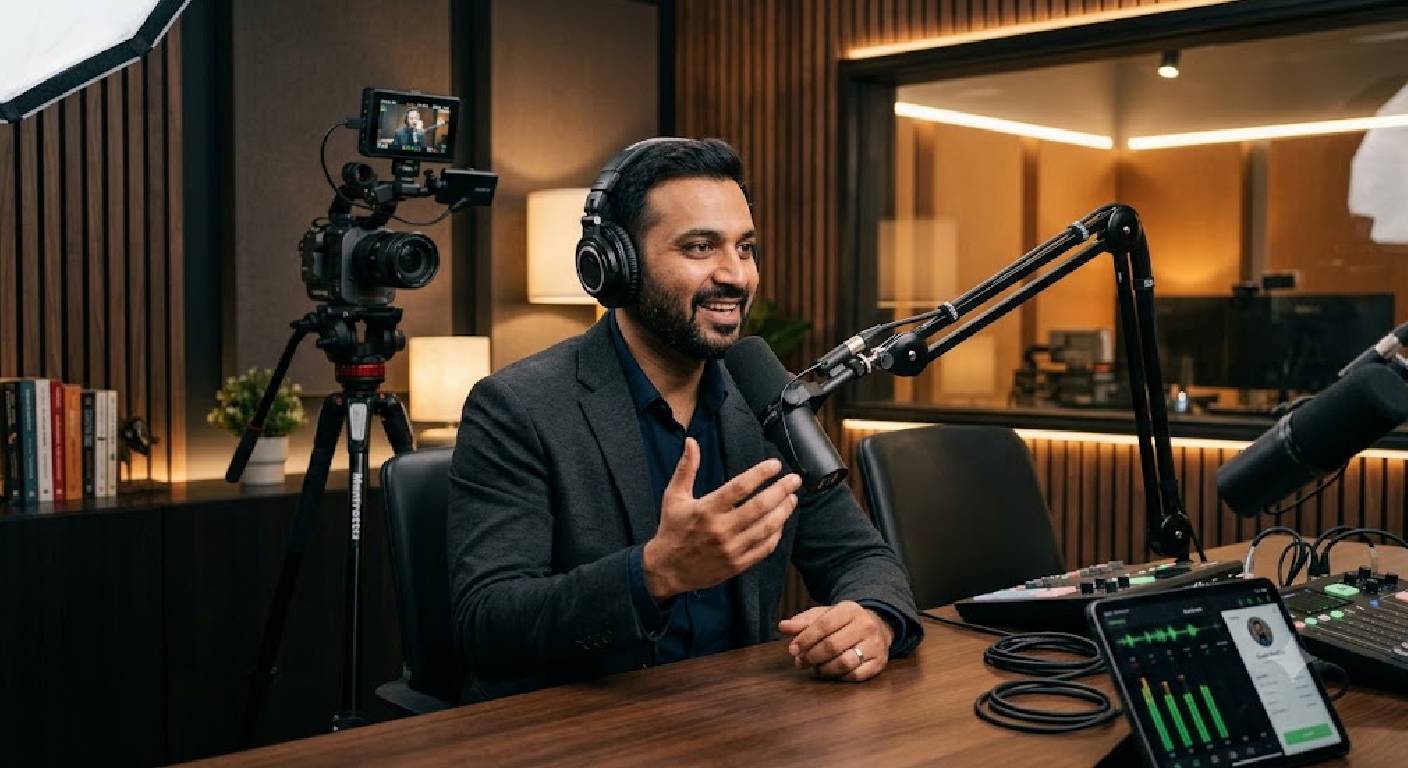
Podcasts have become an increasingly useful format for businesses that want to communicate expertise, share ideas, and develop stronger relationships with their audience.
Unlike short promotional content, a podcast gives businesses the space to discuss subjects in greater depth. A founder can explain how an industry works. A consultant can answer common customer questions. A healthcare professional can discuss general educational topics. A technology company can interview experts about emerging trends. An e-commerce founder can talk about lessons learned while building a brand.
This makes podcasting more than an entertainment format. When planned strategically, it can become part of a company’s broader content and brand-building system.
Industry authority is not created simply by recording a podcast. It develops through useful information, consistent publishing, credible conversations, professional presentation, and a clear understanding of the audience.
A professional production environment can also make it easier for businesses to maintain quality across multiple episodes. MW Stuudio, which started as a podcast and audio-focused studio in Borivali in 2019, now offers podcast production alongside photography, video production, post-production, web development, SEO, and digital marketing.
So, how can businesses use podcasts to build industry authority?
1. Start With a Clear Industry Position
Before recording the first episode, a business should understand what it wants to become known for.
A podcast without a clear direction can quickly become a collection of unrelated conversations. That may make it difficult for listeners to understand why they should continue following the show.
Instead, define a specific area of expertise.
For example:
- A real estate company could discuss property investment and development.
- A digital marketing agency could discuss SEO, advertising, content, and branding.
- A financial professional could discuss business finance and financial planning.
- A healthcare professional could discuss general health education.
- A technology company could discuss technology trends and business applications.
- A fashion brand could discuss design, consumer behaviour, and the fashion industry.
The objective is not to talk about everything the business knows.
The objective is to consistently discuss subjects that connect the company’s expertise with the interests and problems of its target audience.
A clear podcast position also makes episode planning easier.
Once you know what you want to be recognised for, you can create recurring themes, invite relevant guests, and develop a stronger content identity.
2. Choose Topics That Solve Real Audience Problems
Authority comes from being useful.
A business podcast should not simply talk about the company.
Instead, focus on questions, challenges, decisions, trends, and problems that your audience genuinely cares about.
Start by listing the questions customers ask your business repeatedly.
For example:
A website development company may receive questions about website cost, technology choices, SEO, website speed, security, and e-commerce.
A photographer may frequently explain product photography, lighting, preparation, styling, and image requirements.
A business consultant may answer questions about hiring, growth, operations, leadership, and strategy.
These questions can become podcast episodes.
A useful approach is to divide topics into three categories:
Beginner topics:
Questions someone asks when they are first learning about the subject.
Intermediate topics:
Problems faced by people who already understand the basics.
Advanced topics:
Strategic discussions for experienced professionals.
This creates a content journey that can serve different parts of your audience.
3. Turn Expertise Into Educational Conversations
One of the strongest uses of a business podcast is education.
Businesses already have knowledge that customers need.
The podcast creates a format for sharing that knowledge.
Instead of saying:
“We provide professional SEO services.”
A business could discuss:
“Why websites receive traffic but still fail to generate enquiries.”
Instead of:
“We create professional product videos.”
A business could discuss:
“What makes an e-commerce product video useful for online shoppers?”
This difference matters.
The first approach focuses on selling.
The second focuses on helping.
Educational conversations can demonstrate expertise without making every episode sound like an advertisement.
Over time, listeners may begin associating the business with useful information within its field.
That association can support brand credibility.
4. Invite Experts and Industry Professionals
A business does not have to build every episode around its own team.
Guest interviews can introduce different perspectives to the podcast.
Depending on the industry, guests could include:
- Founders
- Consultants
- Industry specialists
- Researchers
- Designers
- Creators
- Authors
- Investors
- Educators
- Technology professionals
- Existing customers
- Business partners
The guest should be selected because they can contribute something meaningful to the audience.
A strong guest conversation can explore their experience, lessons, mistakes, opinions, processes, and observations.
It also creates an opportunity for the host to ask questions that the audience might want answered.
Over time, a guest-based podcast can become a network of industry conversations rather than simply a promotional channel for one company.

5. Prepare Better Questions Before Every Episode
Good podcast conversations usually require preparation.
Even when the format is conversational, the host should understand the guest and the subject before recording.
Research can cover:
- Guest background
- Professional experience
- Current projects
- Industry expertise
- Important achievements
- Relevant challenges
- Recent developments
- Audience questions
- Potential controversial or interesting topics
Instead of asking only generic questions such as:
“Tell us about yourself.”
Prepare questions that encourage detailed answers.
For example:
- What problem were you trying to solve?
- What did you initially get wrong?
- What changed your approach?
- What should businesses stop doing?
- What is a common misconception about your industry?
- What would you recommend to someone starting today?
- What trend do you think businesses should pay attention to?
These questions can create more informative conversations.
A professional podcast does not necessarily need a rigid script, but it does need direction.
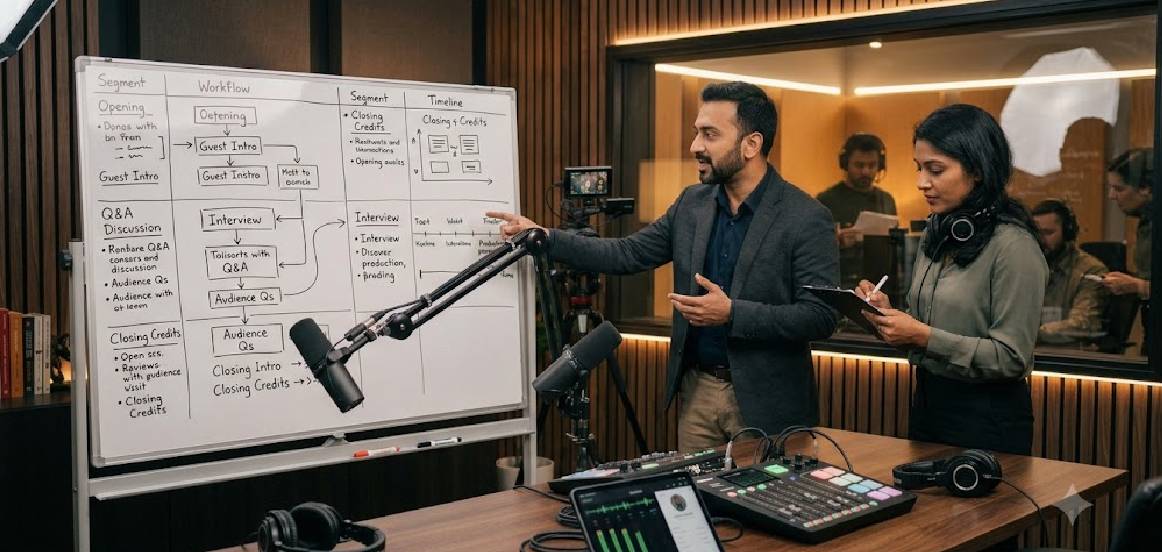
6. Build a Consistent Podcast Format
Consistency helps audiences understand what to expect.
A business podcast can develop a repeatable episode structure.
For example:
Opening
Introduce the topic and guest.
Context
Explain why the subject matters.
Main discussion
Explore the topic through questions and examples.
Practical insights
Ask the guest for actionable advice.
Quick questions
Finish with a short recurring segment.
Closing
Summarise the discussion and direct listeners toward the next episode.
The format does not need to be identical in every episode.
However, having a basic structure helps the host prepare and makes production more efficient.
It also gives the podcast a recognisable identity.
MW Stuudio offers podcast consultation covering ideation and execution, along with recording, editing, sound design, branding, thumbnails, show notes, and distribution support.
7. Invest in Professional Audio Quality
The audience may forgive a simple background.
Poor audio is much harder to ignore.
Podcast listeners need to clearly understand every speaker.
Common audio problems include:
- Echo
- Background noise
- Uneven volume
- Microphone distortion
- Excessive room sound
- Clothing noise
- Poor microphone placement
- Unbalanced speakers
A controlled recording environment helps reduce these problems.
MW Stuudio describes its podcast setup as including acoustic treatment, broadcast-grade condenser microphones, professional audio interfaces, multi-camera video capability, and studio lighting.
Professional audio does not mean every podcast needs an expensive production.
It means the recording environment and equipment should be appropriate for the intended quality level.
Clear audio helps the audience concentrate on the conversation rather than the recording problems.
8. Use Video to Expand the Podcast’s Content Potential
Modern podcasts can be produced as both audio and video content.
A video podcast creates additional opportunities for distribution.
The complete conversation can become a long-form video.
Individual moments can become short clips.
Useful statements can become social media posts.
Questions can become short educational videos.
Guest insights can become quote graphics or written content.
This means one recording session can create multiple types of content.
Video also gives audiences the opportunity to see facial expressions, body language, demonstrations, and interactions between the host and guest.
MW Stuudio provides multi-camera video podcast production alongside its audio setup, allowing podcast conversations to be recorded as video content as well.
9. Create a Strong Visual Identity for the Podcast
Authority is not only about what you say.
Presentation also matters.
A podcast should have a recognisable visual identity.
This can include:
- Podcast logo
- Cover artwork
- Thumbnail style
- Intro and outro graphics
- Lower thirds
- Background design
- Colour palette
- Typography
- Host and guest framing
- Episode artwork
The visual identity should match the wider brand.
For example, a premium consulting firm may use a clean editorial visual style.
A technology company may use a modern minimal visual system.
A creative business may choose a more expressive visual identity.
Consistency makes episodes feel like parts of the same series.
It also makes the podcast easier to recognise when people encounter clips on different platforms.
10. Use Stories and Real Experiences Instead of Only Facts
Facts are useful.
Stories make information easier to remember.
A business podcast can become more engaging when hosts and guests discuss real experiences.
For example:
- A business mistake
- A difficult project
- A failed strategy
- A successful launch
- A customer challenge
- A major business decision
- A change in the industry
- A lesson learned from experience
Consider the difference between:
“Customer experience is important.”
and:
“We once lost a major customer because our onboarding process took too long. That experience changed how we designed our entire process.”
The second statement provides context.
It gives the audience something concrete to understand.
Real experiences can also make experts sound more human.
This balance between expertise and personal experience can make a podcast more memorable.
11. Turn Each Episode Into Multiple Content Assets
A podcast should not end when the episode is uploaded.
One long-form conversation can become a larger content package.
For example, a 45-minute episode could produce:
- One full podcast episode
- Several short video clips
- Multiple Instagram Reels
- YouTube Shorts
- LinkedIn posts
- Quote graphics
- Blog content
- Newsletter material
- Website content
- Episode highlights
- Educational clips
- Guest promotional content
This is where podcasting becomes more powerful as a business content system.
The original recording becomes the source material.
Post-production then turns that source material into platform-specific content.
MW Stuudio provides post-production services including video editing, colour grading, sound design, motion graphics, subtitles, thumbnail design, and related content preparation.
A business can therefore plan each episode not as one piece of content, but as the beginning of a larger content package.
12. Publish Consistently Instead of Treating the Podcast as a One-Time Campaign
A single podcast episode is unlikely to establish a strong industry presence by itself.
Authority usually develops through repeated exposure to useful information.
That means businesses should create a realistic publishing schedule.
Depending on resources, a podcast could publish:
- Weekly
- Every two weeks
- Monthly
The schedule matters less than whether the business can maintain it.
Consistency also becomes easier when episodes are recorded in batches.
For example, a business could plan several episodes around a single production day.
This allows the team to prepare guests, topics, equipment, branding, and production requirements together.
Batch production can also create a larger library of content for future editing and distribution.
MW Stuudio supports both studio rental and fully managed podcast production, which can accommodate different levels of production involvement.
13. Connect Podcast Content With Your Website
A podcast should not exist only on social media or podcast platforms.
Your website can become the central home for the podcast.
Create a dedicated podcast section containing:
- Episode pages
- Guest information
- Episode summaries
- Key discussion points
- Embedded video or audio
- Useful resources
- Related services
- Contact opportunities
- Links to previous episodes
You can also create written content from important episodes.
For example, an episode discussing e-commerce strategy could become a detailed article.
An interview with an industry expert could become a case-study-style article.
An educational conversation could become a guide.
This creates opportunities for the podcast to support your wider website content strategy.
It also gives visitors another way to understand the expertise behind the business.
MW Stuudio combines podcast production with website development, SEO, content writing, and digital marketing, making this type of connected content workflow particularly relevant for businesses building a broader digital presence.
14. Measure Which Topics and Conversations Perform Better
A podcast should not be evaluated only by the number of episodes published.
Businesses should look at what audiences actually respond to.
Useful indicators can include:
- Episode views
- Listening activity
- Average watch time
- Audience retention
- Downloads
- Subscribers
- Comments
- Shares
- Saves
- Website visits
- Enquiries
- Guest referrals
- Traffic generated by podcast content
The goal is not to chase numbers blindly.
Instead, use audience behaviour to understand which subjects deserve more attention.
Suppose episodes about practical business problems consistently generate more engagement than general industry discussions.
That may suggest that future episodes should include more problem-solving content.
If interviews with specific types of experts perform well, the business could develop a recurring guest format.
Analytics can turn podcasting from guesswork into an evolving content strategy.
15. Build the Podcast Into a Long-Term Authority Strategy
The most important step is to think beyond individual episodes.
A podcast can become one part of a larger authority-building system.
A long-term strategy could look like this:
Podcast
Long-form conversations and expert discussions.
Video
Full episodes and short-form clips.
Social Media
Educational clips, quotes, insights, and discussions.
Website
Episode pages, articles, resources, and service connections.
SEO
Useful written content targeting relevant questions and topics.
Episode announcements, insights, summaries, and resources.
Networking
Guest relationships and industry conversations.
Brand Building
Consistent positioning around specific areas of expertise.
This creates a connected content ecosystem.
The podcast becomes the source.
The other platforms become distribution channels.
Over time, the business can build a library of conversations that demonstrates its knowledge and perspective.
The key is to avoid treating authority as something that can be manufactured through production quality alone.
A beautiful studio cannot replace useful ideas.
Professional cameras cannot replace expertise.
Good editing cannot replace a meaningful conversation.
Production quality supports the message, but the message must come first.
MW Stuudio’s broader model reflects this connection between production and digital distribution: its services span podcast production, video, photography, post-production, website development, SEO, digital marketing, and content writing.
Conclusion
A business podcast can become a valuable long-term content asset when it is built around genuine expertise and audience needs.
The objective should not simply be to publish conversations.
The objective should be to create useful conversations that demonstrate knowledge, introduce credible people, answer customer questions, explore industry problems, and provide practical insights.
Businesses can use podcasts to:
- Explain complex subjects
- Share professional experience
- Interview industry experts
- Answer customer questions
- Demonstrate expertise
- Build a recognisable content identity
- Create long-form video
- Generate short-form social content
- Support website content
- Strengthen professional relationships
- Build a reusable content library
Professional production can support this strategy by improving audio, video, lighting, editing, branding, and overall presentation.
But the foundation remains simple:
Choose a clear subject.
Understand your audience.
Share genuinely useful information.
Invite people who add value.
Publish consistently.
Repurpose intelligently.
Learn from audience response.
A podcast does not need to become successful overnight to be useful to a business. Its long-term value can come from consistently building a library of useful conversations that audiences can discover, watch, listen to, and share.
For businesses that want to turn podcasting into a structured content system, working with a professional production team can also make the process more manageable—from planning and recording through editing, video production, branding, and content repurposing.
MW Stuudio offers end-to-end podcast services, including recording, audio and video production, consultation, editing, sound design, branding, thumbnails, show notes, and distribution support.