
When a business plans a professional photoshoot, one of the first decisions is often where the shoot should take place.
Should you book a professional photography studio or photograph your products, people or brand at your actual business location?
The answer depends on what you want the photographs to communicate.
A Photography Studio vs On-Location Shoot comparison is not simply about choosing an indoor or outdoor space. It involves considering lighting, background control, brand identity, logistics, equipment, production time, weather, privacy and the type of content you need.
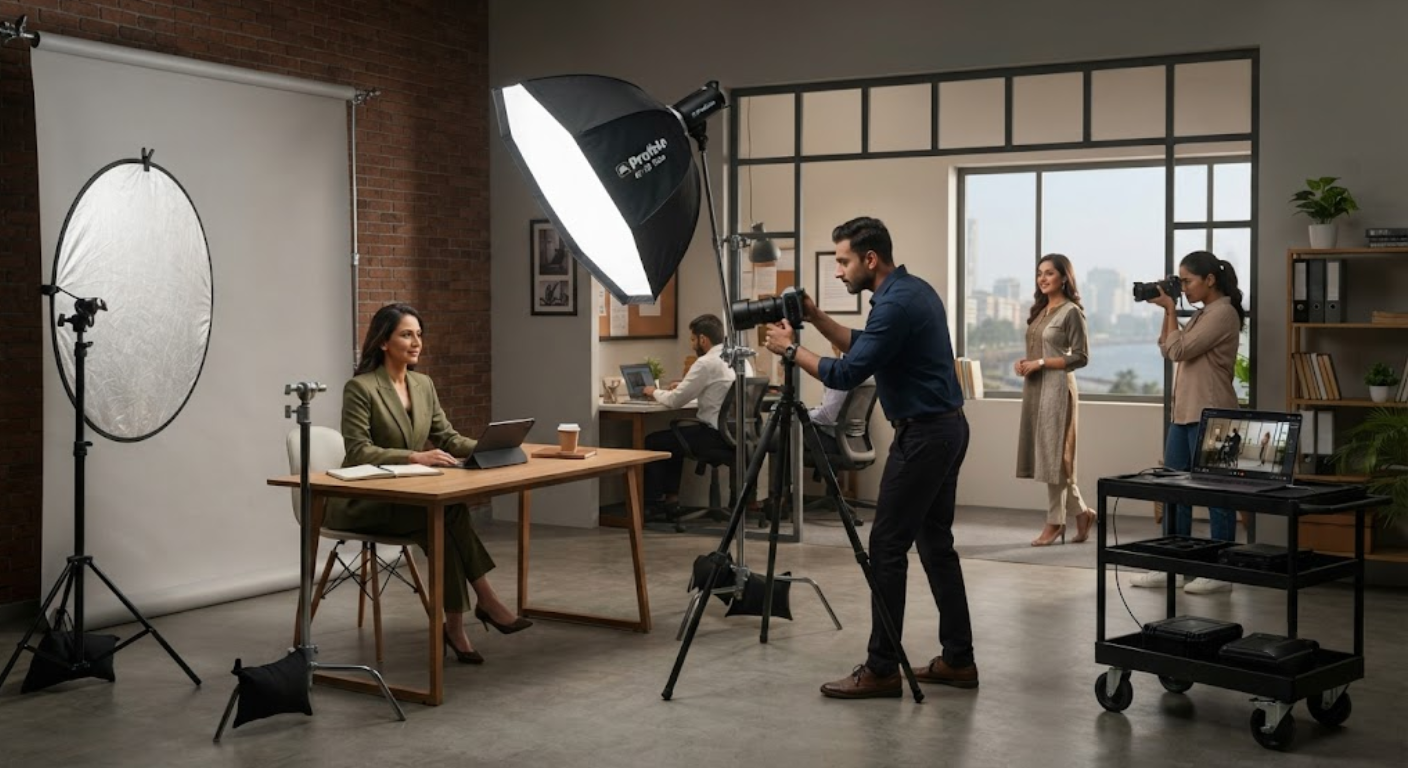
A photography studio provides a controlled environment where the production team can carefully manage lighting, backgrounds, camera positioning and the overall visual presentation.
An on-location shoot provides something different: context.
Your office, showroom, restaurant, factory, retail store or outdoor environment can become part of the visual story.
Both approaches can produce professional results when planned correctly.
For some brands, a controlled photography studio will make the production process more efficient. For others, an authentic location may be essential because the environment itself communicates something important about the business.
This guide compares Photography Studio vs On-Location Shoot across the most important factors so businesses can understand which production approach may suit a particular project.
1. What Is a Photography Studio Shoot?
A photography studio is a controlled environment specifically designed for professional photography and content production.
Studios can be used for:
- Product photography
- Model photography
- Personal branding
- Corporate portraits
- E-commerce photography
- Fashion photography
- Food photography
- Catalogue photography
- Advertising photography
- Social media content
One of the biggest advantages of a studio is control.
The production team can control the background, lighting, camera position and shooting environment without dealing with many of the unpredictable factors found at external locations.
A studio can also be configured for different visual styles.
For example, the same space can potentially be used for a clean catalogue setup, professional founder portraits, lifestyle photography or social media content by changing the background, lighting and props.
This flexibility makes studio photography particularly useful when consistency is important.
2. What Is an On-Location Photography Shoot?
An on-location shoot takes place at a real-world environment rather than inside a dedicated photography studio.
The location could be:
- Company office
- Restaurant
- Retail store
- Factory
- Showroom
- Hotel
- Outdoor space
- Construction site
- Café
- Clinic
- Studio workspace
- Customer location
The main advantage is context.
The environment becomes part of the photograph.
For example, a founder photographed inside their office communicates a different story from a founder photographed against a plain studio background.
A restaurant photographed inside its actual dining environment can show atmosphere, interiors and customer experience.
A manufacturing company can photograph employees working around machinery.
A fashion brand can photograph models in an environment that matches the campaign concept.
On-location photography can therefore be especially useful when the physical environment is an important part of the brand story.
3. Photography Studio vs On-Location Shoot: Control Over Lighting
Lighting is one of the most important differences when comparing Photography Studio vs On-Location Shoot.
In a professional photography studio, lighting can be carefully controlled.
Photographers can use:
- Softboxes
- Strobe lights
- Continuous lights
- Reflectors
- Diffusers
- Grids
- Light modifiers
- Background lighting
This allows the photographer to create a consistent visual appearance.
On location, lighting conditions can be more complicated.
Natural light may change throughout the day.
Windows can create unwanted highlights.
Outdoor conditions can change quickly.
Different parts of an office may have different lighting temperatures.
Professional photographers can manage many of these challenges using portable equipment, but the location itself still introduces variables.
Studio Lighting Advantages
- Greater control
- Consistent exposure
- Repeatable setups
- Controlled shadows
- Predictable results
On-Location Lighting Advantages
- Natural environment
- Authentic atmosphere
- Natural daylight
- Environmental context
Neither approach is automatically better.
The right choice depends on whether visual control or environmental authenticity is more important for the project.
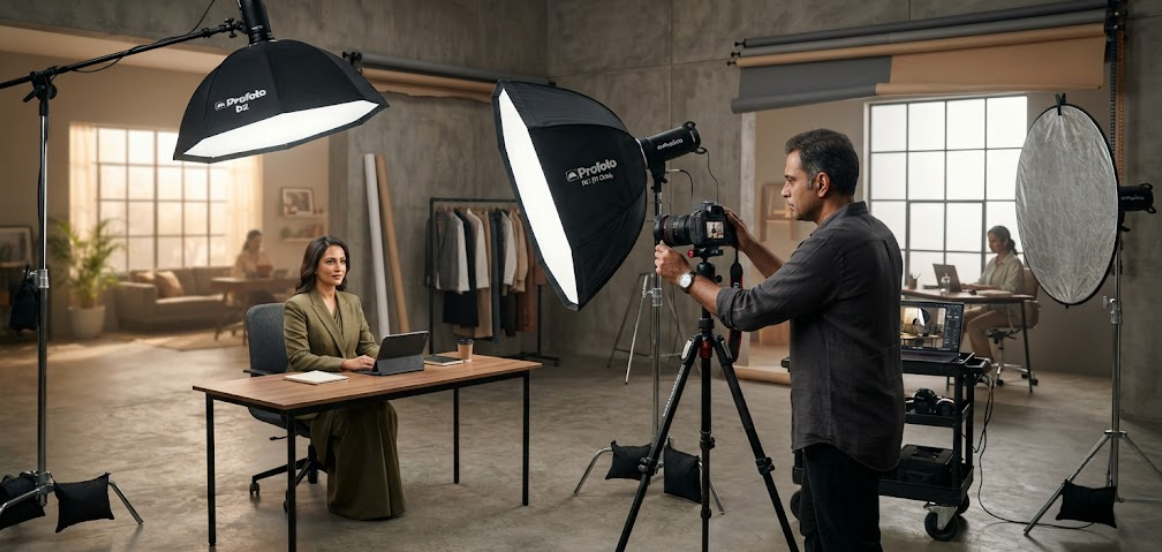
4. Background Control and Visual Consistency
Another major consideration in the Photography Studio vs On-Location Shoot decision is background control.
A studio provides a predictable background.
Depending on the project, photographers can use:
- White backgrounds
- Grey backgrounds
- Black backgrounds
- Coloured backgrounds
- Textured backgrounds
- Seamless paper
- Fabric backdrops
- Custom sets
This is particularly useful for product photography and e-commerce because products need consistent presentation.
On location, the background is part of the environment.
This can make photographs more interesting but also introduces distractions.
The photographer may need to manage:
- People moving in the background
- Unwanted objects
- Reflections
- Clutter
- Signage
- Inconsistent colours
- Uneven lighting
For lifestyle and storytelling photography, these environmental elements may actually be valuable.
Therefore, background requirements should be considered before selecting the shooting environment.
5. Which Option Is Better for Product Photography?
Product photography often benefits from controlled conditions.
A studio allows the photographer to carefully manage:
- Product placement
- Lighting
- Reflections
- Shadows
- Background
- Camera angle
- Colour accuracy
- Consistency
This can be particularly important when photographing large product catalogues.
For example, an e-commerce brand may need hundreds of products photographed using similar compositions.
A controlled photography studio can make it easier to maintain consistency across the entire collection.
However, on-location photography can also be useful for lifestyle product images.
A product can be photographed in an environment where customers would realistically use it.
For example:
A coffee product could be photographed in a kitchen.
Furniture could be photographed in an interior environment.
Sports equipment could be photographed in an active setting.
Skincare products could be photographed in a lifestyle environment.
Therefore, many product campaigns can benefit from combining studio product photography with selected on-location lifestyle images.
6. Which Option Is Better for Personal Branding and Founder Photography?
For founders and professionals, the choice depends on the type of personal brand they want to communicate.
A studio can create polished professional portraits with controlled lighting and backgrounds.
This works well for:
- LinkedIn profiles
- Company websites
- Press profiles
- Speaker profiles
- Professional headshots
- Corporate presentations
An on-location shoot can provide more environmental storytelling.
For example, a founder could be photographed:
- In their office
- With their team
- Working on a product
- Meeting clients
- Reviewing documents
- Walking through their workspace
This gives the audience more information about the founder’s professional world.
For many businesses, combining studio portraits with on-location lifestyle photographs can create a more complete personal branding library.
7. Consider Travel, Logistics and Production Time
Production logistics are an important part of the Photography Studio vs On-Location Shoot decision.
A studio provides a dedicated environment where equipment can be set up once and used throughout the shoot.
On location, the production team may need to transport:
- Cameras
- Lighting
- Tripods
- Backgrounds
- Reflectors
- Props
- Power equipment
- Styling equipment
Travel time also needs to be considered.
If the shoot involves multiple locations, the production schedule can become more complicated.
Traffic, parking, access restrictions and setup time can affect the production.
For Mumbai businesses, travel between locations can also require careful scheduling.
A studio can simplify logistics when the required visual environment can be created indoors.
On the other hand, if the location itself is essential to the story, the additional logistics may be worthwhile.
8. Weather and Environmental Conditions
Weather is another factor when comparing Photography Studio vs On-Location Shoot.
Indoor studios provide protection from:
- Rain
- Strong sunlight
- Wind
- Humidity
- Outdoor noise
- Unexpected weather changes
This can make scheduling more predictable.
Outdoor photography, however, can provide visual opportunities that are difficult to recreate indoors.
Natural landscapes, streets, architecture and outdoor environments can become part of the brand story.
The challenge is that outdoor conditions can change.
For this reason, outdoor shoots should have contingency plans.
Consider:
- Backup dates
- Alternative indoor locations
- Weather monitoring
- Equipment protection
- Lighting adjustments
For important campaigns with fixed deadlines, environmental predictability can be an important consideration.
9. Brand Storytelling and Authenticity
Not every photograph needs to look like it was created inside a studio.
Sometimes authenticity is more valuable.
An on-location shoot can communicate the environment where the business actually operates.
For example:
A restaurant can show its dining atmosphere.
A manufacturing business can show its production process.
A retail brand can show its store.
A design company can show its creative workspace.
A founder can be photographed working with their actual team.
These photographs can create stronger context.
However, authenticity does not mean poor production quality.
Professional lighting, composition and photography skills are still important.
An experienced photographer can preserve the natural character of the location while making the final image look polished.

10. Photography Studio vs On-Location Shoot for Social Media Content
Social media content often benefits from variety.
A studio can provide clean, consistent photographs and videos that can be reused across different campaigns.
On-location shoots can add environmental variety and make social content feel more connected to the real business.
For example, a brand could combine:
- Studio portraits
- Product photographs
- Founder videos
- Office lifestyle photographs
- Behind-the-scenes images
- Team photographs
- Customer interaction shots
This approach creates a broader content library.
Instead of asking whether a studio or location is always better, businesses can ask:
What combination of environments gives us the content we actually need?
A single production day can sometimes include both controlled studio content and selected location-based photographs.
11. Cost, Budget and Production Requirements
Budget should be considered as part of the overall production plan.
The cost of a photoshoot can depend on:
- Photographer
- Crew size
- Studio rental
- Location fees
- Equipment
- Models
- Styling
- Props
- Travel
- Production time
- Editing
- Retouching
- Number of final images
An on-location shoot may appear simpler because there is no dedicated studio rental, but transportation, permits, equipment requirements and additional production time can affect the overall budget.
A studio may involve a dedicated rental cost but provide equipment, controlled lighting and a prepared environment.
Therefore, businesses should compare the total production requirement, rather than looking only at the studio rental cost.
The most appropriate option is the one that fits the content requirements, schedule and production scope.
Conclusion
The Photography Studio vs On-Location Shoot decision should begin with your content objective rather than the location itself.
A professional photography studio provides greater control over lighting, background, composition and production conditions.
An on-location shoot provides authenticity, context and environmental storytelling.
Neither option is suitable for every project.
Product catalogues, e-commerce images and professional headshots may benefit from a controlled studio environment, while lifestyle campaigns, workplace photography and brand storytelling may benefit from real locations.
For many businesses, combining both approaches can create the most versatile content library.
Before booking a photographer or location, identify what you need the photographs to communicate, where they will be used and what type of audience you want to reach.
Once those requirements are clear, choosing between a Photography Studio vs On-Location Shoot becomes much easier.
The right environment is ultimately the one that helps your brand tell its story clearly, professionally and consistently.