
When customers walk into a physical store, they can examine a product before buying it.
They can hold it.
They can turn it around.
They can inspect its material.
They can compare its size.
They can see its colour from different angles.
They can sometimes even try it.
E-commerce removes most of those physical experiences.
Instead, customers depend heavily on what they see on a screen.
That makes product photography one of the most important elements of an online shopping experience.
A product title tells customers what something is.
The product description explains its features.
Reviews provide social proof.
But product images often create the first visual impression.
Before reading a long product description, many shoppers look at the images.
If the photograph is dark, blurry, poorly composed or inconsistent, customers may question the quality of the product itself.
On the other hand, clear and professional images can make a product easier to understand and help establish trust.
This is why product photography for e-commerce should not be treated as simply taking a few pictures for an online store.
It is part of your sales presentation.
A good product image can communicate:
- What the product looks like
- Its shape
- Its size
- Its colour
- Its texture
- Its features
- Its packaging
- How it is used
- How it fits into a customer’s lifestyle
For an e-commerce business, the objective is not simply to create attractive photographs.
The objective is to create images that help customers make confident purchasing decisions.
Professional product photography becomes particularly important when selling on websites, marketplaces, social media and digital advertising platforms.
Whether you sell fashion, beauty products, jewellery, food, electronics, home décor or consumer goods, the quality of your product imagery can influence how customers perceive your brand.
1. What Is Product Photography for E-commerce?
E-commerce product photography is the process of creating images specifically designed to present products online.
It goes beyond simply photographing an object.
The images need to work within the environment where customers will view them.
That could be:
- An e-commerce website
- Amazon
- Flipkart
- Shopify
- Marketplace listings
- Google Shopping
- Digital advertisements
- Product catalogues
Different platforms may have different image requirements.
But the underlying objective remains the same:
Show the product clearly and accurately.
Professional e-commerce photography may include several types of images.
White Background Images
These are commonly used for marketplace listings and product catalogues.
They focus attention entirely on the product.
Lifestyle Images
These show the product in a realistic environment.
Detail Images
These highlight specific features, textures or materials.
Multiple-Angle Images
These allow customers to understand the product from different perspectives.
Scale Images
These help customers understand the approximate size of a product.
Usage Images
These demonstrate how the product is used.
A strong e-commerce product page often uses a combination of these image types.
This gives customers a more complete visual understanding of what they are buying.
Professional product photography therefore becomes an extension of your product presentation.
2. How Professional Product Photos Build Customer Trust
Trust is one of the biggest challenges in online shopping.
Customers cannot physically inspect the product before placing an order.
They have to trust the seller.
Visual presentation can influence that trust.
Imagine two online stores selling similar products.
Store A has:
- Blurry images
- Different backgrounds
- Poor lighting
- Inconsistent product sizes
- Limited angles
Store B has:
- Sharp product images
- Consistent backgrounds
- Professional lighting
- Multiple views
- Detailed close-ups
- Lifestyle photographs
Even before reading reviews, customers may perceive Store B as more professional.
This does not mean photography alone guarantees sales.
Price, product quality, reviews, shipping and customer service all matter.
However, professional photography removes one source of uncertainty.
When customers can clearly see what they are buying, they can make better-informed decisions.
This is especially important for products where appearance matters.
Examples include:
- Fashion
- Jewellery
- Cosmetics
- Furniture
- Home décor
- Food
- Accessories
- Lifestyle products
A professional image communicates attention to detail.
And attention to detail can influence perceived brand quality.
3. Why Better Product Photos Can Improve Conversion Rates
Conversion means turning a visitor into a customer.
An e-commerce visitor may arrive on a product page through:
- Google search
- Social media
- Advertisement
- Influencer recommendation
- Marketplace search
- Direct website visit
Once they arrive, they need enough information and confidence to make a purchase.
Product images are part of that decision-making process.
A customer may ask:
What does the product actually look like?
How large is it?
What material is it made from?
What does the back look like?
How does it look when used?
Is the colour accurate?
Does the quality look premium?
Strong photography can answer many of these questions visually.
Instead of forcing customers to imagine the product, you show them.
This can reduce uncertainty.
However, it is important not to make exaggerated claims that photography alone will increase sales by a specific percentage.
Sales depend on many factors.
Professional photography works best as part of a larger e-commerce strategy involving:
- Product quality
- Pricing
- Website usability
- Reviews
- Product descriptions
- Shipping
- Customer support
- Marketing
Photography strengthens the visual side of that overall system.

4. 8 Ways Professional Product Photography Supports E-commerce Sales
Professional photography can influence different stages of the customer journey.
1. Creates a Strong First Impression
Customers immediately notice the visual presentation of a product.
2. Shows Product Details
Clear images help customers understand shape, texture, construction and features.
3. Reduces Uncertainty
Multiple photographs answer questions that customers might otherwise have before purchasing.
4. Strengthens Brand Perception
Consistent photography creates a more professional visual identity.
5. Supports Marketplace Listings
High-quality images can make product listings more visually competitive.
6. Improves Social Media Content
Product photographs can be reused for Instagram, Facebook, Pinterest and other platforms.
7. Supports Advertising
Good product images provide stronger creative assets for digital campaigns.
8. Enables Content Repurposing
One product shoot can produce website images, social posts, banners, advertisements and catalogue assets.
The biggest advantage is therefore not necessarily one photograph.
It is the content library created through a planned product shoot.
5. White Background vs Lifestyle Product Photography
Both styles are valuable.
The key is understanding when to use each.
White Background Photography
White or neutral-background images focus attention on the product.
They are particularly useful for:
- Marketplace listings
- Product catalogues
- Product pages
- Search results
- Inventory systems
The clean environment makes the product easy to understand.
Lifestyle Photography
Lifestyle photography places the product into a realistic context.
For example:
A sofa can be photographed inside a stylish living room.
A watch can be photographed on a person’s wrist.
A skincare product can be photographed as part of a bathroom routine.
A coffee product can be photographed in a breakfast setting.
Lifestyle images answer a different question:
“What might this product look like in my life?”
The strongest e-commerce photography strategy often uses both.
The clean product image explains the product.
The lifestyle photograph sells the experience.
6. Multiple Angles Help Customers Understand Products
One photograph rarely tells the complete story.
A product may have important details on the front, back, sides and top.
Multiple angles allow customers to examine the product before buying.
Depending on the product, useful views may include:
- Front
- Back
- Side
- Top
- Bottom
- Open
- Closed
- Detail close-up
- In-use
For clothing, customers may want to see the front and back.
For furniture, they may want to see the dimensions and structure.
For electronics, they may want to see ports and controls.
For jewellery, close-up photography can reveal craftsmanship and materials.
For packaging, customers may want to see labels and included accessories.
This is especially important because online shoppers cannot physically turn the product around.
Good photography effectively brings that physical inspection experience to the screen.
7. Lighting and Colour Accuracy Matter
Lighting can completely change how a product looks.
Too much light can remove important details.
Too little light can make a product appear dull.
Incorrect lighting can also affect perceived colour.
This is particularly important for:
- Fashion
- Cosmetics
- Paints
- Home décor
- Jewellery
- Food
- Furniture
Customers expect the product they receive to look reasonably similar to the photograph.
That makes colour management important.
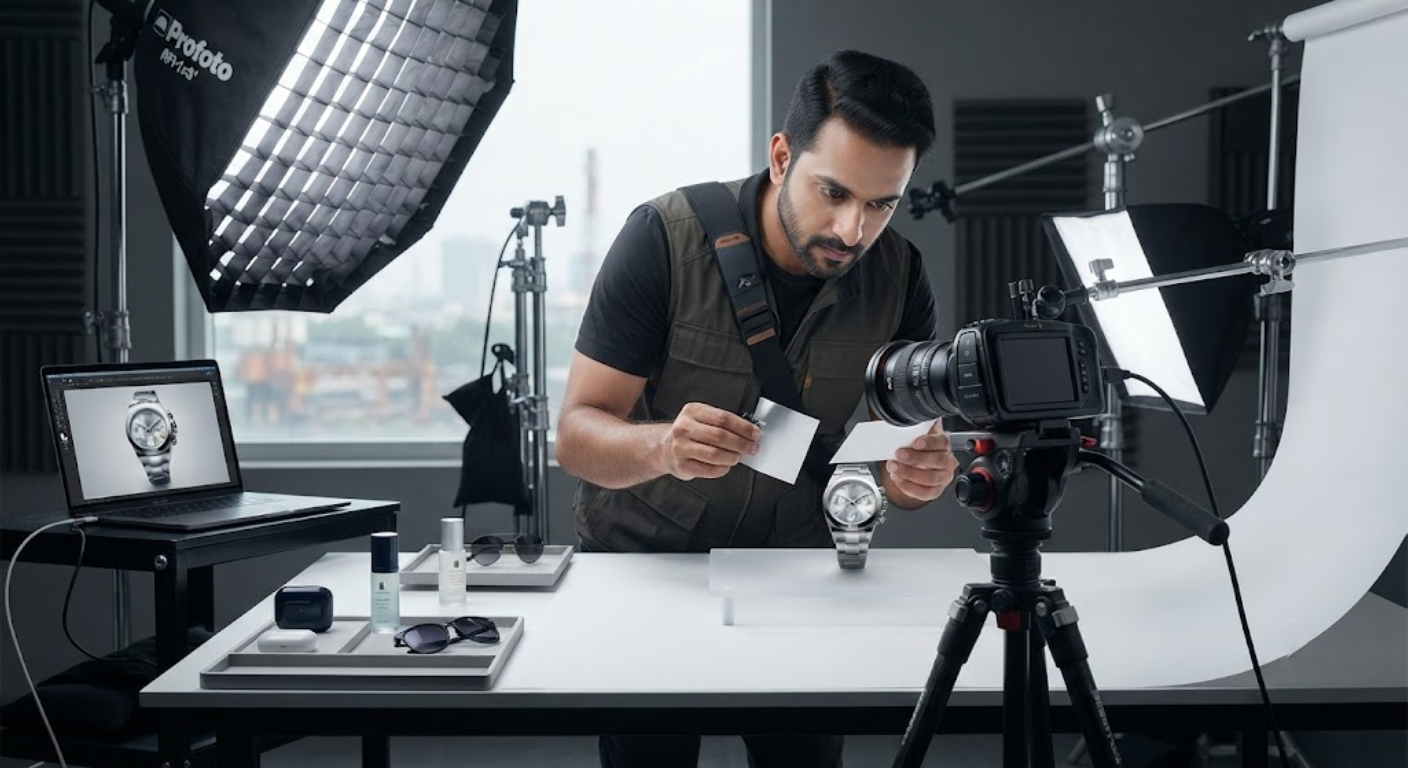
Professional product photography uses controlled lighting to create more predictable results.
Photographers can adjust:
- Light direction
- Intensity
- Shadow
- Contrast
- Reflection
- Highlights
- Background brightness
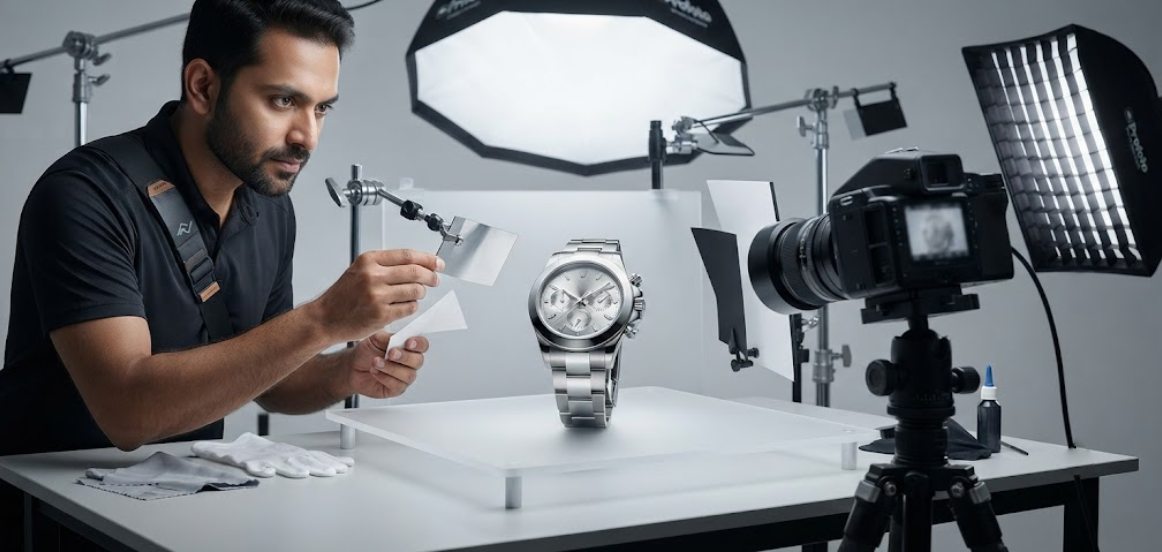
Reflective products require additional care.
Jewellery, glass, watches and polished surfaces can reflect the studio environment.
A professional photographer knows how to position lights and modifiers to control those reflections.
This is one of the reasons professional equipment and experience matter.
A technically difficult product cannot always be photographed successfully with a simple phone camera and room lighting.
8. Product Photography for Amazon, Shopify and Other E-commerce Platforms
Different selling platforms may have different image specifications and presentation requirements.
Amazon product listings, Shopify stores, marketplace listings and independent e-commerce websites can all have different needs.
This means you should plan photography around your distribution channels.
For example, marketplace listings may require clean primary product images.
Your own website may allow greater creative freedom.
Social media may benefit from lifestyle imagery.
Digital advertising may require different crops and compositions.
This is why professional photography should ideally be planned as a content system rather than one isolated image.
Before a shoot, identify where the images will be used.
Then determine:
- Required aspect ratios
- Background requirements
- Image dimensions
- Product angles
- Lifestyle needs
- Close-up requirements
- Advertising requirements
This can prevent the common problem of finishing a shoot and discovering that important images are missing.
A well-planned shoot produces assets that can be used across multiple channels.
9. Lifestyle Photography Makes Products Easier to Imagine
A product photograph tells customers what the product looks like.
A lifestyle photograph can show customers how the product fits into their world.
This psychological difference is important.
Consider a home décor brand.
A plain photograph can show a lamp.
A lifestyle image can show the lamp illuminating a beautifully designed bedroom.
The first image communicates:
“This is the product.”
The second communicates:
“This is what your space could look like with the product.”
The same principle applies to many categories.
Fashion
Show the product being worn.
Beauty
Show the product being used as part of a routine.
Fitness
Show the product during a workout.
Food
Show the product being served or consumed.
Technology
Show the product in a realistic workspace.
Furniture
Show the product inside an actual room.
Lifestyle photography adds context.
It helps customers imagine ownership.
10. Professional Photography Creates a Consistent Brand Identity
Imagine visiting an online store where every product looks different.
One image has a white background.
Another has a grey background.
Another is shot on a wooden table.
Another has yellow lighting.
Another is a smartphone photograph.
The store may feel inconsistent.
Now imagine every product follows the same visual system.
The same:
- Background
- Lighting approach
- Camera perspective
- Product scale
- Cropping
- Shadow treatment
- Image dimensions
The website immediately feels more professional.
This is particularly important as your product catalogue grows.
Consistency helps customers navigate the store visually.
It also creates a recognisable brand identity.
Professional photography can therefore become part of your brand guidelines.
A company might define:
Background: Clean neutral
Product position: Centre aligned
Lighting: Soft controlled light
Perspective: Three-quarter view
Lifestyle style: Minimal and premium
Colour treatment: Accurate and natural
These standards can then be applied to future product launches.
Final Thoughts: Your Product Deserves Better Than a Quick Snapshot
In e-commerce, customers cannot physically touch your product.
Your photographs have to do part of that job.
They need to show the product clearly.
They need to reveal details.
They need to communicate quality.
They need to create confidence.
And they need to help customers imagine ownership.
That is why professional product photography for e-commerce should be considered an important part of your sales and marketing strategy.
The best product photographs are not necessarily the most dramatic.
They are the ones that communicate the product accurately, attractively and consistently.
For some products, that means a clean white background.
For others, it means a lifestyle scene.
For many brands, it means a combination of:
Hero product images
Multiple angles
Detail photographs
Lifestyle images
Usage photographs
Packaging shots
The more effectively your images answer customer questions, the less customers have to guess.
And reducing uncertainty is one of the most important goals of visual e-commerce content.
If you are launching a new product, expanding your catalogue or upgrading an existing online store, investing in professional photography can provide assets that continue working long after the shoot is finished.
Conclusion
Professional product photography is more than making your products look attractive.
It is about helping customers understand what they are buying.
Strong product images can:
- Build trust
- Improve product presentation
- Reduce uncertainty
- Strengthen brand identity
- Support marketplace listings
- Improve social-media content
- Provide advertising assets
- Create a consistent online store
- Support product launches
- Build a reusable visual content library
For e-commerce businesses, every product page is an opportunity to communicate value.
Your photographs should make the most of that opportunity.
Whether you sell through your own Shopify website, marketplaces, social media or multiple digital channels, high-quality product images can give your products a stronger visual presence.
The key is to plan the photography around your customers and your sales journey.
Ask:
What does the customer need to see?
What questions can the image answer?
What details need to be highlighted?
Where will the image be used?
Does the photography match the brand?
When these questions are answered before the camera starts shooting, the final images become much more than photographs.
They become sales and marketing assets.
For brands operating in Mumbai and beyond, working with a professional product photography studio can also make the process more efficient, especially when you need consistent images across a growing product catalogue.
Your product may be excellent.
Your website may be excellent.
Your marketing may be excellent.
Make sure your product photography communicates that same level of quality.