
Mumbai is one of India’s most active business and commercial markets.
From established companies and D2C brands to startups, manufacturers, retailers and independent online sellers, businesses are increasingly using digital channels to reach customers.
For an e-commerce brand, however, selling online creates one major challenge:
Customers cannot physically examine the product before buying it.
In a physical store, customers can pick up a product, examine its packaging, inspect its texture and compare it with other products.
Online, they depend on photographs.
This makes product photography one of the most important visual assets for an e-commerce business.
A product page may contain a title, description, specifications, reviews and pricing.
But photography often creates the first visual impression.
A customer may decide within seconds whether a product looks trustworthy, attractive and relevant.
This is why professional product photography in Mumbai has become increasingly valuable for brands that want to compete in crowded online marketplaces.
Professional photography can help businesses present their products with:
- Better clarity
- Consistent lighting
- Accurate colours
- Multiple product angles
- Detailed close-ups
- Lifestyle context
- Stronger brand identity
- Marketplace-ready images
The objective is not simply to make a product photograph look beautiful.
The photograph needs to communicate the product accurately and help the customer understand what they are considering purchasing.
This guide explains how Mumbai e-commerce brands can plan, execute and maximise the value of a professional product photoshoot.
1. What Is Product Photography?
Product photography is the professional process of photographing products for commercial use.
The final images may be used across:
- E-commerce websites
- Amazon
- Flipkart
- Shopify stores
- Social media
- Digital advertisements
- Product catalogues
- Brochures
- Online marketplaces
- Email campaigns
- Brand websites
The photography approach depends on the product and its intended use.
For example, an e-commerce website may require clean product photographs against a neutral background.
A fashion brand may require models wearing its products.
A furniture company may need lifestyle interiors.
A jewellery brand may need macro photographs showing fine craftsmanship.
A cosmetics company may require both product-only and usage photographs.
Therefore, there is no single product photography style that works for every brand.
The first step is understanding the product, customer and platform.
A professional photographer can then determine the appropriate:
- Camera
- Lens
- Lighting
- Background
- Props
- Composition
- Styling
- Editing
This planning stage is important because product photography is ultimately commercial photography.
The photographs need to support the business objective.
2. Why Mumbai E-commerce Brands Need Professional Product Photography
Mumbai has a highly competitive business environment.
Customers have access to thousands of products from different sellers.
A brand therefore needs to communicate its value quickly.
Professional product photography can help create a consistent visual presentation across the online store.
For example, a fashion brand may photograph 100 products.
If every product uses the same:
- Camera perspective
- Background
- Lighting
- Product scale
- Cropping
- Colour treatment
the entire catalogue appears more organised.
This creates a stronger shopping experience.
Professional images can also help brands communicate their positioning.
A premium jewellery company may require elegant, detailed imagery.
A children’s brand may need bright lifestyle photographs.
A luxury furniture company may require sophisticated interiors.
A technology company may need clean, minimal product images.
The photography style should reflect the brand.
This is why choosing a product photography studio is not only about finding a camera and a room.
You need a production partner who understands how the images will be used.
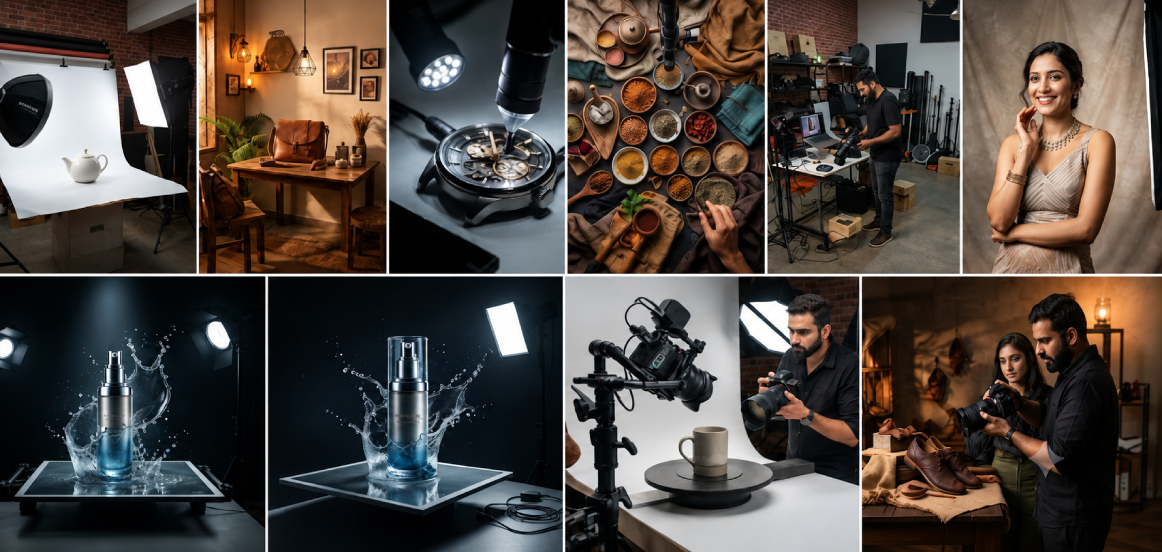
3. 8 Types of Product Photography Mumbai Brands Can Use
Different products require different photography approaches.
1. White Background Photography
Clean product images with a plain background are useful for e-commerce listings and marketplaces.
2. Lifestyle Photography
The product is photographed within a realistic environment.
3. Product-in-Use Photography
Shows how the customer interacts with the product.
4. Detail Photography
Close-ups highlight materials, textures and important features.
5. Flat-Lay Photography
Products are arranged from above and photographed in a controlled composition.
6. Model Photography
Useful for fashion, jewellery, beauty and lifestyle products.
7. Creative Advertising Photography
More artistic compositions can be used for campaigns and advertisements.
8. 360-Degree or Multiple-Angle Photography
Multiple views provide customers with a better understanding of the product.
A brand may use several of these styles simultaneously.
For example, a skincare company could create:
- White-background product images
- Texture close-ups
- Lifestyle bathroom images
- Product-in-use photographs
- Packaging photographs
This provides a comprehensive visual library.
4. How to Prepare Your Products Before a Photoshoot
Preparation can significantly improve the efficiency of a photoshoot.
Products should arrive at the studio in their best possible condition.
Depending on the category, preparation may include:
- Cleaning surfaces
- Removing dust
- Removing fingerprints
- Ironing clothing
- Polishing jewellery
- Checking packaging
- Charging electronics
- Preparing accessories
- Labelling products
- Organising variations
For a large catalogue, create a product list.
Assign each product a unique reference number.
This makes it easier to track:
- Products received
- Products photographed
- Images completed
- Editing status
- Final delivery
If you are photographing clothing, prepare sizes and outfits in advance.
For food photography, ingredients should be fresh.
For jewellery, surfaces should be carefully polished.
For electronics, all components should be available.
For cosmetics, packaging should be clean and undamaged.
A professional studio can photograph the product well, but it cannot completely compensate for damaged packaging or a poorly prepared product.
Good preparation makes the entire production process smoother.
5. Why Lighting Is Critical in Product Photography
Lighting is one of the most important technical elements in product photography.
The right lighting reveals product shape, texture and material.
The wrong lighting can create:
- Harsh shadows
- Reflections
- Incorrect colours
- Flat appearance
- Loss of detail
- Unwanted highlights
Different products require different lighting strategies.
Glass products can create difficult reflections.
Jewellery can reflect lights and surrounding objects.
White products can disappear against bright backgrounds.
Black products may lose surface details.
Food needs lighting that makes textures look fresh and appealing.
Fashion photography requires controlled lighting that represents fabric accurately.
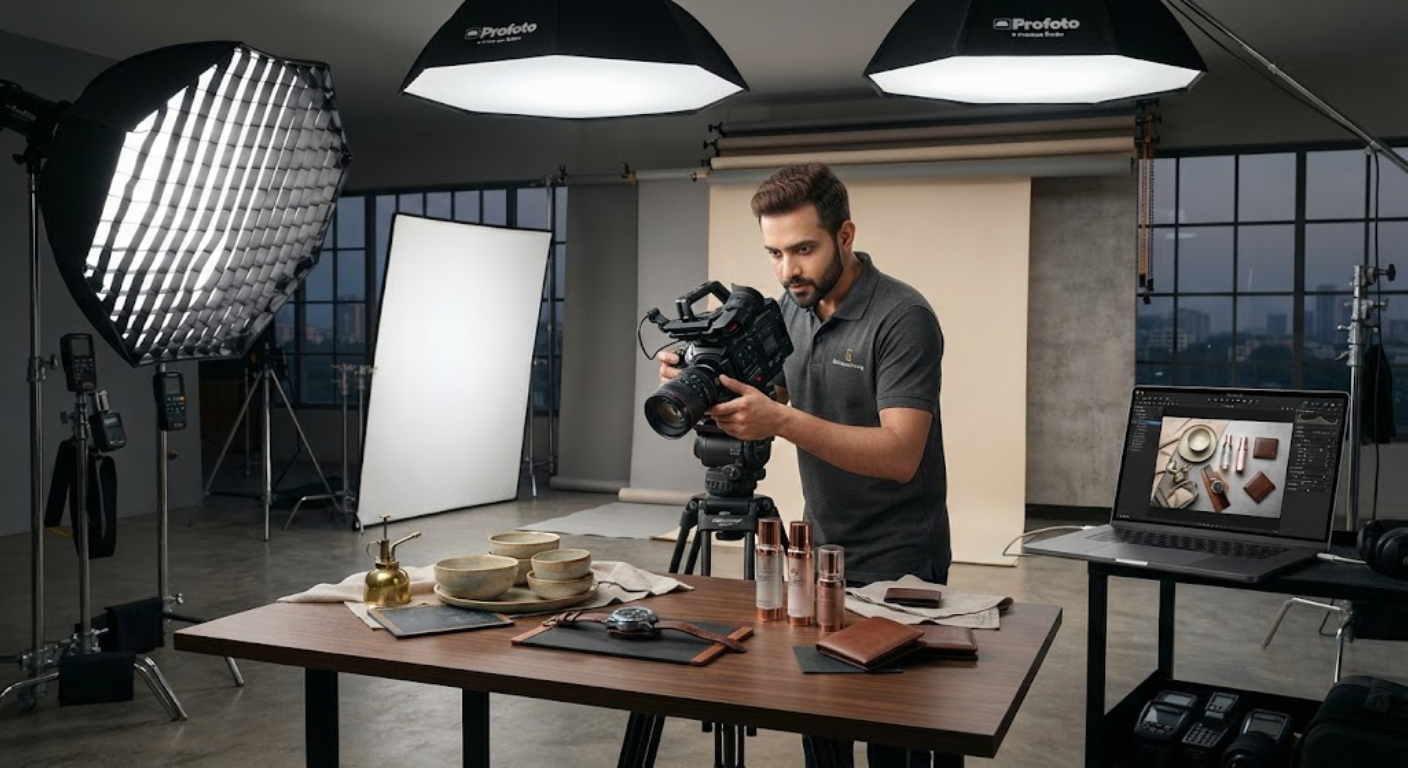
Professional studios can use equipment such as:
- Softboxes
- Strip lights
- Reflectors
- Diffusers
- Flags
- Grids
- LED lighting
- Strobes
The photographer adjusts these tools according to the product.
This is one of the biggest differences between professional product photography and casual product photographs.
The lighting is intentionally designed around the product.
6. Camera and Lens Selection for Product Photography
The camera is important, but it is only one component of the production system.
Professional cameras provide greater control over:
- Resolution
- Dynamic range
- Focus
- Depth of field
- Colour
- Lens selection
Different lenses can produce different visual results.
A macro lens can be useful for small products and fine details.
A standard lens may work well for general product photographs.
A telephoto lens can help control perspective in certain commercial setups.
The photographer chooses equipment based on the product.
For example:
Jewellery: Macro detail
Fashion: Appropriate portrait/fashion lens
Furniture: Wider perspective where appropriate
Small consumer products: Standard or macro lens
Food: Perspective and close-up options
Camera choice should therefore be considered alongside lighting and lens selection.
The objective is not simply to use the most expensive equipment.
The objective is to select the equipment that produces the correct visual result.
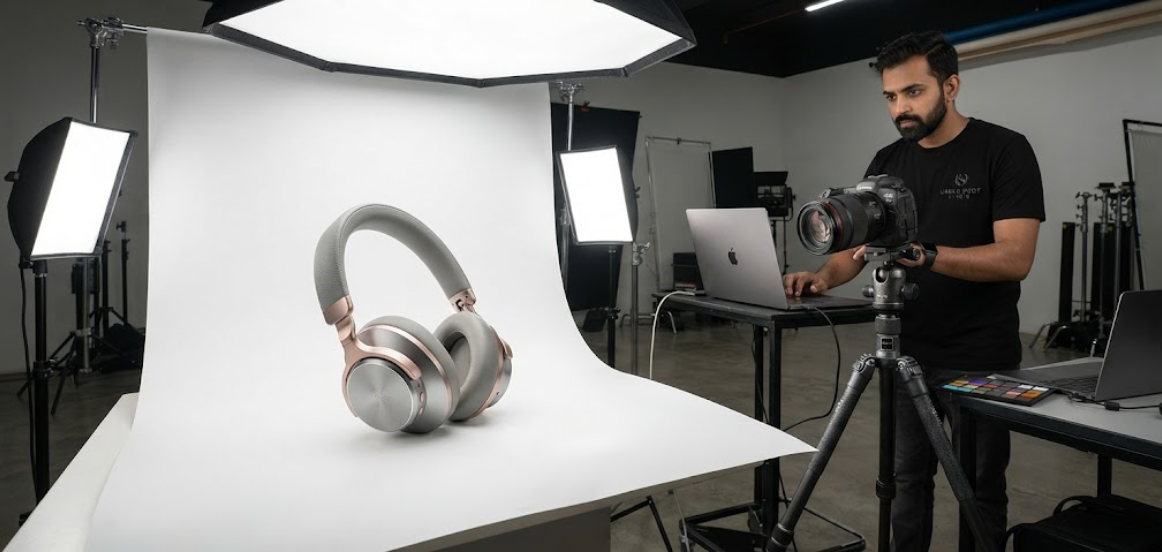
7. White Background Product Photography for E-commerce
White-background photography remains one of the most useful styles for online stores.
The concept is simple:
Product first.
There are no distracting environments.
The customer can immediately see the product.
This style works especially well for:
- Marketplace listings
- Product catalogues
- Online stores
- Search results
- Inventory systems
However, creating a professional white-background photograph is more complicated than placing a product against a white wall.
The product needs to be properly lit.
The background needs to be controlled.
Shadows need to be managed.
The product edges need to remain clean.
The final image should also be properly edited.
White products require particular attention because the product and background can easily blend together.
Transparent products can also require careful lighting.
Professional product photography helps maintain visual consistency across an entire catalogue.
For brands with dozens or hundreds of SKUs, consistency is particularly valuable.
8. Lifestyle Product Photography for Mumbai Brands
Lifestyle photography adds context.
Instead of showing only the product, it shows how the product fits into everyday life.
This can make the content more emotionally engaging.
For example:
A skincare product can be shown in a modern bathroom.
A coffee brand can be shown during a morning routine.
A furniture product can be photographed inside a stylish living room.
A watch can be photographed on a person’s wrist.
A fashion product can be shown on a model.
Lifestyle photography is especially useful for brand websites and social-media marketing.
It helps communicate the personality of the brand.
Mumbai brands can also use local creative direction when appropriate.
A lifestyle scene can reflect:
- Urban living
- Modern workplaces
- Contemporary homes
- Indian consumer lifestyles
- Premium retail environments
The key is to ensure that the environment supports the product rather than distracting from it.
9. How Professional Editing Improves Product Images
Photography captures the original image.
Editing prepares it for commercial use.
Professional post-production may include:
- Exposure correction
- Colour correction
- Background cleanup
- Dust removal
- Reflection control
- Shadow adjustment
- Skin retouching for model photography
- Cropping
- Resizing
- Image sharpening
The amount of retouching should depend on the product.
The objective should generally be to improve presentation without misleading the customer.
For example, removing a temporary dust particle is normal.
But changing the actual colour or appearance of the product significantly can create customer expectations that the physical product cannot meet.
This is why accurate editing is important.
For e-commerce brands, consistency is also critical.
If ten products are photographed and edited differently, the website can appear visually inconsistent.
Professional post-production can establish a common visual standard.
10. Product Photography for Amazon, Shopify and Marketplaces
Mumbai e-commerce brands may sell through multiple channels.
For example, a company could operate:
- Its own Shopify website
- Amazon store
- Flipkart listing
- Instagram shop
- Social-media advertising
- Offline catalogue
Each channel may require different image formats or compositions.
Therefore, the photography plan should consider every platform before the shoot.
A professional product photography project should identify:
Image Dimensions
What resolution and dimensions are required?
Aspect Ratio
Does the platform require a particular image ratio?
Background
Is a clean background required?
Number of Images
How many photographs should each product have?
Detail Shots
Which product features need close-ups?
Lifestyle Assets
Will the images also be used for social media?
Advertising
Will photographs be used in paid campaigns?
Planning these requirements in advance prevents additional reshoots.
One well-planned photoshoot can generate assets for several marketing channels.
This increases the overall value of the photography investment.
Conclusion
A successful e-commerce brand needs more than a good product.
It needs strong presentation.
Professional product photography helps bridge the gap between physical shopping and online shopping by giving customers a clearer visual understanding of the product.
For Mumbai e-commerce brands, the photography process should begin before the camera is switched on.
Plan the products.
Understand the target audience.
Identify the platforms.
Choose the photography style.
Prepare the products.
Select the appropriate equipment.
Control the lighting.
Capture multiple views.
Edit accurately.
Then create a reusable image library.
Whether you are launching five products or five hundred, a structured photography process can make your online store more consistent and professional.
The right product photography studio in Mumbai should therefore be evaluated based on more than its equipment or studio appearance.
Look at its portfolio.
Look at its production process.
Look at its experience.
Look at its editing quality.
Most importantly, ask whether it understands the commercial purpose of your photography.
Your product images are often the closest thing an online customer has to physically seeing your product.
Make those images count.