
Introduction
When customers discover a product online, they cannot physically touch it, examine its material or test how it works. They depend on visual content to understand its appearance, features, quality and benefits. This makes professional product photography and product videography important tools for modern businesses.
However, many brands face the same question: should they invest in product photographs, product videos or both?
Understanding product photography vs product videography can help businesses make better decisions about their content production budgets, marketing strategies and customer experience.
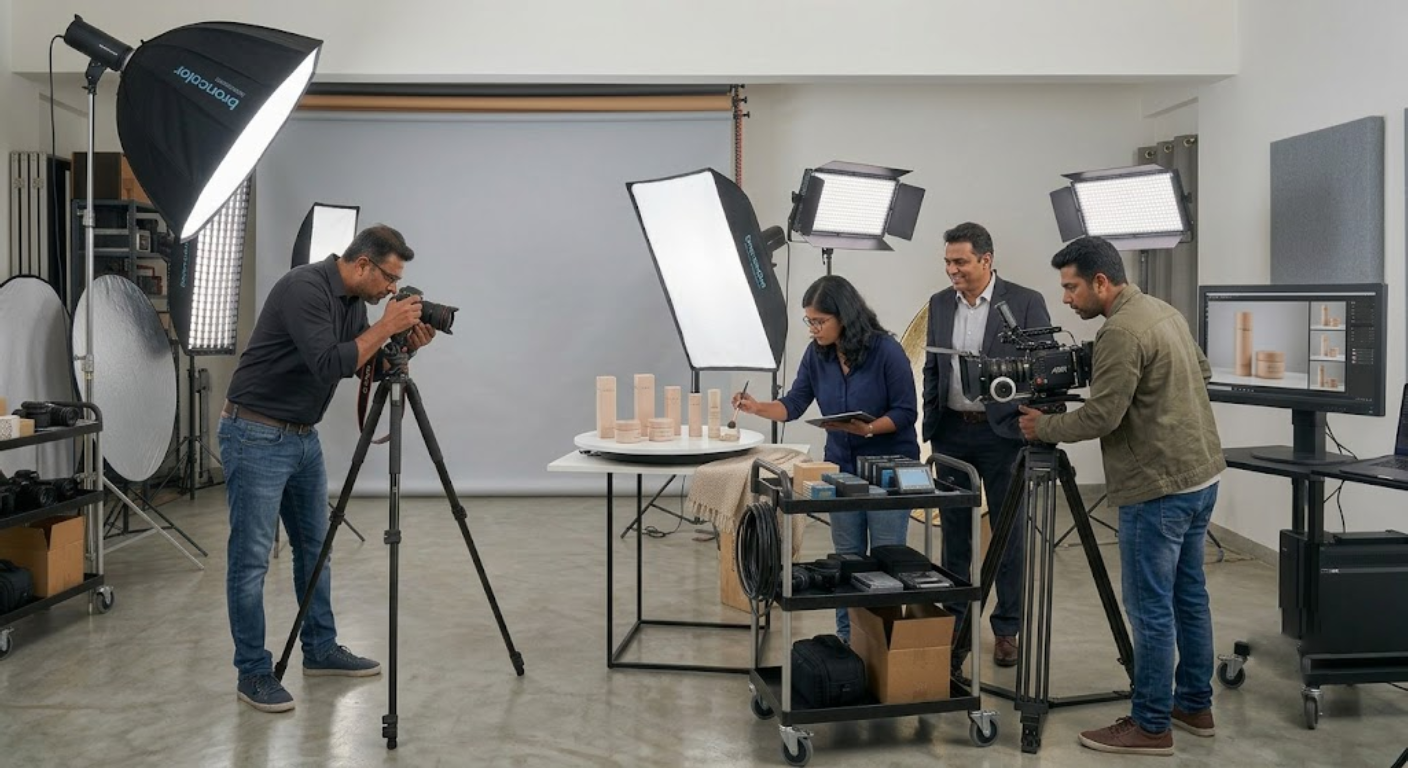
Product photography communicates through carefully composed still images. It helps customers examine product details, compare options and understand the product’s appearance. Product videography adds movement, demonstrations, storytelling and context, allowing customers to see how a product works or fits into everyday life.
Both formats serve valuable purposes, but neither is automatically the right choice for every business.
An e-commerce brand selling jewellery may need detailed photographs that reveal craftsmanship and finishing. A company selling kitchen appliances may benefit from videos demonstrating the product’s features. A fashion brand may need both professional catalogue photographs and videos showing how garments move.
For Mumbai businesses selling through websites, marketplaces, social media and digital advertisements, choosing the right visual format can make content production more effective.
This guide compares product photography vs product videography, explains the strengths of each format and helps you decide when to invest in photographs, videos or a combination of both.
1. What Is Product Photography?
Product photography involves creating still images that present a product clearly, accurately and attractively.
These photographs can be captured in a professional studio, a lifestyle environment, an office, a retail location or another suitable setting.
The objective is to help customers understand what the product looks like and what makes it useful or appealing.
Professional product photography can include:
- Clean catalogue images
- Multiple product angles
- Close-up detail photographs
- Lifestyle images
- Product-on-model photography
- Packaging photographs
- Product collection images
- Advertising compositions
- E-commerce listing images
- Website banner images
The exact approach depends on the product category and intended use.
For example, jewellery photography may require macro lenses and carefully controlled lighting to show fine details. Clothing photography may use models to demonstrate fit and appearance. Food photography may focus on texture, freshness and presentation.
Product photographs are especially useful when customers need to examine a product quickly or compare different products side by side.
2. What Is Product Videography?
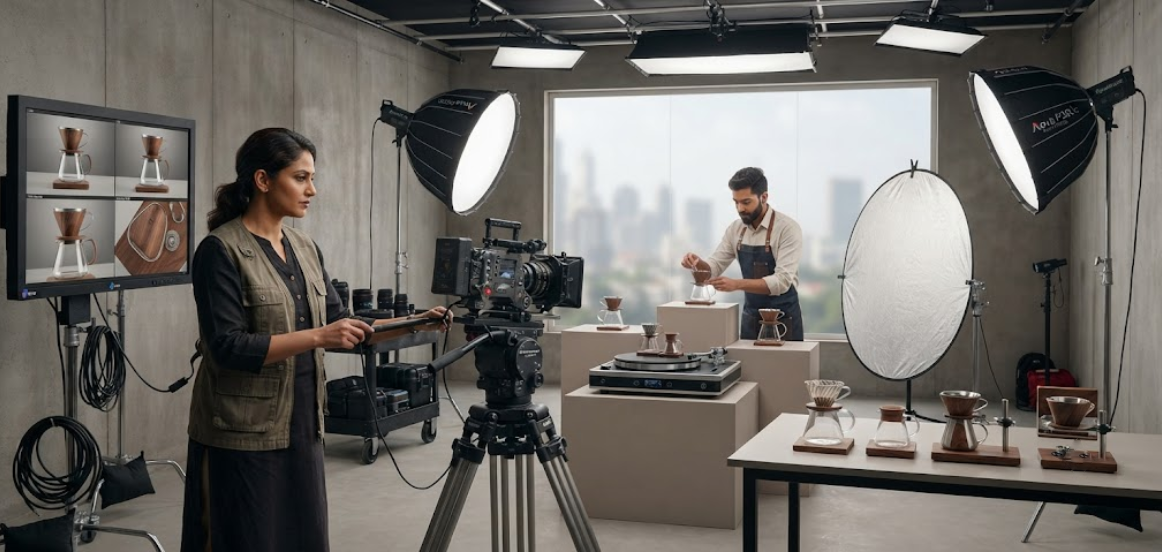
Product videography involves recording moving images that demonstrate a product’s appearance, features, functionality or use.
Unlike still photography, video allows customers to see products from different angles in motion, understand how components work together and observe products being used.
A product video can be short and simple or more elaborate, depending on its purpose.
Common types include:
- Product demonstration videos
- Product feature videos
- Unboxing videos
- Lifestyle product videos
- Product comparison videos
- Product launch videos
- Explainer videos
- E-commerce product videos
- Social media Reels
- Advertising videos
- Product-on-model videos
For example, a video of a kitchen appliance can demonstrate its controls and operation. A cosmetics video can show application and texture. A fashion video can reveal how a garment moves when worn.
Product videography can also incorporate close-up shots, music, voice-over, demonstrations and supporting footage to create a more complete presentation.
It is particularly useful when movement, functionality or the product experience is difficult to communicate through still images alone.
3. Product Photography vs Product Videography: The Main Differences
Although both formats present products visually, they serve different communication needs.
Product photography provides still images that customers can inspect at their own pace. Product videography combines movement, timing, sound and visual storytelling to demonstrate how a product looks or works.
Here is a practical comparison.
The choice depends on what your customers need to understand before purchasing.
If the product’s appearance is the main selling point, photography may be the first priority.
If the product’s functionality or usage is difficult to explain through still images, video may be more useful.
4. When Should Your Brand Invest in Product Photography?
Product photography should generally be a priority when customers need clear, consistent and detailed images to evaluate products.
It is particularly useful for businesses that maintain online catalogues, sell through marketplaces or offer multiple product variations.
Consider prioritising product photography when you need:
- Main images for e-commerce product pages
- Consistent photographs across a large catalogue
- Multiple angles of each product
- Close-ups of material and craftsmanship
- Product images for printed catalogues
- Images for website banners
- Product photographs for social media posts
- Clean images for advertising designs
For example, a business selling bags in multiple colours needs clear images of each variation. A jewellery retailer needs photographs that show design and finishing. A skincare company needs images that present packaging accurately.
Professional photography also provides flexible assets that can be reused across different marketing materials.
If your current product images are inconsistent, unclear or poorly lit, upgrading your photography may be the most practical first step.
5. When Should Your Brand Invest in Product Videography?
Product videography becomes particularly useful when a still image cannot fully communicate the product’s value.
Movement can help explain how a product operates, how its parts interact or how customers use it in real situations.
Consider investing in product videography when you need to:
- Demonstrate product functionality
- Explain complicated features
- Show product assembly or operation
- Present an unboxing experience
- Demonstrate application or usage
- Introduce a new product
- Create social media Reels
- Produce video advertisements
- Tell a product story
- Show products in action
For example, a furniture brand could create a video showing how a chair adjusts. A technology company could demonstrate a device’s functions. A cosmetics brand could show how a product is applied.
Video can also communicate scale, movement and user experience in ways that still photographs cannot fully reproduce.
However, video should have a clear purpose. A moving product shot without useful information may not be more valuable than a well-composed photograph.
6. Which Format Is Better for E-commerce Stores?
For most e-commerce businesses, product photography and product videography should be viewed as complementary formats rather than competing alternatives.
Still images provide the foundation of an online product catalogue. They help customers quickly inspect the product, compare variations and find specific details.
Videos can then provide additional context.
For example, an online clothing store might use:
- Front and back photographs
- Close-up fabric images
- Product-on-model photographs
- A short video showing the garment in motion
An electronics store might combine clean catalogue images with a demonstration video explaining important features.
A cosmetics brand could use packaging photographs, texture close-ups and a short application video.
If your budget is limited, start with the essential product photographs needed for each listing. Add video to products where demonstrations or movement can answer important customer questions.
Always check the current image and video requirements of the marketplaces where you sell.
7. Which Format Works Better for Social Media Marketing?
Social media supports both still images and videos, and each format can play a different role in your content strategy.
Product photography is useful for clear product announcements, carousels, collection posts, promotional graphics and visually consistent feeds.
Product videography can help communicate demonstrations, behind-the-scenes production, product usage, launches and short storytelling formats.
A balanced social media content plan may include:
- Product photographs for catalogue-style posts
- Close-ups for detail-focused content
- Lifestyle images for brand storytelling
- Reels demonstrating product use
- Short videos explaining product benefits
- Behind-the-scenes content from product shoots
- Video advertisements for specific campaigns
The best choice depends on your audience, platform, campaign objective and the type of product you sell.
Do not assume that every product needs a video or that photographs are no longer effective.
Instead, identify the information your audience needs and select the format that communicates it most clearly.
8. Compare Production Costs and Time Requirements
The cost of product photography versus product videography depends on the product, complexity, creative concept, number of deliverables, equipment, crew and post-production requirements.
A simple product photography session may require a photographer, lighting setup, product styling and image editing.
A product video can require additional planning, shot sequencing, movement, demonstrations, audio recording, editing, sound design, subtitles and multiple exports.
However, neither format is automatically expensive or inexpensive.
A complex jewellery shoot involving reflective materials and detailed retouching may require significant time. A simple product demonstration video can be relatively straightforward if the concept and production requirements are clear.
Before requesting a quote, define:
- Number of products
- Number of photographs per product
- Number and duration of videos
- Required backgrounds and locations
- Styling or model requirements
- Editing and retouching expectations
- Required aspect ratios
- Delivery deadlines
A clear brief helps production teams estimate the project more accurately.
9. How to Repurpose One Product Shoot Into Multiple Assets
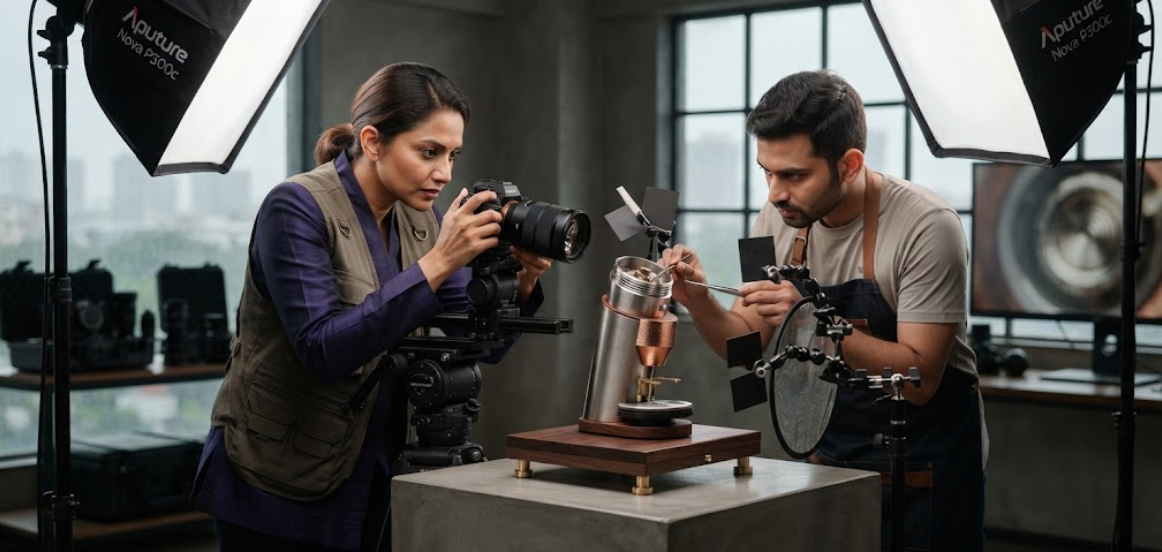
One of the most effective ways to improve your content production efficiency is to plan photography and videography together.
Instead of organising completely separate shoots for every marketing requirement, identify opportunities to capture different assets during the same production session.
A combined shoot could produce:
- Main product photographs
- Alternate product angles
- Close-up detail images
- Lifestyle photographs
- Product demonstration videos
- Vertical Reels
- Horizontal product videos
- Behind-the-scenes footage
- Website banner images
- Social media advertising assets
For example, while a product is arranged for photography, the production team may capture a short rotating shot or demonstration video before changing the setup.
Similarly, a model-based product shoot can generate still photographs alongside movement-focused video clips.
The key is to prepare a combined shot list and allocate sufficient time for both formats.
This approach can reduce duplicated setup work and create a more versatile collection of marketing assets.
10. Plan Product Photography for Social Media and Advertising
Your e-commerce photoshoot can produce more value when it includes images beyond the basic product listing.
Social media and advertising often require stronger visual storytelling, different orientations and more flexible compositions.
Consider capturing:
- Vertical product portraits
- Square-friendly product compositions
- Wide advertising images
- Product arrangements featuring multiple items
- Lifestyle photographs
- Close-up campaign images
- Product photographs with negative space
- Seasonal promotional imagery
- Product-in-use photographs
- Behind-the-scenes content
Negative space is especially helpful when a designer needs to add a headline, price or call to action later.
Capture some photographs with the product positioned off-centre and others with a more central composition.
This gives your marketing team more options when preparing advertisements, social posts and promotional banners.
Planning these variations during the original session can reduce the need for additional photography later.
11. Organise Your Shoot Day and Manage Time Efficiently
When photographing multiple products, organisation can make a significant difference to the time required.
Switching repeatedly between unrelated products, backgrounds and lighting setups can slow production.
A more efficient approach is to group products by similar requirements.
For example, photograph products that use the same background and lighting setup together. Complete all required angles for one product before moving to the next. Keep product variations clearly organised.
A practical shoot-day checklist includes:
- Confirm the final product list
- Check product condition
- Prepare all accessories and props
- Set up the first background
- Test lighting and camera settings
- Review a sample photograph
- Follow the shot list
- Track completed products
- Check images for missed details
- Back up captured files
Build some flexibility into the schedule for products that require more complicated styling or reflection control.
Efficiency should not come at the expense of image quality.
The goal is to complete the planned photographs in an organised way while ensuring that every product receives the attention it needs.
12. Plan Editing, File Management and Final Delivery
The photoshoot is only one part of the product photography process. Editing and file management determine how easily your business can use the final images.
After the shoot, review the photographs to identify the strongest images and check whether all required views have been captured.
The post-production process may include:
- Selecting the best frames
- Correcting exposure
- Adjusting white balance
- Maintaining accurate product colours
- Removing dust or minor distractions
- Refining backgrounds
- Applying consistent cropping
- Resizing images for different platforms
- Exporting suitable file formats
- Organising files by product and channel
Retouching should improve presentation without misrepresenting the product.
For example, colour correction should aim to represent the actual product accurately rather than making it appear significantly different.
Use clear file names and organised folders so your marketing team can quickly locate the right images.
Keep high-resolution master files separately from compressed web versions.
A well-managed product image library makes future website updates, advertising campaigns and product launches easier to execute.
How MWS India Can Help With Professional E-commerce Photoshoots
MWS India provides professional product photography and content production solutions for businesses that need high-quality images for online stores, marketplaces, social media and digital marketing.
A planned e-commerce photoshoot can include:
- Main catalogue images
- Multiple product angles
- Product detail photography
- Lifestyle photography
- Product-on-model photography
- Packaging photography
- Marketplace-ready images
- Website banner photography
- Social media product images
- Advertising compositions
- Product videos
- Professional retouching and image editing
By planning the shot list, backgrounds, lighting and final image requirements in advance, businesses can create a more useful collection of product photographs in a structured production session.
MWS India’s professional studio environment supports controlled lighting, product styling and consistent photography workflows.
For Mumbai businesses, combining different product image requirements in one session can help create a visual library for e-commerce listings, website updates, social media posts and marketing campaigns.
The objective is to help businesses present their products clearly and professionally wherever customers discover them online.
Conclusion
A successful professional e-commerce photoshoot begins with planning rather than simply taking product pictures.
Start by defining your goals, understanding your customers and preparing every product carefully. Create a detailed shot list, choose appropriate backgrounds, plan lighting and capture the product angles and details that customers need to see.
Do not overlook lifestyle photography, marketplace requirements, social media formats and advertising compositions. These additional images can make your product photography more useful across different marketing channels.
Finally, plan editing, file naming and image delivery so the photographs remain easy to manage and reuse.
With the right preparation and professional execution, one e-commerce photoshoot can produce a versatile collection of product images that supports your online store, strengthens your brand presentation and helps customers make more informed purchasing decisions.