
Creating business videos has become an important part of modern digital communication. Brands use videos for websites, social media, advertisements, product demonstrations, corporate communication, podcasts, interviews, testimonials, YouTube channels, and many other marketing activities.
However, recording good footage is only one part of producing effective business content.
The raw footage captured during a shoot usually contains pauses, repeated takes, background noise, inconsistent pacing, unnecessary sections, colour variations, and other elements that need to be refined before the final video is ready for an audience.
This is where professional video editing becomes important.
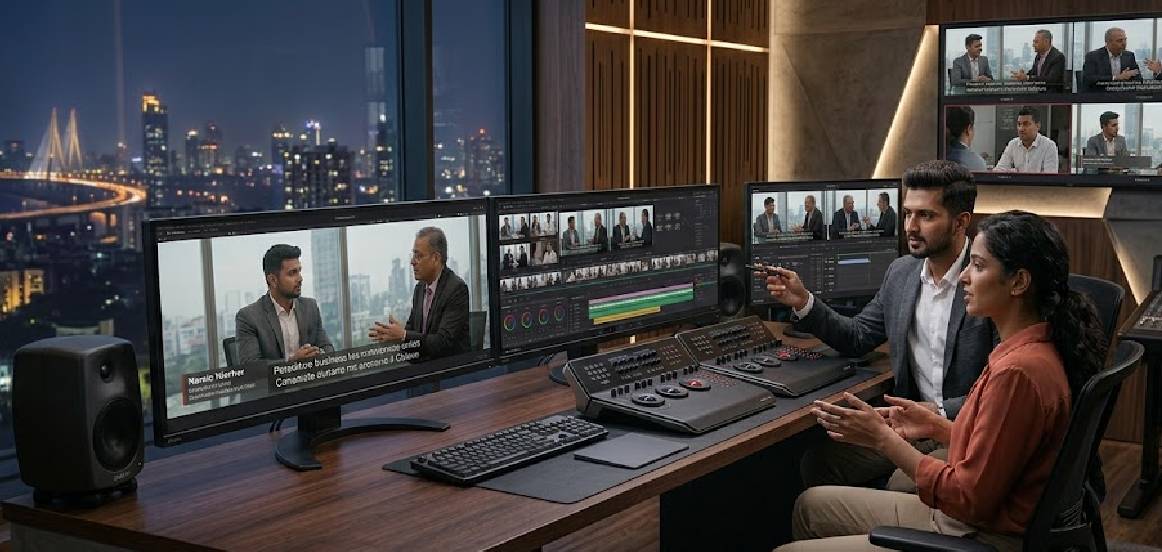
Professional video editing can transform raw footage into a structured and polished piece of content. It can improve the flow of a story, make information easier to understand, create stronger visual consistency, improve audio quality, and prepare content for different platforms.
For businesses, editing is not simply about cutting unwanted footage. It is about shaping the recorded material into content that communicates the intended message clearly.
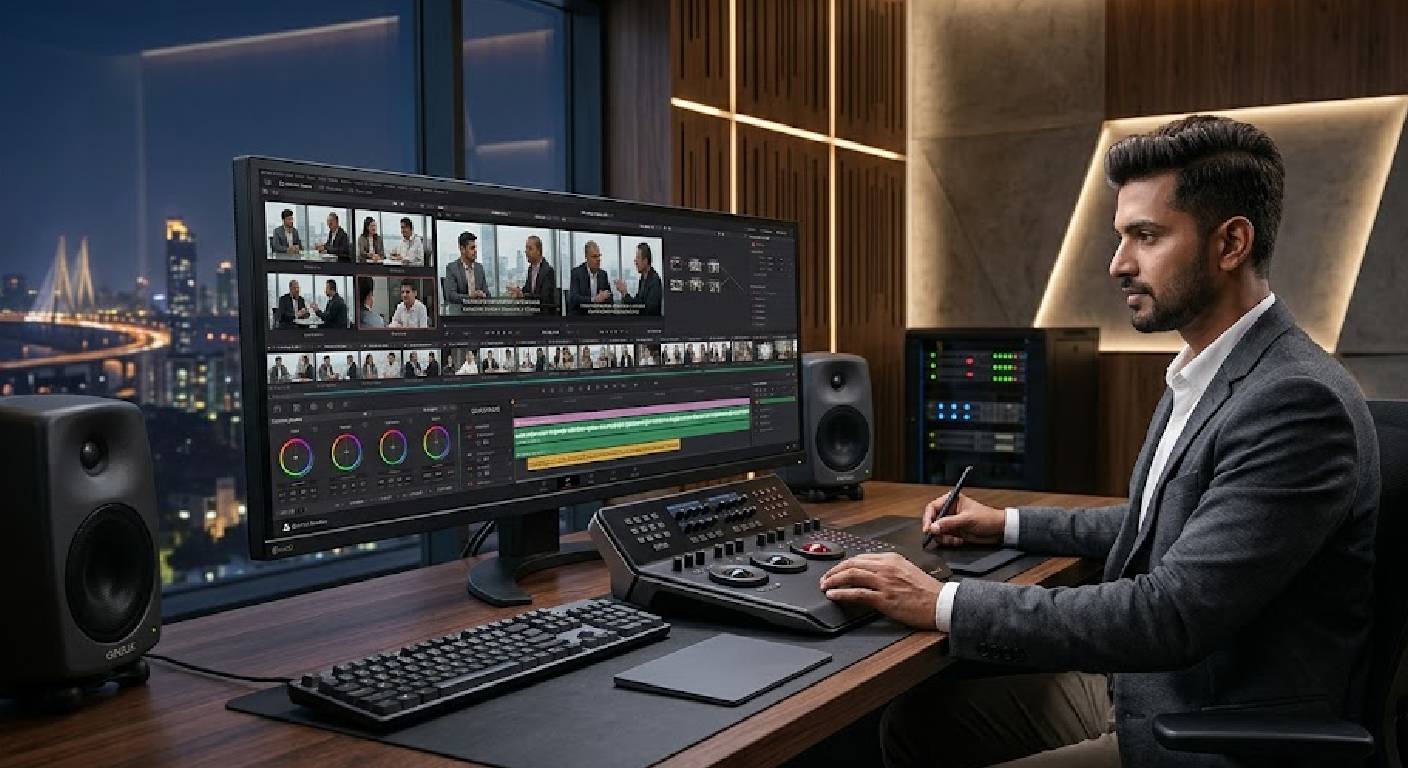
MW Stuudio provides post-production as a standalone service as well as part of its broader video production ecosystem. Its current post-production services include video editing, colour grading, sound design, motion graphics, subtitles, thumbnail design, and photo retouching.
1. Professional Editing Creates a Clearer Story
Raw footage does not automatically have a strong narrative.
A business interview might contain 45 minutes of conversation, but the final video may only need 5–10 minutes. A product shoot may contain dozens of clips, while the final product video needs to communicate only the most important features.
Professional editing helps identify the strongest material and arrange it into a logical sequence.
For example, a business video might follow this structure:
Problem → Context → Solution → Benefits → Example → Call to Action
An interview could follow:
Introduction → Background → Challenge → Experience → Insights → Conclusion
This structure gives viewers a clear reason to continue watching.
An editor can remove sections that repeat information, move important statements closer to the beginning, and connect different parts of the conversation into a smoother story.
The result is content that feels intentional rather than simply being a collection of recorded clips.
2. Better Pacing Keeps Business Videos More Engaging
Pacing is one of the most important elements of video editing.
Even useful information can become difficult to watch when the video moves too slowly.
Long pauses, unnecessary introductions, repeated sentences, awkward transitions, and sections that do not contribute to the main message can make a video feel longer than necessary.
Professional editing allows the pacing to match the purpose of the content.
For example:
- Social media videos may require faster pacing.
- Corporate presentations may use a more measured pace.
- Product demonstrations need enough time to explain features.
- Interviews can benefit from natural pauses while still removing unnecessary gaps.
- Promotional videos may use faster cuts and stronger visual transitions.
Good editing does not mean making every video fast.
It means making every section move at an appropriate pace.
The editor should understand when to let a moment breathe and when to move the story forward.
3. Professional Editing Improves Audio Quality
Good video requires good audio.
A business video may have excellent visuals but still feel unprofessional if voices are inconsistent, background noise is distracting, or music is too loud.
Professional post-production can improve the audio through processes such as:
- Dialogue editing
- Noise reduction
- Volume balancing
- EQ
- Compression
- Sound effects
- Music balancing
- Audio transitions
- Mastering
This is particularly important for interviews, podcasts, testimonials, corporate videos, and educational content where spoken communication is central to the experience.
For example, if one speaker talks significantly louder than another, the editor can balance their levels.
If a section contains unnecessary background noise, it may be possible to reduce it during post-production.
MW Stuudio’s current podcast post-production workflow includes dialogue editing, level balancing, EQ, compression, noise reduction, and mastering.
The objective is to make the spoken content easier and more comfortable to listen to.
4. Colour Grading Creates a More Consistent Visual Look
Different cameras, lighting conditions, locations, and shots can produce footage with different colours and exposure levels.
One clip may appear warm while another looks cool.
One shot may be brighter while another appears darker.
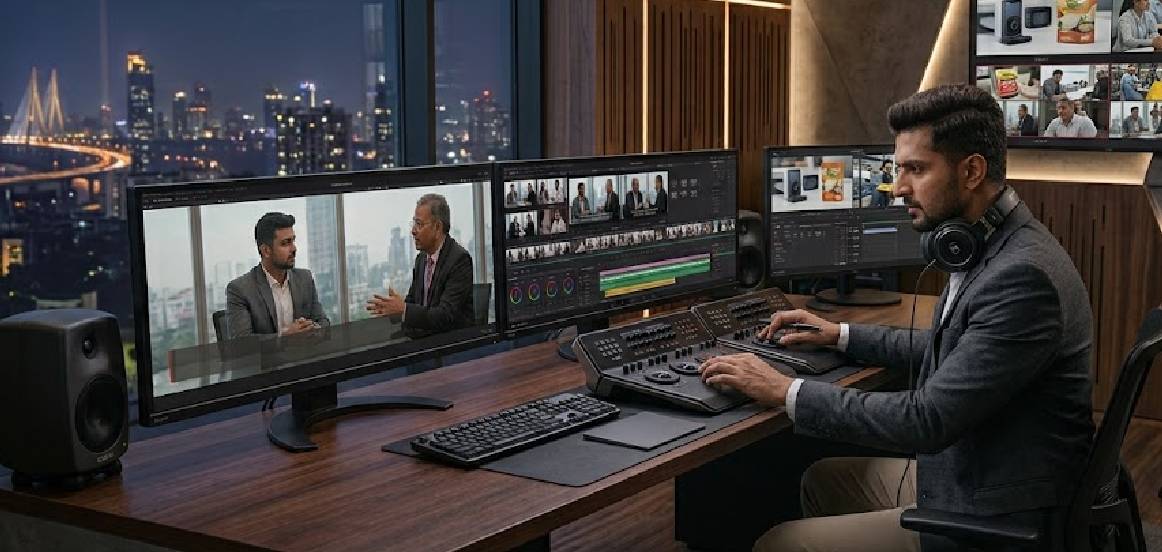
Professional colour correction helps create technical consistency between shots.
Colour grading goes a step further by creating a deliberate visual style.
A brand may prefer:
- Clean and neutral visuals
- Warm lifestyle tones
- Cinematic contrast
- Natural skin tones
- Bright commercial visuals
- Darker premium aesthetics
The appropriate style depends on the brand and the purpose of the content.
For a business producing content regularly, consistent colour treatment can also help different videos feel connected.
MW Stuudio includes colour grading as part of its post-production services and applies consistent colour treatment across content such as professional Reels.
5. Editing Helps Businesses Communicate Their Message More Clearly
Business videos usually have a specific communication goal.
The video may be designed to:
- Explain a service
- Introduce a product
- Educate customers
- Build trust
- Present a founder
- Share a customer experience
- Demonstrate a product
- Promote an offer
- Explain a process
The editor’s job is to make sure the final video supports that goal.
Suppose a company records a founder discussing a new service for 30 minutes.
The raw recording may contain valuable information, but the audience does not necessarily need all 30 minutes.
An editor can identify the strongest statements, remove repetition, arrange the information logically, and create a focused final version.
This makes the communication more efficient.
The result should not simply be shorter.
It should be clearer.
6. Professional Editing Makes Interviews and Testimonials Stronger
Interviews and customer testimonials often contain valuable stories, but people do not always communicate in perfectly structured sentences.
A customer may pause, repeat an answer, change direction, or take time to reach the main point.
Professional editing can preserve the natural personality of the speaker while removing unnecessary sections.
A testimonial can be structured around:
Customer problem → Experience → Solution → Result → Recommendation
Similarly, a founder interview can be structured around:
Background → Challenge → Decision → Experience → Lesson → Future
The editor can use the strongest answers and supporting B-roll to make the story easier to follow.
This can be particularly useful for businesses that want to create customer testimonial videos, corporate interviews, expert videos, or founder-led content.
7. B-Roll Makes Business Videos More Visually Interesting
A talking-head video does not always need to show the speaker continuously.
B-roll provides supporting visuals that can illustrate what the person is discussing.
For example, a manufacturing business could show:
- Production processes
- Employees working
- Machinery
- Products
- Packaging
- Facilities
A restaurant could show:
- Food preparation
- Ingredients
- Kitchen activity
- Finished dishes
- Customers
A software company could show:
- Product interface
- Team meetings
- Customer interactions
- Screen recordings
- Office environment
The editor can place these visuals over the speaker’s audio.
This creates visual variety while reinforcing the information being discussed.
Professional editing therefore works together with professional production planning. The more useful supporting footage captured during the shoot, the more options the editor has.
8. Motion Graphics Can Make Complex Information Easier to Understand
Some business subjects are difficult to explain using talking-head footage alone.
Motion graphics can help visualise information.
They can be used for:
- Statistics
- Processes
- Product features
- Timelines
- Diagrams
- Comparisons
- Key statements
- Brand information
- Data points
For example, a financial company explaining a process could use animated graphics to show each step.
A technology company could visually demonstrate how its product works.
A corporate video could use animated titles and lower thirds to introduce employees.
The graphics should support the message rather than overwhelm the viewer.
Professional editing allows motion graphics to be integrated into the overall visual style of the video.
MW Stuudio lists motion graphics among its post-production services.
9. Subtitles Make Video Content More Accessible
Many people watch social media videos without sound, particularly when browsing in public spaces or situations where audio is inconvenient.
Subtitles allow the message to remain understandable even when viewers are not listening to the audio.
Subtitles can also improve accessibility for viewers who have difficulty hearing the spoken content.
Professional subtitle production involves more than automatically placing text on the screen.
The editor needs to consider:
- Timing
- Readability
- Position
- Font size
- Line length
- Contrast
- Speaker changes
- Important words
- Brand consistency
For short-form business videos, subtitles can also reinforce important statements.
MW Stuudio includes subtitle integration in its video post-production workflow and platform-ready Reel delivery.
10. Editing Helps Create Stronger Social Media Videos
Social media content often needs a different editing approach from a long corporate video.
A 60-minute interview cannot simply be uploaded as a Reel without considering the platform and audience behaviour.
Professional editing can identify short sections that work independently.
For example, one interview can produce:
- Educational clips
- Strong opinions
- Customer questions
- Short stories
- Practical tips
- Founder insights
- Frequently asked questions
Each clip can then be edited with appropriate pacing, subtitles, framing, sound design, and aspect ratio.
For vertical platforms, the editor may need to reframe the original footage into a 9:16 composition.
MW Stuudio’s Reel post-production workflow includes assembly and pacing, colour grading, sound design, subtitles, on-screen text, and 9:16 1080p platform exports for Instagram Reels and YouTube Shorts.
This makes editing an important part of converting professional footage into platform-specific content.
11. Professional Editing Strengthens Brand Consistency
Every business has a visual identity.
That identity can include:
- Colours
- Typography
- Logo placement
- Animation style
- Music
- Transitions
- Photography style
- Video treatment
When different videos use completely different visual approaches, the brand can feel inconsistent.
Professional editing can establish reusable standards.
For example, every video may use:
- The same intro animation
- Consistent lower thirds
- Similar colour grading
- Standard subtitle treatment
- Consistent music direction
- Similar transition styles
- Branded end screens
This creates continuity across a content library.
The objective is not to make every video identical.
Instead, every video should feel like it belongs to the same brand.
12. Editing Allows One Shoot to Become Multiple Content Pieces
A professional shoot can generate a significant amount of raw material.
Instead of using the footage only once, businesses can plan a repurposing workflow.
For example, one founder interview could become:
Full Interview → YouTube Video → Short Clips → Reels → LinkedIn Posts → Blog → Newsletter
A product shoot could become:
Product Video → Product Page Video → Social Clips → Advertisement → Tutorial → Customer Education Content
A podcast episode could become:
Full Episode → YouTube Video → Shorts → Reels → Audiogram → Blog → Quote Posts
Professional editing makes this possible by creating different versions from the original footage.
This can help businesses build a larger content library without requiring a completely new shoot for every individual asset.
MW Stuudio’s wider production model connects video production and post-production with photography, podcasts, content writing, websites, SEO, and digital marketing.
13. Professional Editing Can Improve Video Quality Without Reshooting Everything
Not every production problem requires another shoot.
Some issues can be improved during post-production.
For example:
- Unnecessary pauses can be removed.
- Audio levels can be balanced.
- Colour differences can be corrected.
- Minor distractions can sometimes be reduced.
- Additional B-roll can cover cuts.
- Graphics can clarify information.
- Subtitles can improve accessibility.
- Music can improve atmosphere.
- Multiple camera angles can make a conversation more dynamic.
However, editing has limits.
Poorly recorded audio, severely underexposed footage, missing shots, or major production mistakes may not always be completely fixable.
That is why professional editing works best when combined with good pre-production and recording.
The strongest workflow is:
Plan well → Shoot well → Edit professionally → Review → Export correctly
Post-production should enhance good production rather than be expected to repair every problem.
14. Professional Editing Prepares Content for Different Platforms
A business may need the same core content in several formats.
A YouTube video might be horizontal.
An Instagram Reel may need vertical framing.
A LinkedIn video may require a different duration and presentation.
A website video may need a clean version without social media graphics.
This means exporting one video file is not always enough.
Professional post-production can prepare platform-specific versions based on:
- Aspect ratio
- Resolution
- Duration
- Captions
- Graphics
- Safe areas
- Audio
- Thumbnail requirements
For example, MW Stuudio’s Reel production workflow specifically includes 9:16, 1080p exports for Instagram Reels and YouTube Shorts.
Preparing content correctly for its destination helps prevent awkward cropping and inconsistent presentation.
15. Professional Video Editing Creates a More Scalable Content Workflow
As a business produces more content, editing becomes an important part of the overall content system.
A company that publishes one video occasionally may manage editing internally.
But a brand producing podcasts, Reels, product videos, interviews, corporate videos, testimonials, advertisements, and educational content can quickly accumulate large amounts of footage.
A professional editing workflow can help organise this production volume.
A scalable workflow may look like:
Content Planning → Production → File Management → Editing → Audio → Colour → Graphics → Subtitles → Review → Platform Exports → Publishing
This allows different content types to follow established processes.
It also makes batch production more practical.
For example, a business can shoot 10–15 short-form videos in one production session and have the editing team process them into a consistent content series.
MW Stuudio currently provides post-production as a standalone service and as part of its broader creative production workflow, covering video editing, colour grading, sound design, motion graphics, subtitles, thumbnails, and related post-production services.
Professional editing therefore becomes more than the final step of video production.
It becomes part of the system that allows a business to produce content consistently.
Conclusion
Professional video editing can significantly improve the quality and usefulness of business content by transforming raw footage into structured, polished, platform-ready communication.
It can improve storytelling, pacing, audio, colour consistency, visual variety, subtitles, graphics, social media formatting, and brand consistency.
More importantly, professional editing allows businesses to get more value from the footage they have already produced.
A single interview can become a long-form video and multiple short clips. A podcast can become video, social media, blog, and website content. A product shoot can generate product demonstrations, advertisements, social content, and educational videos.
The most effective approach is not to think of editing as simply removing unwanted footage.
Think of it as shaping the raw material into content that communicates clearly and represents the brand professionally.
MW Stuudio offers standalone post-production services as well as complete production workflows. Its current services include video editing, colour grading, sound design, motion graphics, subtitles, thumbnail design, and photo retouching, while its broader creative ecosystem includes photography, podcast production, video production, website development, SEO, digital marketing, and content writing.
For businesses investing in professional content, good editing can help turn individual recordings into a consistent and reusable content library.
The goal is simple: shoot with purpose, edit with clarity, and create content that works across the platforms where your audience spends time.